PishPash got me thinking with his (I mean her - Ed.

) post of the AE from Caria Rhodes. He (I mean she - Ed.) reminded me of this Celtic drachm I have. The connection might not be immediately obvious, but here are some tangents:
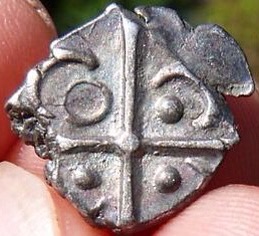
Arecomici. Circa 118-76/74 BC. AR silver Unit (16mm, 3.23g ) . Obv Head with African features left . Rev Cross; three pellets and annulet in quarters. Depeyrot NC II, 249; CCCBM II 71-3; De la Tour 2986.
•this coin is thought to have evolved from a drachm of Rhoda, NE Spain, itself named for the Greek island colony. That Spanish drachm, struck before 250BC, bore a rose in full bloom seen from beneath on its reverse.
•however the parallel with the Bronze Age sun cross is unmistakeable. This symbol is at least 4000 years old:

So was it based on the rose or the cross, or a union of the two?
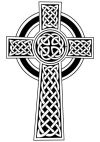
•legend has it that St.Patrick created the modern Celtic cross, of a Christian cross overlayed with a circle, in the 5th century in order to show the pagans the importance of the Christian cross to the new religion. However, again, was it so much a question of one replacing the other or a union of the two?
•as an aside, St.Patrick also apparently drove snakes from Ireland, snakes being a pagan symbol of wisdom (just as was the apple and the Apple tree btw).
•until the 12th century, the development of Christianity in Celtic NW Europe remained relatively free of Rome's control. Many of the Druidic ways were melded with the new Christianity, union rather than replacement, until Rome was able to 'sort things out'.
•even so I am reminded of the semi-religious role of the rose in British heraldry.
•then there are the Rosicrucians!
As a personal comment by one living in North Wales, I can tell you that today you don't have to look far before you see that even then, Rome's attempt to eliminate the pagan from the Christian wasn't entirely successful, as much amongst the priests and vicars as the lay members.....but no one shouts about it








 Posted 10/19/2014 8:34 pm





