| Author |
 Replies: 19 / Views: 5,758 Replies: 19 / Views: 5,758 |
|
Pillar of the Community
United States
4778 Posts |
I never properly shared these two until now, now that I have good photos of them.   These two rare nummi were struck by the Visigothic Kingdom, the dominant power in Hispania (Spain and Portugal) from the 5th to 8th centuries AD. The Visigoths, a Christianized Germanic tribe, are best known as the barbarians that sacked Rome in 410 AD, the first conquest of the city in eight centuries, and, although mild as far as sacks go, was a major psychological victory over the Romans. The Visigoths after the sack eventually made their way into Roman Gaul (France), where they were later granted the province of Aquitania after securing peace with the Western Empire. Over the course of the 5th century they expanded southwards into Hispania, fighting the Vandals for control of the land, and again the Romans, who briefly retook the peninsula during the campaigns of Emperor Majorian. But with the murder of Majorian, the Visigoths recovered their kingdom, and became one of the more powerful barbarian kingdoms on former Roman territory. Despite losing all but one of their Gallic provinces to the Franks and temporarily losing their southern territories to the Eastern Romans in the 6th century, the Visigoths ruled a stable and successful state in Hispania for nearly three centuries, adding to the culture and history of the peninsula. In 711 AD, Muslim armies of the Umayyad Caliphate crossed over from North Africa and invaded the Visigothic Kingdom, winning time and again over the disorganized Visigothic army. By 720 AD, the kingdom was gone and nearly all of Hispania was now under the rule of Islam. The Visigoths that refused to live under the invaders escaped to the unconquered northern part of the peninsula, where they established a resistance that became the start of the Christian Reconquista ("Reconquest"). The Reconquista to take back Spain would be finally be completed in 1492. These two coins are from Emerita (Merida) and carry an anonymous bust on the obverse with the legend CIVITA, and a monogram of the city's name on the reverse (I believe the obverse legend and the monogram form the Latin phrase CIVITA EMERITA-"City of Emerita"), and were struck sometime in the mid-7th century AD. Here are my other two Visigothic coins. Both carry a facing bust on the obverse, and a cross flanked by the letters S and P, meaning they were struck at the city of Hispalis (Seville). 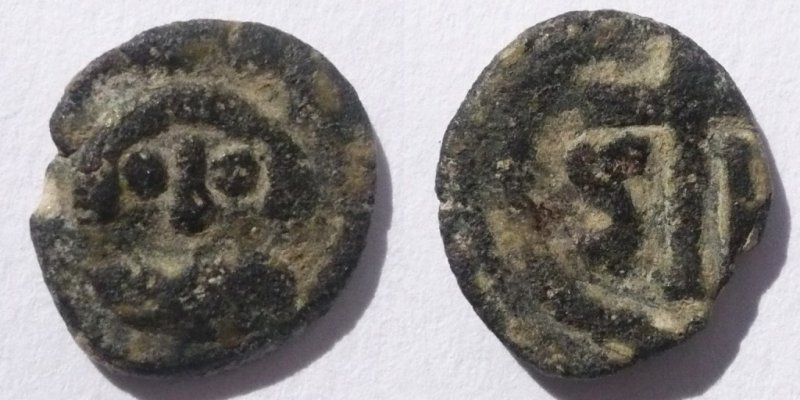  All four coins range from around 8 mm to 13 mm wide. Edited by VisigothKing
10/22/2014 11:54 pm
|
|
|
|
Pillar of the Community
3772 Posts |
Interesting coins.
Is there a good reference for Visigoth coins? The only information source on Visigoth coinage I have is Cayon & Castan.
While I appreciate that your focus are the Visigoths, where is the mention of the Suebi?
|
|
Moderator
 United States
23731 Posts |
VK, excellent historical information. I always enjoy and learn from your research into these coins. Thanks for posting them.
|
|
Pillar of the Community
United States
5010 Posts |
who else but VK would post such interesting coins!
so the two coins are the same type? my brain wants to see a facing bust on the first coin and a side view on the second. are they both in profile?
|
|
Pillar of the Community
United States
987 Posts |
Quote:
Is there a good reference for Visigoth coins? Medieval European Coinage: Volume 1, The Early Middle Ages (5th-10th Centuries)by Philip Grierson and Mark Blackburn (most often abbreviated as MEC) is the best book on this period. |
|
Pillar of the Community
3772 Posts |
Thanks, seems to be part of a massive project (and like RIC coming out in bits and pieces) - doubt I can afford the price tag for the whole collection.
Does volume 1 give a general overview of the whole coinage of those times in Europe?
As said, my more detailed information on Visigoth coinage is restricted to Spain from:
"Las Monedas Espanolas desde los Reyes Visigodos ano 406 a Juan Carlos I" by J.R.Cayon and C.Castan
It contains regal coinage from the Visigoths but no mention of those city coins you posted here.
|
|
Pillar of the Community
United States
987 Posts |
Quote:
Does volume 1 give a general overview of the whole coinage of those times in Europe? Yes, it covers all the major Germanic people and some of the smaller ones like the Suevi. Quote:
It contains regal coinage from the Visigoths but no mention of those city coins you posted here. MEC does not list this type either, but there is disagreement over whether these are Visigothic. The main proponent is Crusafont in "El sistema monetario visigodo" |
|
Valued Member
United Kingdom
435 Posts |
Thanks for a great summary of the history VK. I have never had the history of the Visigoths and Vandals very clear. It's really helpful. Of course, I could research it and provide it here myself, but as you are able to give it so very clearly and concisely..and I have so much that I should read right now...could you describe just one more part of the historical puzzle? You state that the Visigoths were a Germanic tribe who arrived in Hispania as a fait accompli....what is the historical story of their origin and passage there?
Edited by Valecrucis
10/23/2014 4:25 pm
|
|
Pillar of the Community
 United States
4778 Posts |
Quote:
While I appreciate that your focus are the Visigoths, where is the mention of the Suebi? I neglected to mention them in my effort to keep it from being a lengthy read but still have have all of what I think are the important points. But since you asked, I'll give you all a short version of their later history  The Suebi, after centuries of on-and-off fighting with the Romans, crossed the Rhine into Gaul in 406 along with the Vandals and Alans. The tribe migrated towards Hispania, and, taking advantage of the lack of imperial authority in the region, established the first barbarian kingdom on former Roman land, in Gallaecia in the northwest of the peninsula, with Bracara Augusta as their capital. The Visigoths and the Suebi became neighbors when the former took over most of Hispania (the Suebic Kingdom being smaller in size than its neighbor), and the Suebi would also be temporarily conquered by Emperor Majorian in the late 450s. The two kingdoms occasionally fought each other, but in the end the Suebic Kingdom was annexed by the Visigoths in 585 AD. There were also a few areas under local rule by peoples such as the Cantabrians and the Basques, in the north, but these too would eventually be taken over by the Visigoths. |
|
Valued Member
United Kingdom
435 Posts |
Thank you VK! Very interesting history and coins. Time I tried to lay my hands on one or two! Edited by Valecrucis
10/23/2014 4:29 pm
|
|
Pillar of the Community
United States
4778 Posts |
Quote:
You state that the Visigoths were a Germanic tribe who arrived in Hispania as a fait accompli....what is the historical story of their origin and passage there? The Vandals, Alans, and Suebi that migrated into Gaul in 406 AD had moved southwards into Hispania by 409 AD. Wars against usurpers in those regions had drained much resources from the Western Roman Empire, and reduced its authority over those two areas. Emperor Honorius turned to the very people that had sacked Rome only a few years before in order to fight the Vandals/Alans and the Suebi. For their service to the empire, the Visigoths were rewarded with the province of Gallia Aquitania in 418 AD. They expanded southwards into Hispania during the 5th century AD, again coming into conflict with the Romans. |
|
Pillar of the Community
3772 Posts |
'VisigothKing', I knew the history of the Suebi but thought they deserved a mention. Part of the territory they held for a long time and which was then taken over by the Visigoths was the only part of the Iberian peninsula never conquered by an Islamic ruler.
And a little more history which you probably know but 'Valecrucis' might find interesting:
1. The Visigoths adhered to Arianism, one reason for the regular fighting with the surrounding people (including the Suebi) which adhered to Catholicism.
2. Visigoths, Ostrogoths, Suebi and Vandals belong(ed) to the 'East Germanic Tribes' as differentiated from the North Germanic (Skandinavian) ones and the South (or West) Germanic Hordes (more or less the Germans, Dutch, etc including most of the Germanic influence in Britain).
3. While the Vandals got a terrible name, they were not more cruel or ruthless than other people around that time. Quite differently to being destructive they were actually preserving what they conquered, one reason why we have a reasonable amount of ancient Carthage ruins/buildings left at all.
|
|
Valued Member
United Kingdom
435 Posts |
Thanks Medieval and VK...much appreciated and very interesting history.
|
|
Pillar of the Community
United States
4778 Posts |
No problem! A couple of more facts: The Visigoths were the only ones to found new cities in western Europe in first few centuries after the fall of Rome. Many names in Spanish originated from Visigothic and other Germanic names: http://en.wikipedia.org/wiki/List_o...in#ForenamesEdited by VisigothKing
10/23/2014 5:10 pm
|
|
Pillar of the Community
United States
4778 Posts |
Also, if any one is interested, BBC made an episode about the 410 Sack of Rome as part of their Ancient Rome docudrama series. The whole episode (in six parts, title "Fall of Rome") can be found on Youtube. I definitely highly recommend it.
|
|
Pillar of the Community
United States
4778 Posts |
Quote:
so the two coins are the same type? my brain wants to see a facing bust on the first coin and a side view on the second. are they both in profile? The first coin's bust has what looks like those two hanging pearls behind it that late Emperors have as part of their diadem. They are hanging to the left of the bust so the bust must be facing right. The second to me kind of looks like its facing left. I haven't seen this type with a facing bust. Edited by VisigothKing
10/23/2014 5:30 pm
|
| |
Replies: 19 / Views: 5,758 |







 Posted 10/22/2014 11:59 pm





