| Author |
 Replies: 40 / Views: 6,224 Replies: 40 / Views: 6,224 |
|
Pillar of the Community
1121 Posts |
I recently purchased a Tetartemorion from Phokaia, Ionia, that had the head of a 'Griffin' on it. It was listed as AR 4 mm and 0.08 gm, but that didn't register with me until the coin arrived, recently. 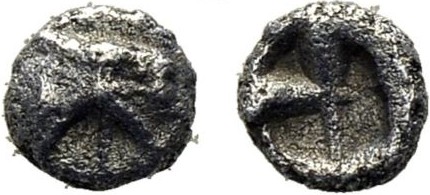 Here is the same coin alongside an 1883 Morgan dollar. 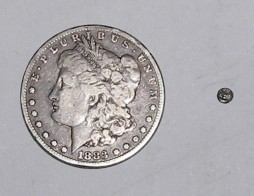 As far as 'competitions' go, perhaps we could see if other members have smaller coins and if they would show them to us alongside a Morgan dollar? (With measurements, please?) What do you think? Edited by Topcat7
11/27/2014 10:14 pm
|
|
|
|
Pillar of the Community
New Zealand
526 Posts |
Interesting little coin - so tiny it would be easy to lose.
I picked up a Norge 10 Ore yesterday which I though was really tiny - but its 15mm and has a centre hole. The centre hole is over half the size of your coin.
|
|
Moderator
 United States
23731 Posts |
Gee at 4 mm that is tiny, I'd have a hard time even seeing it. That has to be the smallest coin even made.
|
|
Valued Member
United Kingdom
183 Posts |
I've a tiny bronze that's soaking, it's maybe 5 or 6mm.
it's a full bust coin so not a broken part.
question is what could that have bought in a time when
the monetary value was dependent on it's metal content?
HH
|
|
Pillar of the Community
 1121 Posts |
Bas - 'Gidday Mate' - Re: the Norwegian coins, here are two that I have handy. The 1936 5 Ore has no centre hole but the 1940 50 Ore has a centre hole of 4 mm or the same size as the Tetartemorion. (I don't have a 10 Ore). 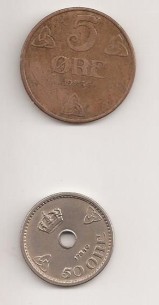 Ski, I am (sort of) hoping that someone has something (coin) out there that is of a similar size (or smaller). H.H. How about a well worn video of 'The Titanic'? Joking aside, followng your logic, perhaps a proverbial "loaf of bread'? Edited by Topcat7
11/28/2014 05:24 am
|
|
Pillar of the Community
Netherlands
1204 Posts |
wow that is really small, nice find!
|
|
Pillar of the Community
United States
2368 Posts |
Wow that is tiny. My smallest ancient isn't even close to that. I'd imagine that these things would get lost quite often when they circulated.
|
|
Bedrock of the Community
Australia
21792 Posts |
How on earth did the die cutter manage to cut the dies for it, without a jewelers loupe?
I think that is a fair question, because I am a gem facetor.
|
|
Pillar of the Community
United States
5155 Posts |
Proof the ancients had utilized optics is in the pudding.I would bet they had a loup and possibly eyeglasses. Good find.
|
|
Pillar of the Community
Italy
1790 Posts |
The only coin I can think of TC that might be smaller would be an Indian gold fanam .
|
|
Pillar of the Community
United States
1391 Posts |
If anyone has ever seen a medieval manuscript you will know that the calligrapher had to have some sort of magnification, as the font size is incredibly small, (around 8 point font in some cases).
There is some research that indicates that medieval craftsmen probably used glass bowls filled with water to magnify what they were working on. I stumbled across this research largely by accident, as I was reading a passage in St. Augustine (one I can not find at the moment to quote in the post, but I believe if was in The Confessions) where he talks about the fire going through a glass but not warming the water. The passage caught my attention so I did some more research.
St. Augustine would have been right between the Ancient and Medieval epochs so I would suspect that optical magnification would have been pretty well know by the time he was writing, as he mentions it in passing as an analogy, (and an analogy is a comparison between something familiar and something unfamiliar).
|
|
Valued Member
United Kingdom
435 Posts |
Another aspect of their tiny-ness is how on earth they are found, thousands of years later. Perhaps in clean sand, where they would stand out? Surely not in clods of soil? How could they be spotted? 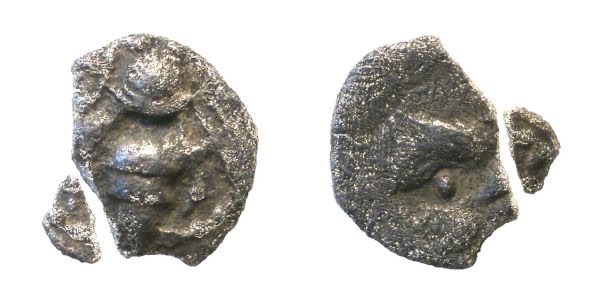 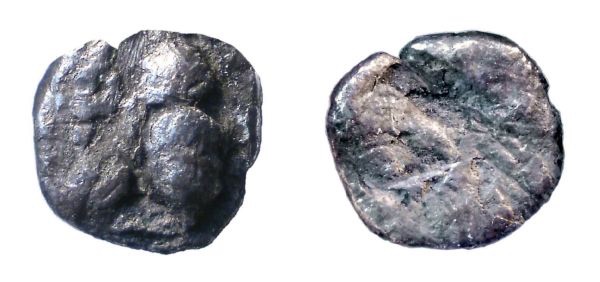 Ephesus, IONIA. tetartemorion, 5mm, c.500-420BC, ~0.15g. Ref. uncertain, Obv. Bee, Rev. Bird or eagle head r. Edited by Valecrucis
11/28/2014 1:32 pm
|
|
Pillar of the Community
1121 Posts |
A.M. - I am not that familiar with Indian coins so I'll just have to go with you on that one, however my 'research' shows the size of the 'fanam' to range from 5 mm (up) but you are right in that it is an extremely tiny coin too. Allranger - great explanation - thanks V.C. - Wow! How did anyone ever find the 'chip' off your 5 mm coin, or was it broken off AFTER it was found? Thanks to the other contributors.  Edited by Topcat7
11/28/2014 3:20 pm
|
|
Valued Member
United Kingdom
435 Posts |
I got those ones from ebay. The seller had very meticulously been keeping the chip together with the coin, so I am continuing to do so also. I am not sure whether they were responsible for the original chip or not...but it wasn't me! ;-) |
|
Pillar of the Community
New Zealand
526 Posts |
Quote:
Bas - 'Gidday Mate' - Re: the Norwegian coins, here are two that I have handy. The 1936 5 Ore has no centre hole but the 1940 50 Ore has a centre hole of 4 mm or the same size as the Tetartemorion. (I don't have a 10 Ore). Topcat......Gidday Here's the 10 ore against the side of a GB Penny. 10 Ore = 15mm (The photo makes it look bigger) Penny = 30mm 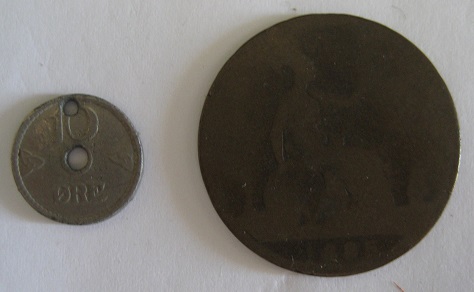 |
|
Pillar of the Community
1121 Posts |
Thanks for the photo, Bas. Interesting. Smaller than the 50 Ore but smaller than the 5 Ore as well.
Does it have a date on it? (You may need to utilize a 'magnifier'.)
|
| |
Replies: 40 / Views: 6,224 |







 Posted 11/28/2014 01:55 am





