| Author |
 Replies: 11 / Views: 1,357 Replies: 11 / Views: 1,357 |
|
|
Pillar of the Community
United States
2368 Posts |
So I was possibly interested in this coin in the link below: http://www.ebay.com/itm/Philip-I-Th...em3ceb113001I was thinking about it, and it seems to have some surface issues. Is this your typical porous-surfaced ancient bronze, or does this look like it has scarring due to a bronze disease infection? I don't see any green, but I suspect if there was BD, it was treated in the past leaving the pits on the coin. |
|
|
|
Pillar of the Community
United Kingdom
3626 Posts |
I think it looks ok as far as BD goes. I have couple of these sorts. I think it is brass?
|
|
Pillar of the Community
United Kingdom
3626 Posts |
|
|
Pillar of the Community
United States
3497 Posts |
The coin appears to be fine. No trace of BD just ordinary corrosion.
The As is a fairly rare denomination in the 3rd century. By the reign of Philip the sestertius was in steady decline and the antoninianus was the primary denomination. I would grab this one if it sells below $30 !
It's a 'nobrainer' really !
|
|
Pillar of the Community
 United States
2368 Posts |
Thank you pish and RVFVS. I checked wildwinds, and they say it's a sestertius...Who's right? According to the seller, this is a Rome mint issue, but wildwinds doesn't say where it was minted. I might pull the trigger on this one, an early birthday present maybe.  |
|
Pillar of the Community
United States
3497 Posts |
The light just went off over my head !
It is a sestertius ! 10.46 grams and 29.5mm equals an underweight sestertius.
As mentioned previously the sestertius (As too !) was in steady decline. The coin is bronze as are all ae's from this period. Orichalcum becomes a very rare metal for coinage during the reign of Gordian III.
It's worth about $10
|
|
Pillar of the Community
United States
3497 Posts |
For around $30 you might find one full weight (16-18 grams) and much prettier !
|
|
Pillar of the Community
United States
2368 Posts |
Huh. How come it's so underweight? 10.46 grams is way off from 16 to 18 grams.
|
|
Moderator
 United States
23731 Posts |
I like the dark patina on this coin, by this time the Sestertius was falling out of vogue but was still in limited use. The weight was reduced from the earlier one to coincide with the economics of the time.
|
|
Pillar of the Community
United States
5155 Posts |
AncientGallon is cool. I have bought A LOT OF STUFF from that seller. I am sure he would be happy to answer whatever questions you might have. Hes a cool guy, can't remember his name but he used to live in my town years ago and we talked about some of the locations. Thats my Two Cents. |
|
Pillar of the Community
United States
2368 Posts |
I've also had positive experiences with the seller. I bought this from him: 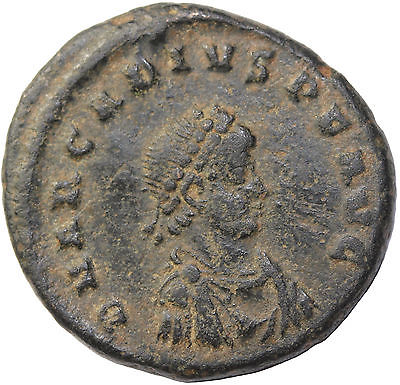 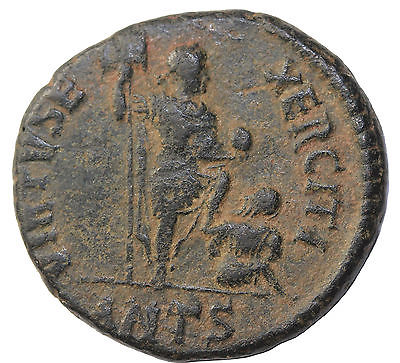 It's an Roman AE2 nummus. Minted in Antioch under Arcadius during the years 383 to 388 CE. The obverse legend is DNARCADIVSPFAVG and the reverse legend is VIRTVS EXERCITI. Fairly well-centered, good sized flan, clear lettering, not too much wear, pretty sand patina, etc, etc (can you tell I'm pleased with this one?). The reverse is my avatar. Well a sketch of it (inside joke from the US coin forums). The coin arrived a day early, and it arrived in very safe packaging. An envelope, bubble wrap, a smaller envelope, and then a plastic flip containing the coin with a note card with all the information on it. I was very happy with my purchase, and I'd definitely buy from AncientGalleon again. You're all such a helpful group here. Thanks!  |
|
Pillar of the Community
United States
3497 Posts |
By the mid third century the bronze coinage had become purely tokens of exchange. Of course bronze still had value but the weights were in a steady decline. Within twenty years the antoninianus had been so debased it became an 'ae' and the sestertius was something a grandpa might show the kids.
Extreme low weights were not too uncommon. Someone probably needed to pay the bills and had a shortage of bronze
( probably stolen !).
|
| |
Replies: 11 / Views: 1,357 |
|







 Posted 10/28/2014 5:08 pm





