The second worst thing you can do is to argue price. (The worst thing you can do is to argue religion.)
GETTING TO YES: NEGOTIATING AGREEMENT WITHOUT GIVING IN by Roger Fisher and William Ury.
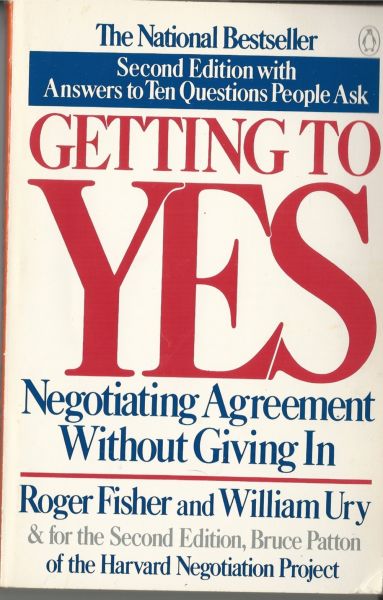
At a Michigan State Numismatic Society "Educational Forum" several years ago, our guest speaker was Steven Roach. Now the editor-in-chief at
Coin World, Roach had just completed his JD at Ohio State and was working in the Trust Department at Heritage. He spoke to us about "Getting to Yes."
On the bourse floor and in the coin store, arguing price leads to known outcomes. You each come down or move up a little and hopefully meet somewhere in the middle. The implicit understanding is that the seller tried to cheat you, but you insisted on being cheated for less. Underlying that - and the pun is on the lying - is that all prices are scams. The process breaks down to a tug-of-war, a battle of wills. It is seldom satisfying.
But we live in a world of price guides. Long before
ebay, Krause published an annual book of important numismatic auctions. We have Greysheet, Bluesheet,
Red Book, Blue Book, Teletrade,
Coin World Values, and more.
The only other thing to argue is grade. Grading is subjective, but not arbitrary. Once a coin or note has been graded by a top tier company - certainly after it receives the second CAC hologram - you do not have to agree; but you are hard-pressed to argue.
Debating price and grade does not bring the outcome you really want.
Getting to Yes suggests a different set of strategies entirely. The book was taken up by the Harvard Negotiation Project specifically because it opened the door to successful negotiations in other - more consequential - circumstances, such as hostage stand-offs.
Too often, when buying and selling coins, we act as if actual blood were on the table when the truth is that the outcome is mostly trivial.
The structure of buying and selling sets the parties in opposition: we sit or stand opposite each other. Rather, if at all possible, work from the same side of the table.
Rather than argue price and grade, find some other points, preferably of agreement. If you are building a set, does the dealer have others you can use? Conversely, does the dealer have clients who could use others from your collection? Now the trade has more dimension; no one point stops the process. Does the item have a pedigree? Ultimately, this is a small community and eventually, you can own items previously owned by collectors, dealers, or authors whom you know or know of. The seller may not think to mention it unless you ask. Does it have some other attributes different from the ones you care about? If you are building a Date and Mint set, adding an overdate, or repunched Mint mark, a small date or large date, could justify paying more. The same applies when selling to a dealer, of course.
The main idea is to avoid arguing price and keep seeking areas of agreement.
(On religion: Long ago, I found an English translation of a German book,
Merchants Make History by Ernst Samhaber. Warriors launched crusades. Meanwhile, the successful merchant never argued religion with his customer.)









 Posted 10/31/2014 09:57 am


