I still consider myself a newbie of sorts because my first coin purchase as a coin collector was only in late 2012. The majority of my small collection consists of mostly modern semi-numismatic silver coins produced by some of the world's major mints. I also see myself as a part-time stacker because I have purchased some silver bars for the sole purpose of believing that in doing so I am preserving wealth.
This thread is about a silver coin I came across very recently that I really like a lot and I think some of you will too.
I'd like to get your opinion on this coin.
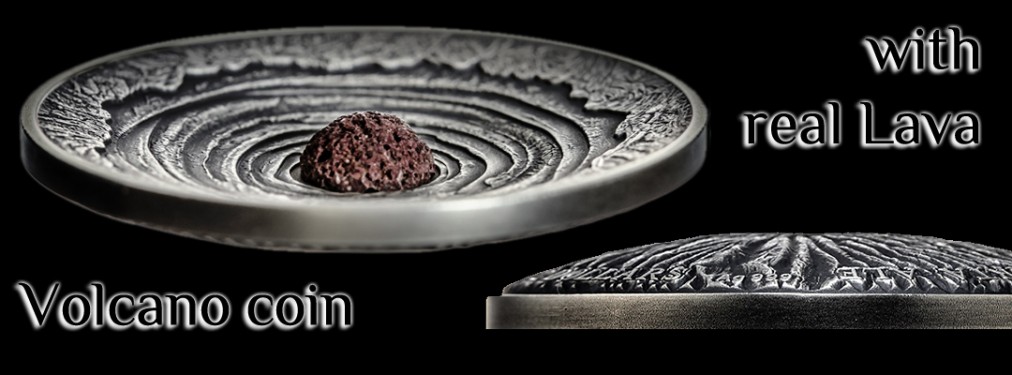
I love well designed and well crafted coins. I love silver. I love high relief coins. I love bigger than average coins. I love coins that are very low mintage and are first in an exciting new series. This brand new silver coin hits all my sweet spots. Links are below. It's minted by (in my opinion) one of the finest mints in the world, the Mint of Poland. I even tracked down a video which shows the actual coin...it rocks, literally, because it actually contains a real piece of volcanic rock (is lava considered rock?)!
The coin is called Volcano Erta Ale. It's a 50mm 99.9 fine silver coin.
Went away when I saw the word "Niue". ;) On one hand I like the idea that mints have more opportunities this way to experiment with new shapes, materials, etc. The government of a bigger country may well have said No to such a suggestion. On the other hand, such pieces have nothing to do with the concept of coins as means of payment. I do not collect them, but if others like them, why not ...
Thanks for your view though you are mistaken. Lava is still considered lava even after it has cooled ( "Lava is the....and the resulting rock after solidification and cooling." ) http://en.wikipedia.org/wiki/Lava
The fact that a Mint of Poland Volcano coin has a premium attached to it is not even remotely out of the ordinary.
Hi chrisild,
I too like the idea when mints get an opportunity to expand the field or hobby of coin collecting...personally I see only advantage to bringing in new hobbyists that may not otherwise have interest in coins except for the fact that they were drawn in by a novel coin concept like a domed Baseball or Volcano coin.
As for the concept of coins as a means of payment, using your criteria, all collector coins have nothing to do with a means of payment and therefore I would have to assume you have no interest in any modern collector coin. Which is fine by me if it's true.
Incidentally, from time to time, other forum members post notice of sales and discounts and so for those who collect unusual coins, and since I brought this coin to the attention of the CoinCommunity members here, in an e-mail I received, First Coin Co. has a new discount coupon and due to the updated currency exchange rate, the price of the Volcano Erta Ale coin is even lower now.
I am a former geologist. Please read the reference you have provided carefully.
" A lava flow is a moving outpouring of lava, which is created during a non-explosive effusive eruption. When it has stopped moving, lava solidifies to form igneous rock. "
You certainly are mistaken and you have not yet shown any evidence that lava is not referred to as lava even after it has cooled. Based on the references I've read and cited here, and whether you are a former geologist or not, lava that has cooled can and does get referred to as lava. Now some may refer to it as igneous rock but that is an issue of semantics because others refer to it as lava. The wiki article, as I have already cited, states emphatically that lave is still referred to as lava even though it has cooled and hardened. Here's a USGS article which refers to lava that has cooled as "lava" not "igneous rock". I'm sure I could find dozens of articles from official or scientific sources which refers to cooled and hardened lava as "lava".
I think both sides of this argument are "right" but only under completely different circumstances.
"Lava" when I was in college in Geology class referred ONLY to molten or semi-molten rock that is produced by volcanic activity. The professor a Doctor of Geology and an expert on volcanology insisted on his class adhering to this definition. To do otherwise resulted in the Doctor's wrath and a failing grade. Lava in this context is a narrow and precisely defined thing.
The other side of the discussion is representative of GENERAL usage - a dictionary definition not a text book definition. It is what the general populace believes and how they use the word.
From the technical side the problem is that lava can become one of several types of rock when it hardens based on how it hardens. Lava is therefore geologically an exceptionally generic, horrifically imprecise term. So solid lava from a geological perspective CAN NOT and does not exist. Solidified lava varies from pumice that floats on water to volcanic glass.
Not impressed at all. If you refuse to accept lava as igneous rock - Earth should not exist in it's current state. Hawaii and Iceland are two good examples of islands formed by volcanic activity.
Swamperbob - I remember a similar discussion in my geology class. Depending on how lava is cooled and what minerals are in it, they form the building blocks of various igneous rocks.
Is ice the same thing as water? Ice is basically frozen/solidified water, but it is usually considered separately from water, as it behaves very differently (you don't normally think of Antarctica as being covered by water).
The relationship of "lava" vs. "igneous rock" is basically the same; some consider them the same thing, but they do behave differently (and, I dare say, to a layman "lava" would probably mean that bright hot thing you shouldn't go near - in other words, pretty much any very hot rock, which in practice happens to be almost the same as the geological definition).
I can agree to the description of Icelandic rock - or the stuff in these "coins" - as "solidified lava" or something to that effect, however.
Quote: As for the concept of coins as a means of payment, using your criteria, all collector coins have nothing to do with a means of payment and therefore I would have to assume you have no interest in any modern collector coin. Which is fine by me if it's true.
Well, I have my principles ... and am happy to ignore them if there is a good reason. ;) Primarily I do collect coins that, at least in theory, can be found in change. Surcharged collector coins I tend to avoid, but I make exceptions ...
Also, there are countries where the government makes some kind of issue plan, and then the mint produces the coins (regular ones and collector coins). Niue, and also Palau, Liberia, Cook Islands and a few others, usually issue collector coins based on what some numismatic "agency" suggests and then sells worldwide. I don't draw a strict dividing line though - would probably be impossible anyway.
Disclaimer: While a tremendous amount of effort goes into ensuring the accuracy of the information contained in this site, Coin Community assumes no liability for errors. Copyright 2005 - 2026 Coin Community Family- all rights reserved worldwide. Use of any images or content on this website without prior written permission of Coin Community or the original lender is strictly prohibited. Contact Us | Advertise Here | Privacy Policy / Terms of Use











 Posted 11/10/2014 4:34 pm


