











 Posted 11/15/2014 2:37 pm


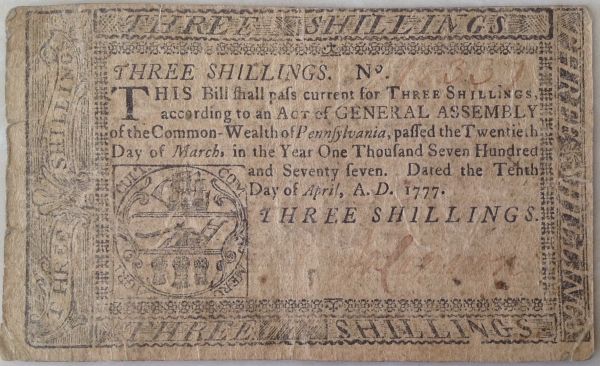
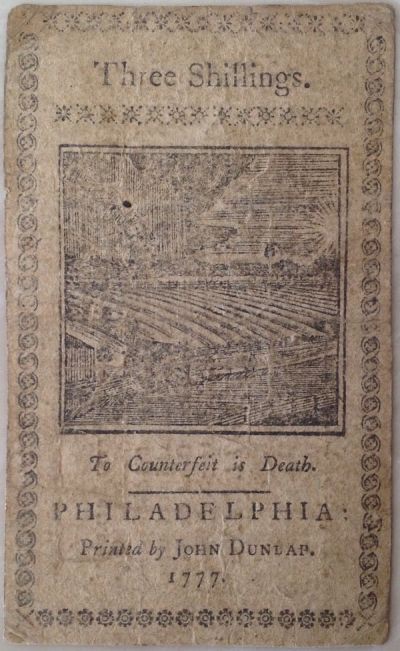
Very nice! This was the first issue of Pennsylvania's currency as a free Commonwealth, and as such, is the first to sport the new coat of arms (which are still in use), instead of the arms of King George III. Your note was signed by James Cannon, Professor of Mathematics at (what is now) the University of Pennsylvania. Here a biographical blurb on him from the you Penn Archives:
James Cannon, Professor of Mathematics at the College, was born in Edinburgh, Scotland, in 1740. In 1763, after completing his early education at the University of Edinburgh, Cannon came to Philadelphia to continue his studies. He received a Bachelor's degree from the College, graduating with the Class of 1767. Six years later, Cannon returned to the College to serve as a Professor of Mathematics.
Despite his professorial duties, Cannon took an active position on the patriot side when the Revolution broke out. According to the diary of Christopher Marshall, Cannon was the leading spirit in private meetings held to select candidates to be placed before the people in opposition to those representing more conservative sentiments. He was also very active in forming and organizing the American Manufactory, which was comprised of citizens of Philadelphia and manufactured woolen, linen and cotton fabrics. On July 15, 1776, Cannon became a member of the Constitutional Convention of Pennsylvania, where he was put in charge of drawing up the instructions to the delegates of Pennsylvania in Congress. The Convention made him a Justice of the Peace for Pennsylvania, and also enabled him to serve as a member of the Council of Safety from July 24, 1776 to December 4, 1777. Cannon is credited with being one of the two principal draughtsmen of the Constitution of 1776, and is the author of the Cassandra Letters, the publication of which further elevated him in the esteemof the patriots.
Cannon died on January 28, 1782 in Philadelphia, while still employed as a Professor of Mathematics at the College.
James Cannon, Professor of Mathematics at the College, was born in Edinburgh, Scotland, in 1740. In 1763, after completing his early education at the University of Edinburgh, Cannon came to Philadelphia to continue his studies. He received a Bachelor's degree from the College, graduating with the Class of 1767. Six years later, Cannon returned to the College to serve as a Professor of Mathematics.
Despite his professorial duties, Cannon took an active position on the patriot side when the Revolution broke out. According to the diary of Christopher Marshall, Cannon was the leading spirit in private meetings held to select candidates to be placed before the people in opposition to those representing more conservative sentiments. He was also very active in forming and organizing the American Manufactory, which was comprised of citizens of Philadelphia and manufactured woolen, linen and cotton fabrics. On July 15, 1776, Cannon became a member of the Constitutional Convention of Pennsylvania, where he was put in charge of drawing up the instructions to the delegates of Pennsylvania in Congress. The Convention made him a Justice of the Peace for Pennsylvania, and also enabled him to serve as a member of the Council of Safety from July 24, 1776 to December 4, 1777. Cannon is credited with being one of the two principal draughtsmen of the Constitution of 1776, and is the author of the Cassandra Letters, the publication of which further elevated him in the esteemof the patriots.
Cannon died on January 28, 1782 in Philadelphia, while still employed as a Professor of Mathematics at the College.
Edited by philadelphian
11/15/2014 2:38 pm
11/15/2014 2:38 pm


