Coin Community Family of Web Sites Join Thousands of Coin, Bullion, & Money Collectors
Specializing in Modern Numismatics Coin, Banknote and Medal Collectors's Online Mall Royal Estate Auctions - $1 Coin Auctions300,000 items to help build your collection! Vancouvers #1 Coin and Paper Money Dealer Join Thousands of Coin, Bullion, & Money Collectors Royal Canadian Mint products, Canadian, Polish, American, and world coins and banknotes.


Username:
Password:
Save Password
Forgot your Password?


This page may contain links that result in small commissions to keep this free site up and running.

Welcome Guest! Registering and/or logging in will remove the anchor (bottom) ads. It's Free!

What's Inside My Coin?

To participate in the forum you must log in or register.
Author Previous TopicReplies: 5 / Views: 2,368Next Topic  
New Member

Canada
3 Posts
 Posted 11/18/2014  04:42 am Show Profile   Bookmark this topic Add curious_collector to your friends list Get a Link to this Message Number of Subscribers
I have a few questions that I am hoping can be answered by the knowledge of this forum's community.

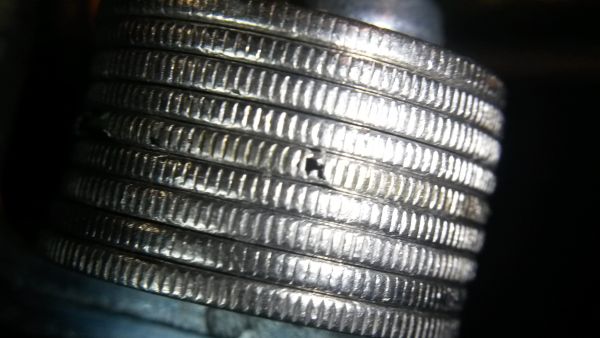
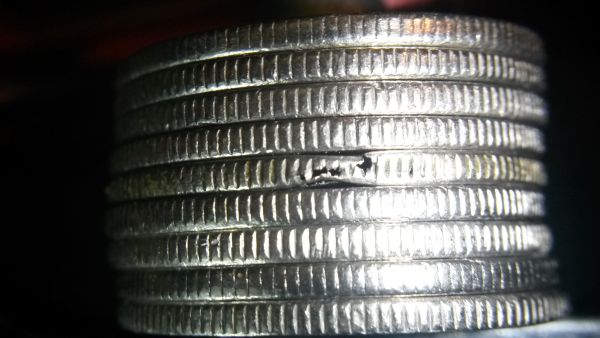
My Coin: The Details

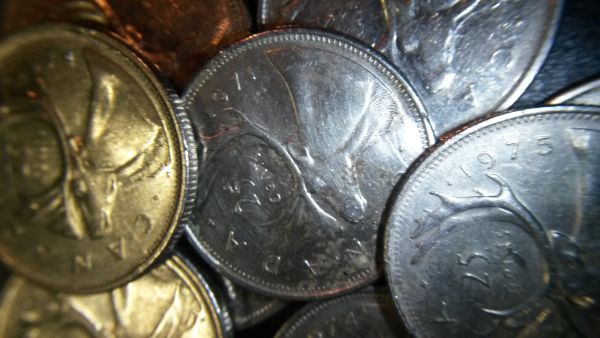
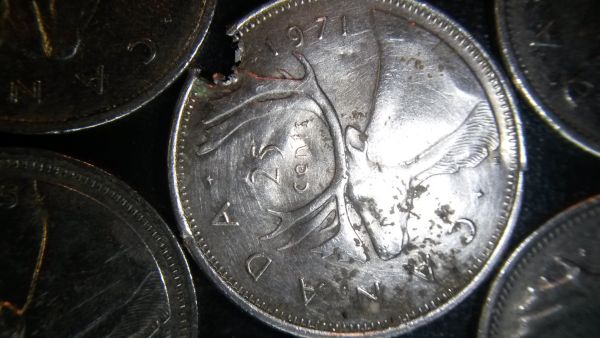
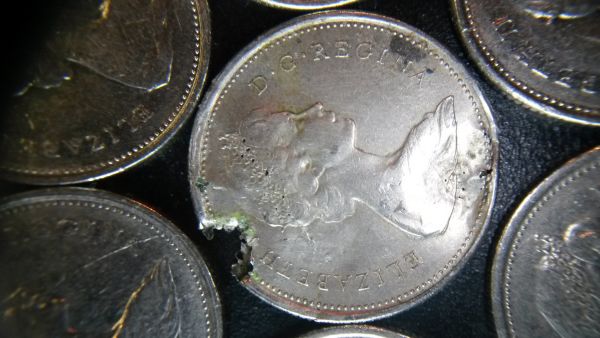
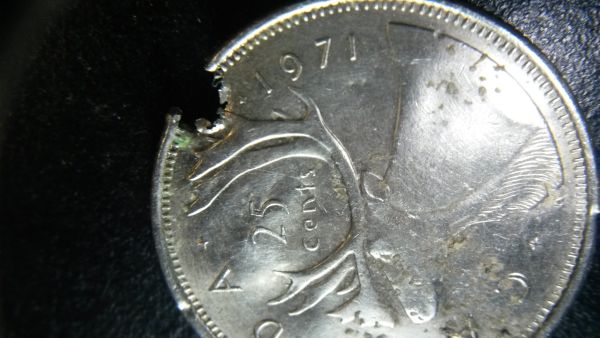
-1971 Canada 25 cent (quarter)
(supposed to be composed of 99% nickel)
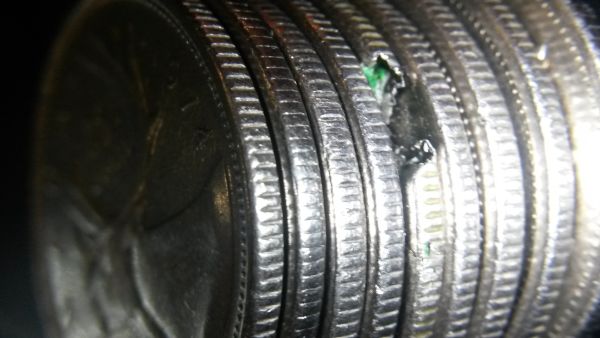
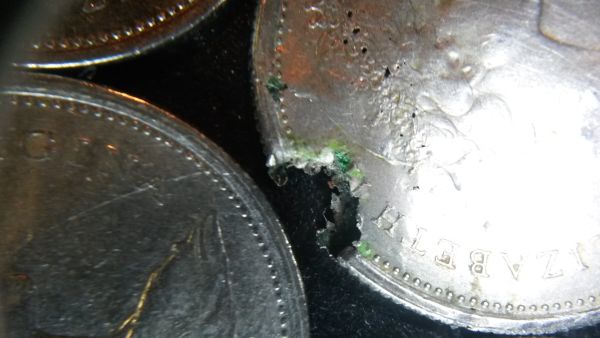
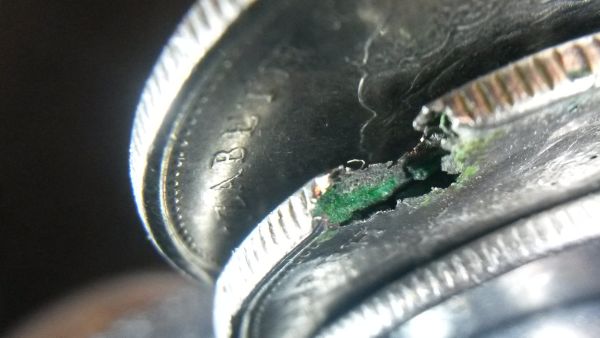
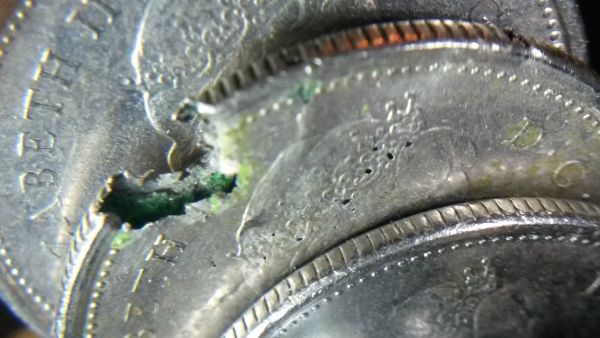
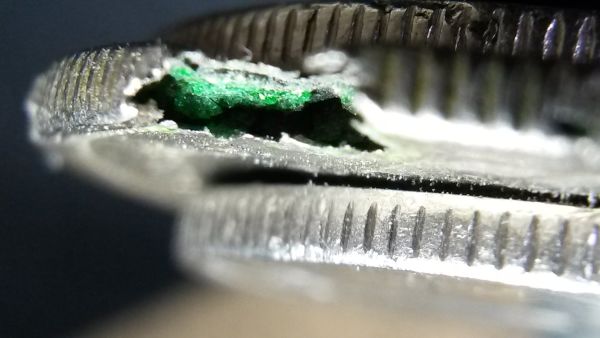
- Hollowed out completely
(but still a solid coin)
-Coin weighs 2.4 Grams
(missing a little piece, I assume weighs 0.1 grams)
-Missing Half Weight
(1971 minted Canada 25 cent coin weighs 5 grams)


Inside of Coin: The Details

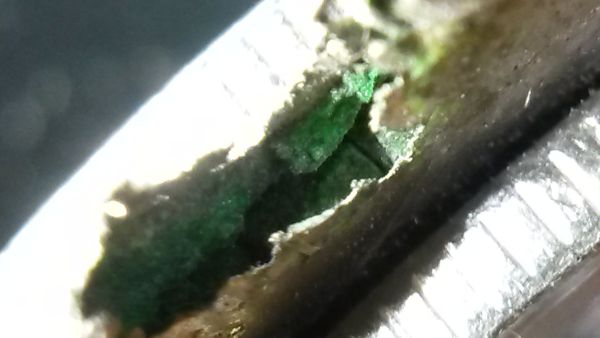
-Green Substance
(Unknown)
-Appears to be a green powder
(crystallized to a bright green almost fluorescent tone, perhaps a liquid that has dried and cracked over time)


How the Coin Was Found: The Details

It was given to me as change, when I purchased my coffee in the morning from my local gas station (2014/11/17).
(Which leads me to have many questions and possible concerns regarding this oddity coin)


My Questions:

-All Theories and Speculations Welcome
(Please Comment)


1: Is this a coin from the Royal Canadian Mint?
2: How would this damage possibly happen?
3: What would PCGS grade or classify this oddity as?
4: Should I send it to PCGS?
5: Was it possible for the RCM to cheap out on materials?
6: How can this coin still be in circulation?
7: Rarity, how rare is it?
8: Why does it weigh exactly half of the minted weight?
9: Should I analyze the residue at a lab?
10: Could this really be a spy coin or a suicide coin from the 70's, that made it's way back or stayed in circulation?


What's-Inside-My-Coin?

What's-Inside-My-Coin?

What's-Inside-My-Coin?

What's-Inside-My-Coin?

What's-Inside-My-Coin?

What's-Inside-My-Coin?

What's-Inside-My-Coin?

What's-Inside-My-Coin?

What's-Inside-My-Coin?

What's-Inside-My-Coin?

What's-Inside-My-Coin?

What's-Inside-My-Coin?
Pillar of the Community
Fixguy's Avatar
Canada
532 Posts
 Posted 11/18/2014  05:57 am  Show Profile   Bookmark this reply Add Fixguy to your friends list Get a Link to this Reply
The green is from the copper in it. I see this on electrical connections all the time. Mostly when energized with current for a spell.
Pillar of the Community
mdpmedia's Avatar
United States
3546 Posts
 Posted 11/18/2014  08:07 am  Show Profile   Bookmark this reply Add mdpmedia to your friends list Get a Link to this Reply
Hello and welcome to the CCF forum.

The green appears to be a form of verdigris present when there is a reaction of copper with the air and humidity.

Please search for this word in the search box for a multitude of very detailed discussions in the CCF forums.

Sending this coin to PCGS would be a waste of time and money.

IMO
Moderator
Learn More...
Sap's Avatar
Australia
16859 Posts
 Posted 11/18/2014  08:38 am  Show Profile   Bookmark this reply Add Sap to your friends list Get a Link to this Reply
It's not copper. If genuine, a 1971 25 cent piece should be pure nickel.

You ask for theories. Here are mine. To answer your questions, in order:

1. Almost certainly, yes. It did not, however, come out of the mint looking like this. Therefore, this qualifies as "post-mint damage".

2. Acidic corrosion. Chemically, nickel behaves very similarly to stainless steel: when exposed to air, it quickly forms an invisibly thin protective oxide layer on the surface, which is resistant to further chemical attack. However, if you dunk the coin in strong acid, once the oxide layer is penetrated at certain spots, the raw metal is readily attacked by the acid. Leave it in the acid long enough and what you can end up with is a "shell" of protected, oxidized nickel around a core comprising nothing but corrosion products.

3. Environmental damage. It is not a "mint error".

4. If you wish; it's a free planet. But, given the answer I just gave to question 3, I suspect it would be a waste of money on your part.

5. No. The coin was made in 1971, not the Middle Ages, when mintmasters worked relatively unsupervised and unaccountable. The Mint has to account for all raw materials purchased, and purchasing zinc, tin or some other material not usually used in the coins of the day would show up on the books.

6. We do not know the history of this coin. We do not know when the damage took place, or exactly what happened to the coin before, during or after the incident that created the effect under discussion. It should be noted that just because a coin dated 1971 is received in change, does not mean it has been circulating constantly since 1971. It might have sat on the bookshelf of whoever created it for decades, before being cleaned out and banked or spent.

7. Get yourself some pure nickel quarters and some strong acids, and I suspect you can make as many of these as you wish. Therefore, they are not "rare".

8. Coincidence.

9. It is, as I said, a free planet, so you can send it away for analysis if you wish. But I suspect the answer will be "nickel compounds". Most nickel compounds are green or greenish-blue. Which compounds you might find depends on which acid did the damage: you might find nickel chloride, nickel phosphate, nickel carbonate, nickel nitrate, nickel sulfate... you get the idea. I do not know which acid might be best at creating this effect; I suspect sulfuric acid (battery acid) might do the trick.

10. No.
Don't say "infinitely" when you mean "very"; otherwise, you'll have no word left when you want to talk about something really infinite. - C. S. Lewis

Moderator
Learn More...
SPP-Ottawa's Avatar
Canada
10463 Posts
 Posted 11/18/2014  09:33 am  Show Profile   Check SPP-Ottawa's eBay Listings Bookmark this reply Add SPP-Ottawa to your friends list Get a Link to this Reply
"Discovery follows discovery, each both raising and answering questions, each ending a long search, and each providing the new instruments for a new search." -- J. Robert Oppenheimer

Content of this post is licensed under a Creative Commons Attribution-NonCommercial 3.0 Unported License. See: http://creativecommons.org/licenses...0/deed.en_US

My eBay store
Moderator
Learn More...
jbuck's Avatar
United States
189648 Posts
  Previous TopicReplies: 5 / Views: 2,368Next Topic  

To participate in the forum you must log in or register.


Disclaimer: While a tremendous amount of effort goes into ensuring the accuracy of the information contained in this site, Coin Community assumes no liability for errors. Copyright 2005 - 2026 Coin Community Family- all rights reserved worldwide. Use of any images or content on this website without prior written permission of Coin Community or the original lender is strictly prohibited.
Contact Us  |  Advertise Here  |  Privacy Policy / Terms of Use

Coin Community Forum © 2005 - 2026 Coin Community Forums
It took 0.29 seconds to rattle this change. Forums