| Author |
 Replies: 9 / Views: 2,501 Replies: 9 / Views: 2,501 |
|
|
Pillar of the Community
United States
5155 Posts |
I am really enjoying collecting the coins of the Hunnic Tribes. I really feel that with little market interest even very rare coins in good condition can be had relatively cheaply. I spotted this one for sale from a very reputable dealer of eastern coins. I have never before seen this particular type and felt I needed this Hun for my collection. I was completely taken back by the this fine silver piece. This coin, with a marvelous, nearly complete and centered bust on the obverse. Nice sharp details front and back made the coin was irresistible. Apparently, Mitchiner considered these coins rare, but the dealer states that they have turned up somewhat often in recent years. This is a very good example of the type, for sure. I suppose with that being said, you envision how crappy(I believe the correct numismatic term is Crude) these coins are regularly. The Huns as a whole are not just one people but rather a confederation of different semi-nomadic peoples inhabiting Central Asia. Seemingly appearing out of nowhere, they forced the collapse of the native Indian Gupta Empire. This coin was minted by either the Hephthalites or the Gurjaras who might have also been a branch of the Hunnic Group. Minted between AD 550-600, the coin is described as the bust imitating that of the Persian Shah Peroz I (r. AD 457-484). Although the clear characteristic of the bust look nothing like Peroz. I wouldn't be surprised if we were actually looking at the true face of a Hunnic chief whose name is lost to time. Very interesting! North and Central India Hephthalites or Gurjaras Anonymous (s.AD 550-600) AR Drachm 23.8 mm x 4.00 grams Obverse: Crowned Bust of Peroz with winged skull cap. Unreadable crude legend. Reverse: Crude Zoroastrian fire altar. Flanked by two attendants. ref: MACW 1479-1482 Note: Rare. Beautiful Well centered nearly complete example. 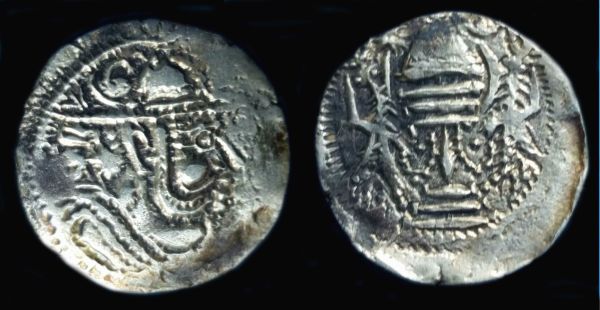 Edited by Ancientnoob
12/13/2014 10:27 pm
|
|
|
|
Pillar of the Community
United States
7066 Posts |
Wow! Great acquisition. Congrats.
|
|
Pillar of the Community
 United States
5155 Posts |
Thanks BobL, stay tuned in the next couple of days, I have some interesting Persians coming.
|
|
Pillar of the Community
3772 Posts |
Nice coin, congrats to it. Allow me a comment to: Quote:
Apparently, Mitchiner considered these coins rare, but the dealer states that they have turned up somewhat often in recent years. With so many hoards still to be discovered I am always hesitant to pay extra for rarity when buying ancient coins (except where the rarity is self-evident, eg Laelianus). |
|
Pillar of the Community
United States
4778 Posts |
Interesting coin and post Anoob, as always  It seems (I could be wrong) like the only Huns that didn't produce coins were Attila's Huns. Now THOSE I would collect  (not that there's anything wrong with your Hunnic coins Anoob!) Edited by VisigothKing
12/13/2014 10:47 pm
|
|
Moderator
 United States
23731 Posts |
I remember we talked about this coin, it's a type I have on my list to get. Nice one buddy congrats.
|
|
Pillar of the Community
United States
5155 Posts |
Its funny you bring that up VK.
This tribe of Xionites is somehow related to the Avars. I will see if I can find the source. I can't remember off hand how the two are related, but I remember that the relations was somewhat whimsical.
|
|
Pillar of the Community
United States
5155 Posts |
@VK
Found this...not the source I was looking for but you might find this interesting...
The Kidarite dynasty which ruled the Xionites came from the Uar. As a result, the Xionites have sometimes been called Uar-Hunnoi.
Uar and Hunnoi are the names associated with the two biggest tribes of Procopius's White Huns, commonly identified with the Sanskrit Sveta Huna but called Varkhon or Varkunites (OuarKhonitai) by Menander Protector. Procopius writes that these White Huns are white-skinned and have an organized kingship. According to him, their life is not wild or nomadic, and they live in cities.
The Uar and Hunnoi are supposed to have united around 460 under the rule of one of the five Yuezhi families, the Hephthal. Near the end of the 6th century they were joined by the Zabender, Tarnach and Kutrigurs. They became known as the Onogurs, from whom the name Hungary derives. The Onogurs were composed of three groups, see also Avars and Kabars. Around 670 the Bulgars under Kouber and Asparukh, who were also part of their empire, revolted. The Kouber tribes moved south to Thessaly and Asparukh lead his people south of the Danube.
|
|
Pillar of the Community
United States
5155 Posts |
I suppose one of the closest coins to what you desire is a Xionite Peroz imitation. Here is mine. 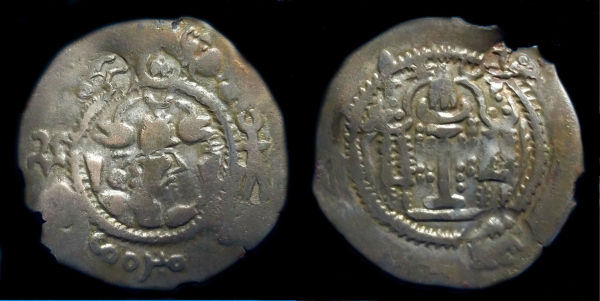 |
|
Pillar of the Community
United States
5003 Posts |
that's another awesome eastern coin AN...great pick up. another neat take on the ol' sassanian fire altar!
|
| |
Replies: 9 / Views: 2,501 |
|







 Posted 12/13/2014 10:28 pm





