Coin Community Family of Web Sites Join Thousands of Coin, Bullion, & Money Collectors
Vancouvers #1 Coin and Paper Money Dealer Join Thousands of Coin, Bullion, & Money Collectors 300,000 items to help build your collection! Specializing in Modern Numismatics Royal Estate Auctions - $1 Coin AuctionsRoyal Canadian Mint products, Canadian, Polish, American, and world coins and banknotes. Coin, Banknote and Medal Collectors's Online Mall


Username:
Password:
Save Password
Forgot your Password?


This page may contain links that result in small commissions to keep this free site up and running.

Welcome Guest! Registering and/or logging in will remove the anchor (bottom) ads. It's Free!

Regal Edges On 8 Reales

To participate in the forum you must log in or register.
Author Previous TopicReplies: 5 / Views: 1,930Next Topic  
Valued Member
RockyRoad's Avatar
United States
63 Posts
 Posted 12/15/2014  7:33 pm Show Profile   Bookmark this topic Add RockyRoad to your friends list Get a Link to this Message Number of Subscribers
With the printing of Swamperbob's book we now have a great new resource for discovering counterfeit 8 reales in the marketplace and in our collections. But being a newer student of this coin type I would like to ask for anyone's opinion about the best available resource in print or online for a description and photos of regal edges and what variations to expect. I could just start collecting reference books from the list as I see them become available and analyze for myself, but to me that seems like reinventing the wheel. It would also take considerable time. So I'm hoping that someone will steer me in the right direction. Thanks to all.
Valued Member
PatAR's Avatar
United States
262 Posts
 Posted 12/16/2014  4:56 pm  Show Profile   Bookmark this reply Add PatAR to your friends list Get a Link to this Reply
For the dos mundos coins (1732-1772) my book of choice is The Milled Columnarios of Central and South America by Frank Gilboy. It's a bit pricey, but well worth it in my opinion. Among the many drawings and descriptions of all aspects of these coins is a study of the edges.

For the later portrait pillars I'm less certain. Some of our other members are more familiar with this series so I'll let them chime in.

Riddell's book (the reprint at least) is not terribly useful as the images are difficult to discern. I don't recall right now if this book includes any close examination of the edges.

Hope this helps.

Pillar of the Community
swamperbob's Avatar
United States
5362 Posts
 Posted 12/16/2014  7:37 pm  Show Profile   Bookmark this reply Add swamperbob to your friends list Get a Link to this Reply
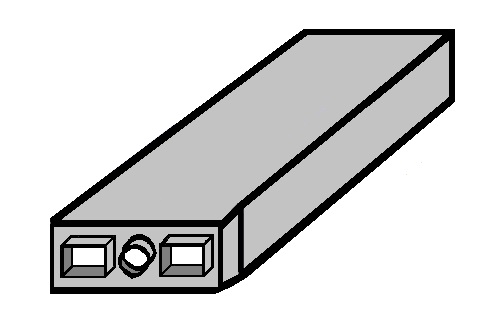
There is NO source for genuine edge designs now available. The best in my opinion can be estimated by viewing the matrix punch illustrated in Gilboy's book. It is a simple pattern of two rectangles and a circle in between. The rectangles are both the same size - and all three have the same wall thicknesses.

Regarding range of variation - we have no pictures of the other matrix blocks used at the other mints yet. I hope some day we do. Until then I suggest creating your own matrix block (reconstructions) by looking at as many coins as possible. There is absolutely no reason to postulate more than a slight initial variation between the matrix blocks initially, but I would expect that there might be subtle changes in designs when the blocks were changed at the change of the Kings.

This is not a difficult task or even one that takes a great deal of effort.

The key to detecting counterfeits by reviewing the edge is to spot differences in the edge pattern which could not happen.

1. Since there are two Rectangles and a circle in between then on each punch - there can never be two circles adjacent to one another except at overlaps.

2. Since all three elements have the same dimensions of height and width - there can be NO variation in size or wall thickness as you travel around the edge.

3. The distance between the circle and the adjacent two rectangles CAN NOT VARY unless there is ONE double set rectangle involved.

4. The edge design can not change angle (wave side to side) unless a rectangle shows a rotated overlapping punch.

5. There can be no angle change at the circles - that is impossible.

6. Regarding the application - there much be two overlaps at precisely 180 degrees apart on the edge and they must be the same length.

All of the above are simple physics based on the way the edge dies were made. Any coin that varies from this pattern of consistency must be treated as suspect and/or counterfeit.
Valued Member
RockyRoad's Avatar
United States
63 Posts
 Posted 12/16/2014  11:29 pm  Show Profile   Bookmark this reply Add RockyRoad to your friends list Get a Link to this Reply
PatAR - Thank you for the recommendation. From your description it seems to be a reference I'd use frequently. I'll look for a copy online and at coin shows. Here in the northwest there are few coins and even fewer reference books available so I've had to rely on the internet for most of my collection and reference material.

Swamperbob - I don't think I could ask for a more concise, clear explanation than the one you just provided. I feel like I have a new tool that not only increases my knowledge but will allow me to enjoy my 8 reale collection even more. Thank you very much.

But I have a couple of questions:

When you refer to a double set rectangle does that mean one rectangle punched on top of another at an overlap?

And could you elaborate on what a rotated overlapping punch looks like?

Thanks again.
Pillar of the Community
swamperbob's Avatar
United States
5362 Posts
 Posted 12/17/2014  1:08 pm  Show Profile   Bookmark this reply Add swamperbob to your friends list Get a Link to this Reply
Rocky Road


Quote:
When you refer to a double set rectangle does that mean one rectangle punched on top of another at an overlap?

And could you elaborate on what a rotated overlapping punch looks like?


A double set rectangle refers to the making of the edge die itself and not the overlap of the two edge dies on the coin. It happens when the three segment punch is set into the edge die. At both ends is a rectangle. Here is a sketch I made of the punch:

Regal-Edges-On-8-Reales

The die would be created by placing the first rectangle on this die over the last previously punched rectangle. This maintains spacing and directionality. The overlap should be extremely minimal but aligned with the previous punch. Because the die was set into a groove in the edger die a twist at the rectangle would be minimal and based on the width of the groove it would be a few degrees at most. The edge die was not a sloppy undertaking. It was an anti-counterfeiting device.

This moves right into the second question about the degree of rotation that can be seen between individual segments on the same die. It is response to counterfeit die patterns where odd rotations are seen.

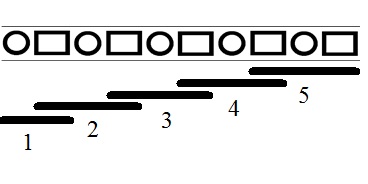
First you need to envision a shallow groove cut in a metal block that is just slightly wider than the blank that will be edged. This is the beginning of a standard edging die. The design is punched into the bottom of the groove with the punch shown above. The graver starts at one end (left end for discussion) of the die (which is at most 2-3 inches in length - it has to be only slightly over 1/2 the circumference of the coin) and sets the punch. The result is a rectangle a circle and a second rectangle. The punch is the approximate width of the groove so there is little to no play side to side. The graver moves the punch to the right so the left rectangle on the punch sits over the right rectangle punched into the die. This placement can be felt and assures a proper special alignment while the groove aligns the punch on the other axis. This procedure repeated 8 or 9 times creates a die. The base of the groove can then be leveled by grinding (to off-set differential setting depth) and the result is ready to have the ends made suitable for mounting in the apparatus.

Here is a sketch of a series of punches 1-5 and the result at top.

Regal-Edges-On-8-Reales

So based on this theory of die manufacture (based on available data) there is no way that a die pattern should rotate internally more than a couple degrees and that rotation will begin and end at a rectangle. On forgeries of all types 1,2 and 3 this is not the case.

Some edge dies were made with two punches a circle and a rectangle and the pattern is variable entirely.

Regal-Edges-On-8-Reales

Others made with two punches will have variations at the punch seam.

Regal-Edges-On-8-Reales

Next think of these punches being placed out of alignment on a flat die face one without the machined groove. Those could rotate which is a bit harder to show.

That should give you a picture of the overlaps within the edge die itself. These are harder to see - but seen most clearly on counterfeits where dies are not usually made as well.

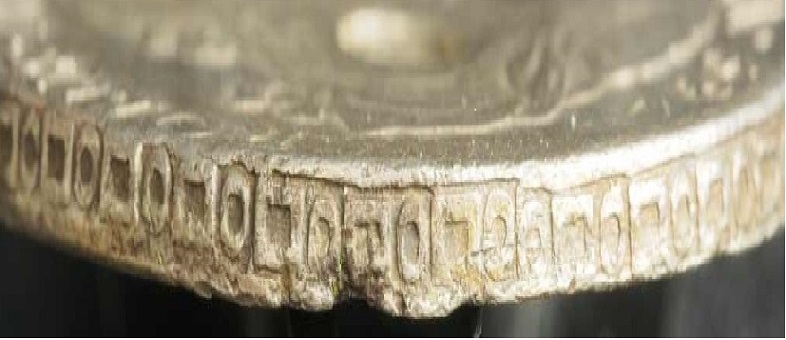
Here is a picture that is enlarged along the vertical axis 2x - it shows a pattern in the edging that is incorrect which becomes super visible when you increase the vertical aspect of the picture.


Regal-Edges-On-8-Reales

None of this is to be confused with the two overlaps in the application of the edge die to the blank.

Valued Member
RockyRoad's Avatar
United States
63 Posts
 Posted 12/18/2014  2:40 pm  Show Profile   Bookmark this reply Add RockyRoad to your friends list Get a Link to this Reply
Swamperbob:

Thank you once again for a clear, concise explanation. It has become obvious to me that determining regal from counterfeit on ebay is an immense challenge that almost certainly involves winning an auction from a seller with a high feedback rating and a liberal return policy so that the coin can be examined in hand.

That point was again driven home this week as I received an 1809 capped bust half that was listed as genuine but looked like a contemporary circulating counterfeit in the photos, only to discover that it was a modern numismatic forgery. It has been returned. It would seem that return shipping charges are the "tuition" we pay to learn these distinctions.
  Previous TopicReplies: 5 / Views: 1,930Next Topic  

To participate in the forum you must log in or register.


Disclaimer: While a tremendous amount of effort goes into ensuring the accuracy of the information contained in this site, Coin Community assumes no liability for errors. Copyright 2005 - 2026 Coin Community Family- all rights reserved worldwide. Use of any images or content on this website without prior written permission of Coin Community or the original lender is strictly prohibited.
Contact Us  |  Advertise Here  |  Privacy Policy / Terms of Use

Coin Community Forum © 2005 - 2026 Coin Community Forums
It took 0.29 seconds to rattle this change. Forums