Coin Community Family of Web Sites Join Thousands of Coin, Bullion, & Money Collectors
Coin, Banknote and Medal Collectors's Online Mall Specializing in Modern Numismatics Royal Estate Auctions - $1 Coin Auctions300,000 items to help build your collection! Vancouvers #1 Coin and Paper Money Dealer Royal Canadian Mint products, Canadian, Polish, American, and world coins and banknotes. Join Thousands of Coin, Bullion, & Money Collectors


Username:
Password:
Save Password
Forgot your Password?


This page may contain links that result in small commissions to keep this free site up and running.

Welcome Guest! Registering and/or logging in will remove the anchor (bottom) ads. It's Free!

1918 Rouble (Armavir) Russia. Real Or Fake?

To participate in the forum you must log in or register.
Author Previous TopicReplies: 7 / Views: 5,881Next Topic  
New Member

Sweden
47 Posts
 Posted 12/21/2014  4:18 pm Show Profile   Bookmark this topic Add zypronix to your friends list Get a Link to this Message Number of Subscribers
Good day to you all =)

I found this beauty in my latest bag of findings, I read somewhere that it is a bit scarce and seeing the prices on NGC and auctions confirms that.
But also that they often are fakes / remakes but usually easy to spot the difference?

Are there any obvious "fake" with this one?

1918-Rouble-Armavir-Russia.-Real-Or-Fake?

Regards
Edited by zypronix
12/21/2014 6:07 pm
Pillar of the Community
swamperbob's Avatar
United States
5362 Posts
 Posted 12/21/2014  8:16 pm  Show Profile   Bookmark this reply Add swamperbob to your friends list Get a Link to this Reply
zypronix Hello and

I was able to find an example that is in slightly better shape than yours on the heritage web site. It sold for more than $900. This is a rather rare coin in higher grades and was a state issued piece that was struck on a thin copper planchet - the edge should be reeded.

http://coins.ha.com/itm/russia/worl...#17091709895

Heritage indicates in their description:


Quote:
Armavir. Copper Rouble 1918, KM1, MS63 Brown NGC, glossy surfaces and bold details. This scarce type is unpriced in the SCWC in UNC, and is rare in mint state. Armavir is a city in Krasnodar Territory in Southern Russia.


A close comparison of your coin with the Heritage pictures raise some slight concerns on my part. Your coin appears (based on my scaling of both sets of pictures) to have been struck on a slightly enlarged planchet about 2% oversized when compared to the die face by my measurements.

I also note that the collar die on your example is clearly chipped. I do not notice that same wear on the Heritage coin. The coin is so scarce that I would presume it was unlikely that the mint used two different die pairs mounted on different coining presses. If anyone has historical records of the Armavir issues please advise.

The circles or beads at the perimeter are slightly different shapes and are different distances from the raised rim. This area is often neglected by forgers and is one area I focus on.

The details of the dies are well done, however that may simply be an excellent transfer of design which can be done with newer plastic or computer assisted die making methods.

I would ask a couple questions:

1. Is the edge reeded and can you send photographs of the edge in the same clear focus that you sent for the faces?
2. Are the reeds applied by a collar die? Is there a seam or overlap in the reeded pattern? Take pictures of any damage or possible laps.
3. Are the reeds split top reeds?
4. Where did you "find" it - what were the circumstances? What if any coins came with it?

I am not certain it is either real or a forgery at this point but I feel there are causes for real concern.
New Member
Sweden
47 Posts
 Posted 12/22/2014  11:08 am  Show Profile   Bookmark this reply Add zypronix to your friends list Get a Link to this Reply
Thanks! And thanks for showing interest =)

1. Yes, the edge is reeded, and yes here are some pictures
1918-Rouble-Armavir-Russia.-Real-Or-Fake?

2. I think its applied by a collar die? But I don't know, I hope the pictures can answer 2+3.

3. What is split top reeds? My English isn't the best and I don't know all the English coin collecting terms compared to the Swedish ones

4. I recently bought a collection from a old lady, maybe not so much a collection but more like a 6 kilo/13.2 pounds bag of unsorted coins.
Almost all the coins are pre 1923, mostly emergency money from Germany but also from France and other countries, some of which is up to 100usd coins.

She inherited a large part of the coins from a relative when he died in the 80-90is and sins then it's been in her safe deposit lockers in the bank.
The man that collected all of it did so when doing his job in the 40-60is, cleaning out storages of people that did not pay the bills and from shipping containers that no one collected/paid.

I have not had the time to go through it all, but I have not yet seen any more Russian ones

2 Threads on other forums about the same problem with pics, and a auction with a good picture:
http://www.worldofcoins.eu/forum/in...topic=4733.0
http://www.coinforums.com/world-anc...coinage.html

http://www.sixbid.com/browse.html?a...7&lot=742638
Edited by zypronix
12/22/2014 1:25 pm
Pillar of the Community
swamperbob's Avatar
United States
5362 Posts
 Posted 12/22/2014  7:36 pm  Show Profile   Bookmark this reply Add swamperbob to your friends list Get a Link to this Reply
The forgeries of this Russian coin have been around a long time - from the 60s at least. As noted in the files you listed the 1 Ruble is the most common forgery of the type.

You have the correct weight now given in the Sixbid auction - 5.56 grams. Any deviation of 1/10th gram would be a bad indication. Of course this coin may not have had a high level of accuracy because it is copper - but a tiny coin requires a rather precise thickness to get a full strike so I would not expect a large variation in thickness at all.

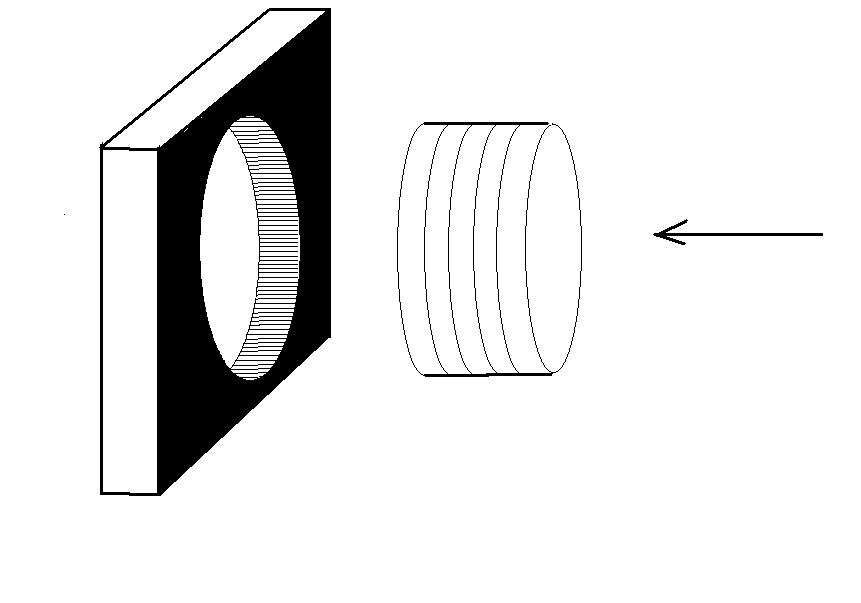
A split top and split tail reed is created when a forgery is pressed through a tapered ring die that cuts the reeds into the edge by gradually scraping off some of the edge and curling it up to form the reeds. If you have ever used a manual pipe threader the principle is the same. This process usually involves a stack of coins to keep the reeds perpendicular to the faces. The following is a sketch of the ring die.

1918-Rouble-Armavir-Russia.-Real-Or-Fake?

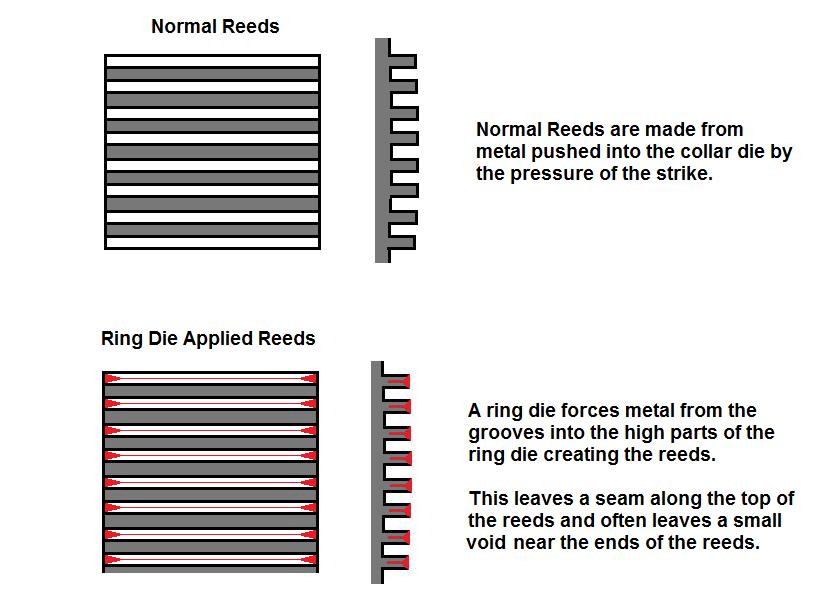
The result of this process is a small closed seam along the top of each reed and a split at each end. The sketch below shows the results with the traces marked in red.

1918-Rouble-Armavir-Russia.-Real-Or-Fake?

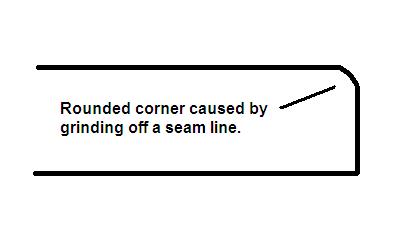
One of the ways to conceal the split ends is to grind one or both corners and the top of the reeds. Here is a sketch of what I mean by the clue left at the corner by grinding. It seems quite clear to me that is rounded corner is what your coin has. A collar struck coin in high grade usually does not have corners as rounded or irregular as what I see here.

1918-Rouble-Armavir-Russia.-Real-Or-Fake?

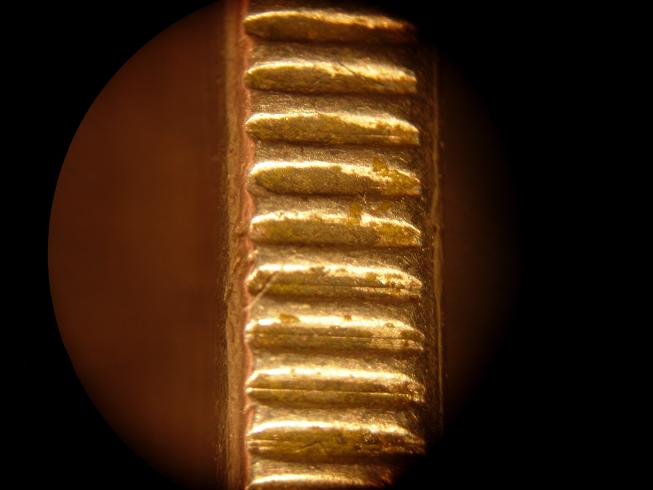
As I noted above most forgers press a stack of coins at one time to keep the coins from turning in the die. Too small a stack of coins and they can tilt resulting in slanted reeds. The following is a picture of an 1878 Trade dollar forgery with tilted reeds. This tilt will ONLY OCCUR on a short segment of the circumference, but it can not be seen on a normal collar that rises vertically aligned by the die press itself.

1918-Rouble-Armavir-Russia.-Real-Or-Fake?

On your coin if you look at the center of the bottom edge picture you will see reeds that are NOT perpendicular to the faces.

I would, based on the reeds, call this coin a numismatic forgery.
New Member
Sweden
47 Posts
 Posted 02/15/2015  7:37 pm  Show Profile   Bookmark this reply Add zypronix to your friends list Get a Link to this Reply
I would like to discuss this a bit further, as I'm not fully convinced it's a fake after some researching

Size:
As you pointed out, the size might differ from the Heritage coin but this type was both minted on new pellets and old, grinded down coins, the site http://www.m-dv.ru specifies this issue as 25,9-26,1mm wide.
Mine is within those margins.

Weight:
1/10th grams deviation from the Sixbid coin doesn't seem to be a bad indication at all, the same site as before specifies the coin at 5,6-6,1 grams.
Mine weighs 5.76g.

Dies:
Your probably correct with assuming that there were only one die pair used and that the design (if a forgery) is excellent. You pointed out that the circles or beads had different shapes, the same type of "error" is present in the MS63 Heritage coin also, many of the error dots line up perfectly with mine.

As I can't really find any flaws in the details I compared the die chips (with the NGC graded coin) and a single die crack on others.

Die, Obverse:
Almost all the chips line up perfectly.
1918-Rouble-Armavir-Russia.-Real-Or-Fake?

Die, Reverse:
This side is in better shape, but there is some chips that line up nicely and a die crack that's present in at least 2 more coins that have been auction off as real.
1918-Rouble-Armavir-Russia.-Real-Or-Fake?

Die crack (present in the NGC coin and 2 more):
1918-Rouble-Armavir-Russia.-Real-Or-Fake?

I pretty sure it's the same dies used on the Heritage coin as mine, or can a forgery be this perfect?

Rim/Reeds:
This is the hardest one to compare with confirmed real, but here is 2 pictures with the rim "visible", the same type of "grinded off" look.
1918-Rouble-Armavir-Russia.-Real-Or-Fake?

What if the reeds isn't applied in the die process but milled in place?
I mean, with a unspecified diameter of 25,9-26,1mm and a huge difference in weight, the mintage of this issue was clearly not that precise And being Russia, I'm not that surprised.
Edited by zypronix
02/15/2015 7:48 pm
Pillar of the Community
swamperbob's Avatar
United States
5362 Posts
 Posted 02/16/2015  6:58 pm  Show Profile   Bookmark this reply Add swamperbob to your friends list Get a Link to this Reply
zypronix The fact that the design of your coin exactly matches a real coin does not mean it is genuine. Forgers can produce a die that is identical to any specific original coin including die cracks, chips irregularities and even flow erosion lines. Not all forgers do as well making dies but I know several capable of duplicating the details that you are illustrating.

This coin is worth enough to attract just such forgers who can complete such a project. However unless they also have a closed collared press - they may use other methods of making the reeds.

Regarding a reeded edge - I was under the impression that Russia used a closed collar press for coining after about 1903. Variable diameters can mean that different collars were used which can happen at any time a collar die breaks. Similar but not exactly identical collars can be employed.

Regarding the corner grinding I simple do not see evidence of any grinding on the two coins you used as examples. I also wonder how you can be positive the coins you used in that case are genuine?

Individually milling coins to apply reeds is not typically a process seen in mints because of the cost to do so relative to the value of the coin.

I see nothing at all that would cause my opinion to be changed.
New Member
Sweden
47 Posts
 Posted 03/10/2015  1:58 pm  Show Profile   Bookmark this reply Add zypronix to your friends list Get a Link to this Reply
I know that my example is at least 30 years old (based on what the old lady have told me ofc) so any computer assisted die making methods where probably never used, can a molded die from 70-80is be so good that it even fools experts today?

About the reeds again, it was not a official coin minted by "Russia mint", it was only used locally.
Armavir mintage was produced by one Austrian war prisoner Joseph Zadler, all the parts that were used in the minting process was hand crafted and used in a hand built machine, far from good conditions and precision, that's why it sometimes look strange.

That was the explanation I got from m-dv.ru and later from a couple more Russian collectors, which all told me it was real.

I can't be positive that they are real, but I assume as they where displayed as the real thing and even had the same "problems" as in my earlier comparison.

As you where the only one telling me it was fake, I really wanted to know for sure, so I sent it in.
Even though I pointed the suspicious reeds out to NGC, they graded it as AU 55 BN, 1 of 3 graded by NGC.
Pillar of the Community
swamperbob's Avatar
United States
5362 Posts
 Posted 03/12/2015  10:26 pm  Show Profile   Bookmark this reply Add swamperbob to your friends list Get a Link to this Reply

Quote:
I know that my example is at least 30 years old (based on what the old lady have told me ofc) so any computer assisted die making methods where probably never used, can a molded die from 70-80is be so good that it even fools experts today?


In the middle 1970s I was training in Counterfeit Detection and authentication. I recall the "final exam" in that process included an exceptional counterfeit US dollar that was flawless. It could not be detected at that time - unless a pair were available to compare "post-strike" damage that had been copied into the forged dies.

The presumption that coins made in the 1970-80 period (or earlier) are not well enough made to fool a professional authenticator is absolutely incorrect. Many counterfeits that have been around for 50 years ate only being identified today after years of being reviewed. As a case in point - are the micro-O US Morgan dollars. The reason most of these really great forgeries are spotted is actually "matching damage" which is an impossibility.
  Previous TopicReplies: 7 / Views: 5,881Next Topic  

To participate in the forum you must log in or register.


Disclaimer: While a tremendous amount of effort goes into ensuring the accuracy of the information contained in this site, Coin Community assumes no liability for errors. Copyright 2005 - 2026 Coin Community Family- all rights reserved worldwide. Use of any images or content on this website without prior written permission of Coin Community or the original lender is strictly prohibited.
Contact Us  |  Advertise Here  |  Privacy Policy / Terms of Use

Coin Community Forum © 2005 - 2026 Coin Community Forums
It took 0.39 seconds to rattle this change. Forums