| Author |
 Replies: 3,662 / Views: 264,127 Replies: 3,662 / Views: 264,127 |
|
|
|
Moderator
  United States
197800 Posts |
Quote:
Finally... we reach 1979... a cool year for some of my errors!! Okay, wow, that is awesome!  |
|
Valued Member
Japan
349 Posts |
|
|
Bedrock of the Community
United Kingdom
19132 Posts |
In 1977 the UK celebrated the Silver Jubilee - 25 years since Queen Elizabeth II came to the throne. The occasion was celebrated with commemorative mugs, tea towels, street parties and a legal tender crown with a face value of 25 pence. The design was by Arnold Machin, who was responsible for the famous 'Commonwealth' portrait of the Queen that was used on Britain's standard circulating coins at the time, as well as on Canadian, Australian and New Zealand coins. The equestrian portrait of the Queen on the obverse was reminiscent of that on the 1953 Coronation crown, and also reflected the Queen's love of horses. The original design for the reverse showed a crowned '25' within a floral garland; this was replaced on the final coin by a depiction of the ampulla and anointing spoon that have been used in the Coronation ceremony since Medieval times. The ampulla is a gold, eagle-shaped vessel that contains the oil with which the Archbishop of Canterbury anoints each new monarch. The spoon and ampulla are kept with the Crown Jewels in the Tower of London. Cupro-nickel crowns were available from banks at face value. Some numismatists reported that they had problems using the coins in everyday commerce, as no face value was stated on them, but I remember spending several with no trouble, even once buying a snack in a self-service restaurant with them! This coin is the .925 silver proof version, which was my birthday present from my parents that year! Interestingly, 1977 was also the first year since the adoption of decimal coinage that each one of the 'normal' denominations from the halfpenny to the 50p was issued for circulation. 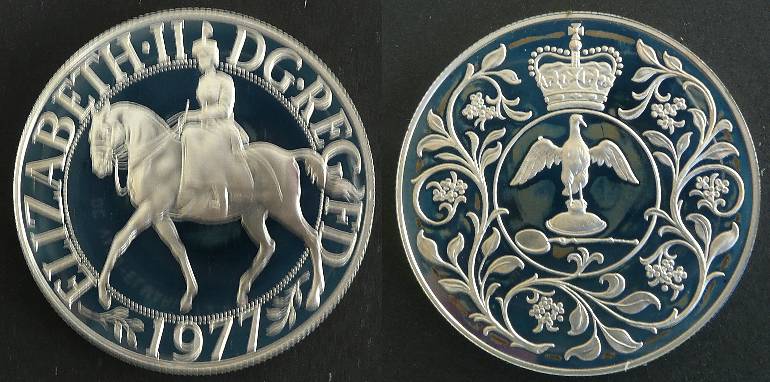 Edited by NumisRob
02/27/2015 03:43 am
|
|
Pillar of the Community
United States
8137 Posts |
 It looks like the U.S. bicentennial is up tomorrow. I've got lots to post for that year. |
|
Bedrock of the Community
United Kingdom
19132 Posts |
1976 French silver 50 Francs: 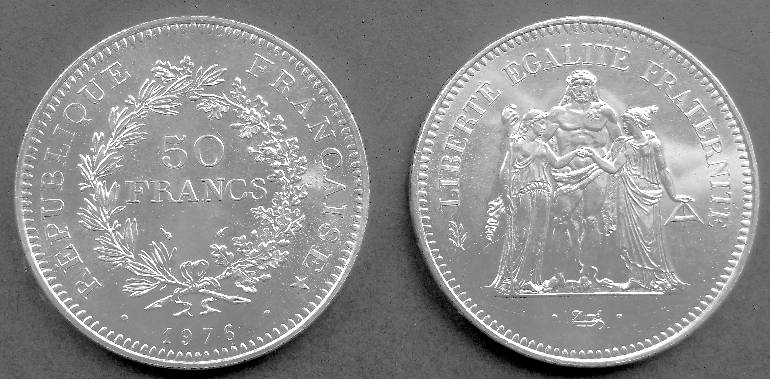 After the revaluation of the franc in 1960, the French had a policy of always maintaining a 'prestige' high value silver coin in circulation. The silver 5-franc coin, roughly the size of the half dollar, circulated fairly widely alongside a banknote of the same value, but had to be replaced by a base metal coin in 1970 owing to the rise in the price of silver. The 37mm 10-franc coin, which never circulated widely, suffered the same fate in 1974, and, after a stillborn attempt to introduce a 20-franc coin (resulting in a few rare and valuable patterns), a 41mm 50-franc coin was issued. At the time, its silver content was worth only about 20 francs, but by 1980 this coin too was withdrawn as its silver content exceeded its face value. From 1982 a much smaller silver 100-franc coin was issued. The 50-franc coin was often paid out by Post Offices to pensioners and other benefit claimants, many of whom sold them to coin dealers for a small profit. By 1976 the coins could, with a bit of luck, be obtained for face value from main post offices and branches of the Caisse d'Epargne - the state-owned savings bank. I actually got one in change from a 100-franc note in December 1978, so they did genuinely circulate to some extent! The design of the 50-franc coin shows Hercules flanked by two female figures representing the Republic and Justice. It was originally engraved by Augustin Dupre and was used on silver 5-franc coins in the 19th century and on the 10-franc coins of 1965-1973. |
|
Pillar of the Community
United States
1156 Posts |
1976 is the first year that coins were minted featuring the the modern sport of fencing, so it's the last fencing coin I can post on this thread. The Royal Canadian Mint issued 28 different coins to commemorate the Montreal Olympics. In addition, some coins were minted with two different finishes. The pictured coin is the satin finish. I also have the proof fencing coin with satin lettering. Mintages were so high (1,985,257 for the satin finish fencing coin, for example) that many are still readily available to collectors. 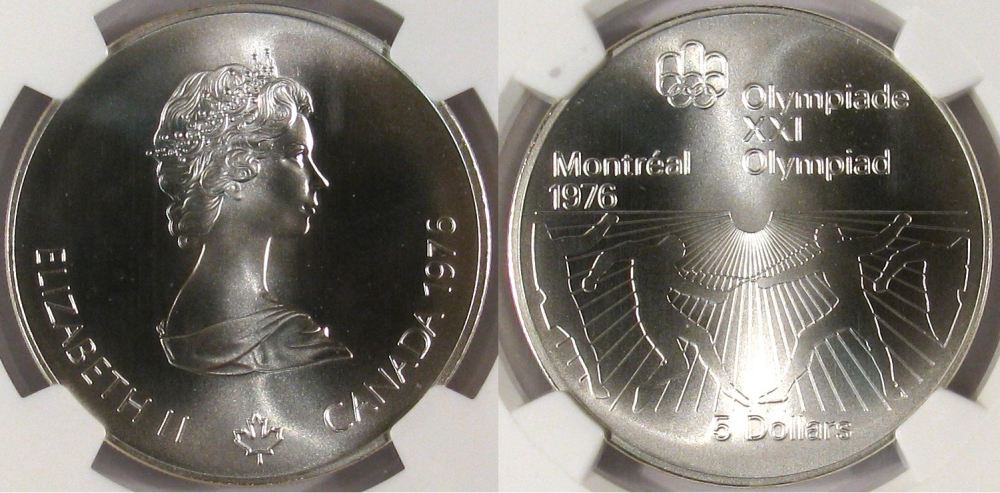 Edited by jgenn
02/28/2015 11:28 am
|
|
Bedrock of the Community
United States
11951 Posts |
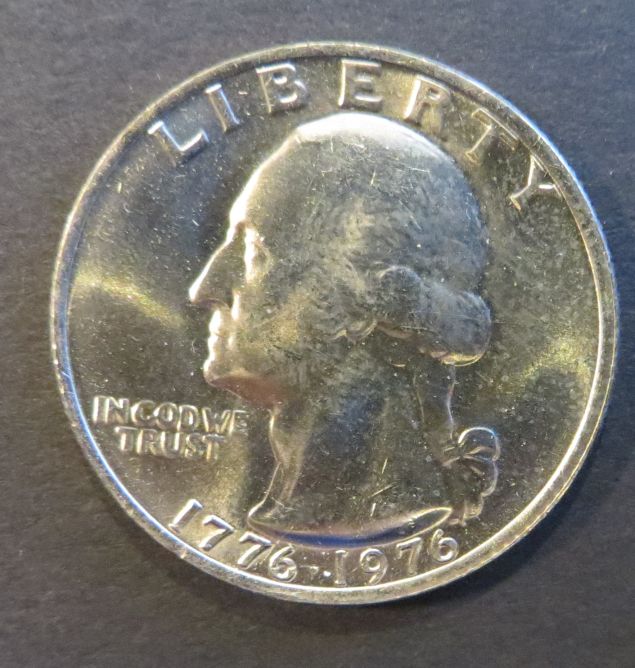
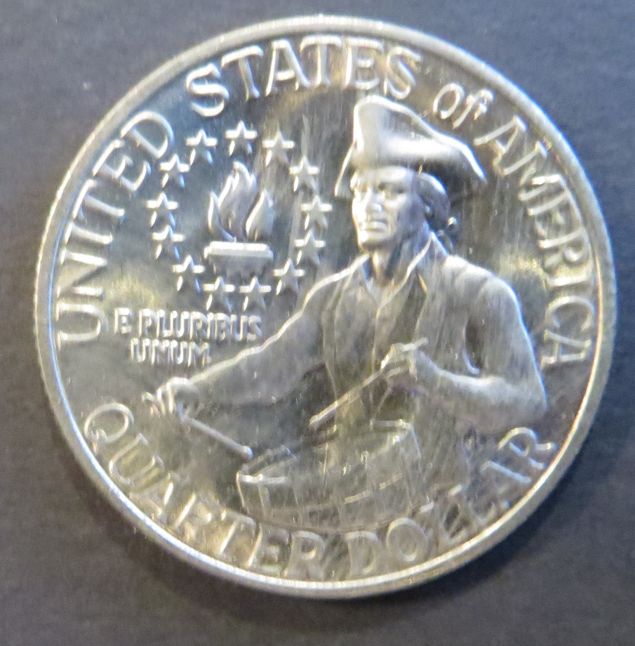
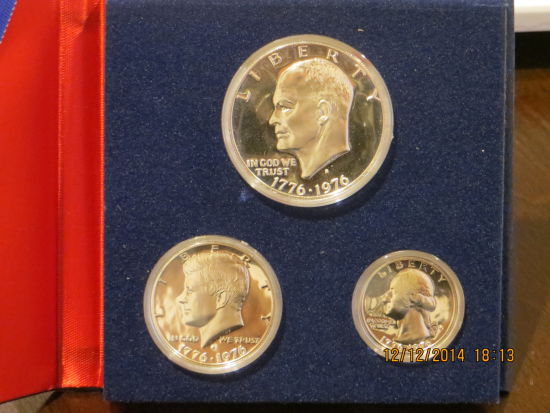
1976 Bicentennial three coins set (UNC 40%) 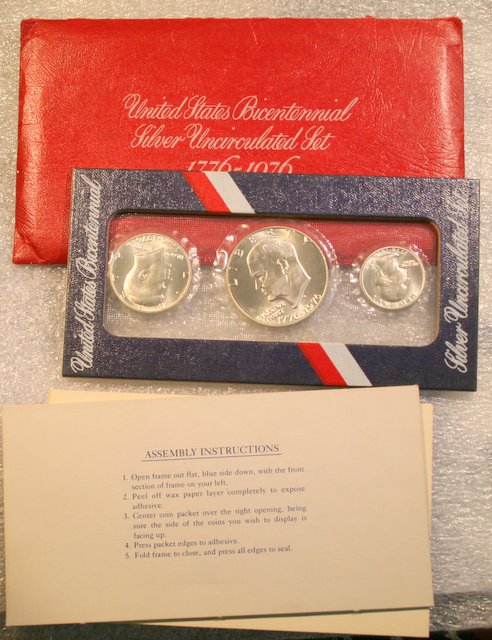 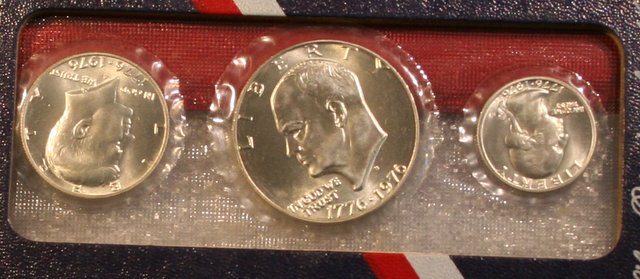 |
|
Pillar of the Community
United States
8137 Posts |
Edited by CoinCollector2012
03/01/2015 1:28 pm
|
|
Valued Member
Japan
349 Posts |
Showa 51 = 1976 100 Yen with the Imperial Palace / Bridges. 30mm diameter, large compared to the 22.6mm of the usual 100 yen coin. 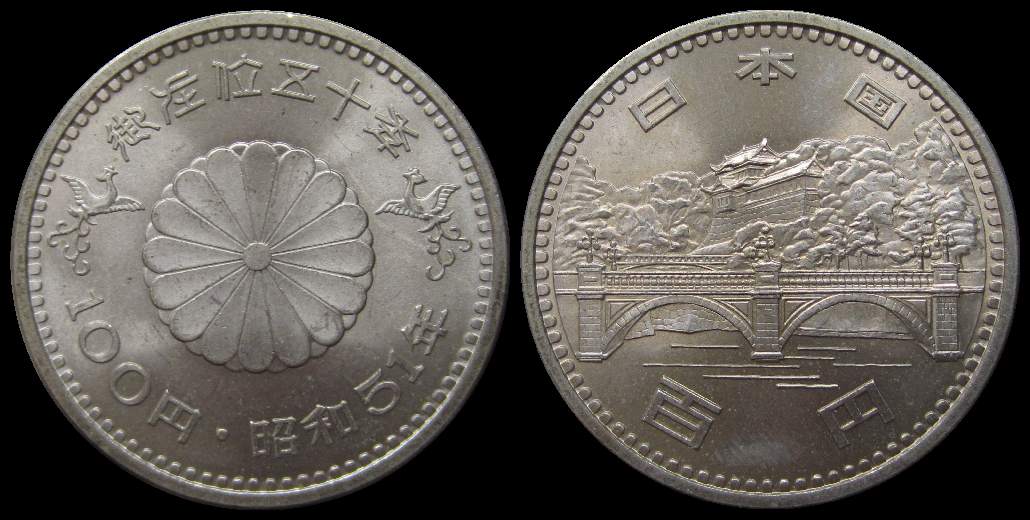 |
|
Bedrock of the Community
United Kingdom
19132 Posts |
Very attractive Japanese coin, Bungle! From 1975 here is a Swiss commemorative 5-franc coin commemorating Architectural Heritage Year. The design is a sharp contrast to the very traditional Swiss definitive coin series: 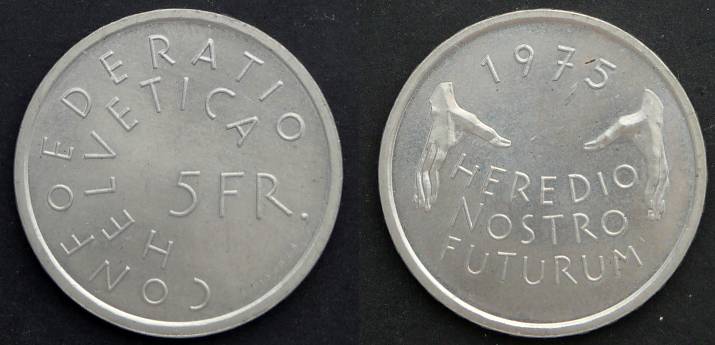 |
|
Pillar of the Community
 United States
1916 Posts |
Here is some low value counterpoint to all the round coins we have been seeing. It's Cu-Ni; 13mm on a side. 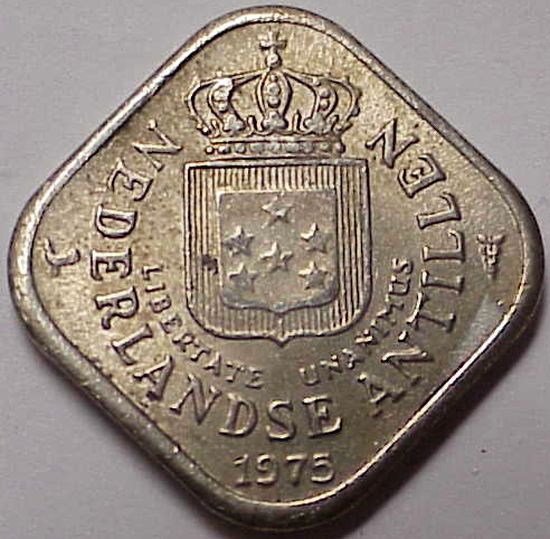 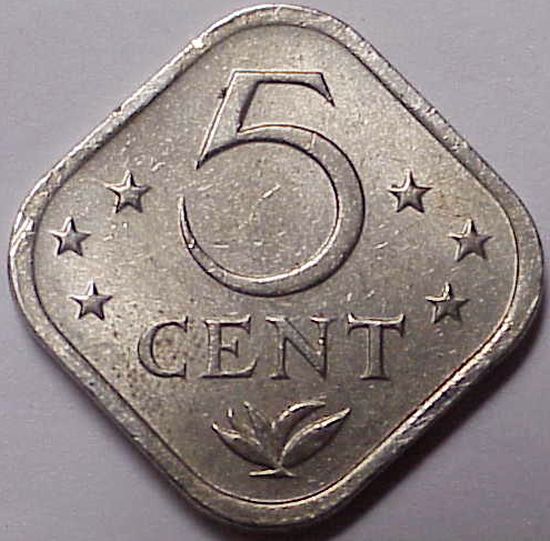 |
|
Pillar of the Community
United States
8137 Posts |
I have a cool little error for today...   Edited by CoinCollector2012
03/01/2015 1:30 pm
|
|
Bedrock of the Community
United Kingdom
19132 Posts |
1974 French 10 Francs: 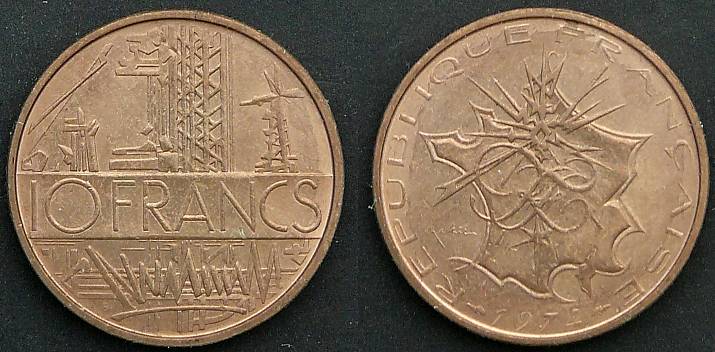 The cupro-nickel-aluminium 10-francs was one of the first of the 'new wave' of circulating high-value base metal coins in Europe, with a face value equivalent to about $2 or one pound when first issued. Between 1965 and 1973 a 37mm silver 10F had been issued, but this was considered a prestige coin and was rarely seen in circulation: a ten-franc note was in general day-to-day use. The coin was designed by the well-known French painter Georges Victor Mathieu d'Escaudœuvres, known as Georges Mathieu (1921-2012). The modern design contrasted with the traditional 'Sower' on the half, one and five-franc coins. The new 10F coin was not immediately popular: up to the early part of 1976 it was still a rarity in change, and by 1978 the coins and notes were roughly equally common. By 1981 a 10-franc note was a rarity, but the coin and note circulated together until the notes were finally withdrawn in 1986. By then, the 10F coin was being heavily counterfeited, and foreign coins of similar size but lower value were being extensively used in slot machines. After a short-lived attempt to replace it with a small pure nickel 10F coin, which was almost immediately withdrawn as people confused it with the half-franc, a new bimetallic 10F coin was introduced in 1988, and the Mathieu 10F was demonetised on October 1, 1991. Edited by NumisRob
03/02/2015 02:34 am
|
|
Pillar of the Community
United States
1916 Posts |
1974 South Africa 1 rand: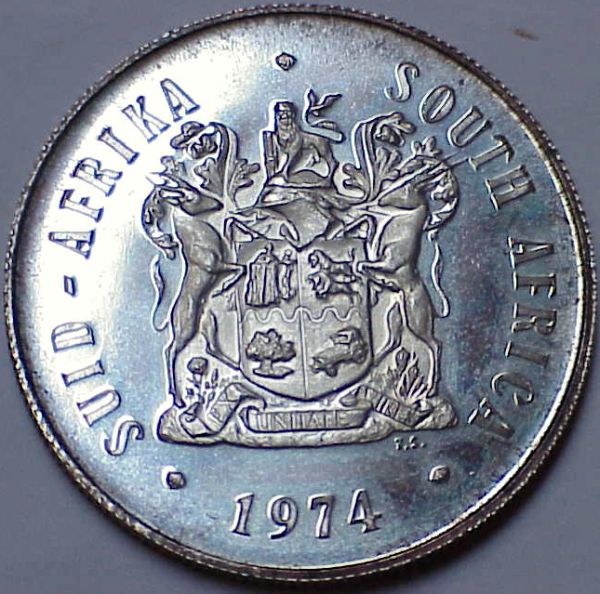 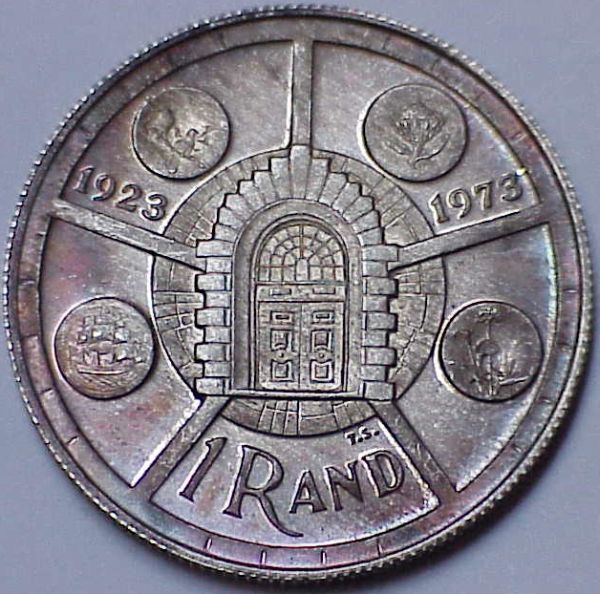 I strongly suspect this heavily toned 32mm. 0.800 silver coin is an impaired proof. There were two varieties issued that year- one for regular circulation with a mintage of 20000, and the proof version, with a mintage of 15000.
|
|
Pillar of the Community
United States
8137 Posts |
|
| |
Replies: 3,662 / Views: 264,127 |




 First Page
 Previous Page


 Posted 02/26/2015 12:52 pm