| Author |
 Replies: 18 / Views: 4,323 Replies: 18 / Views: 4,323 |
|
Pillar of the Community
 United States
2703 Posts |
|
|
|
|
Moderator
United States
23731 Posts |
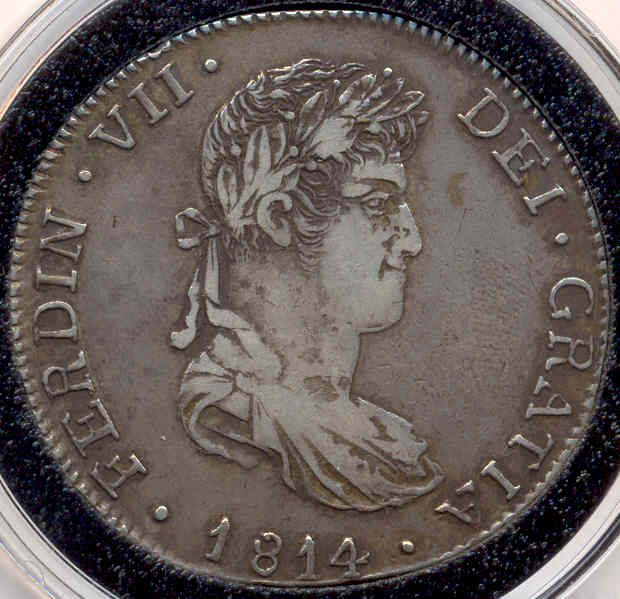
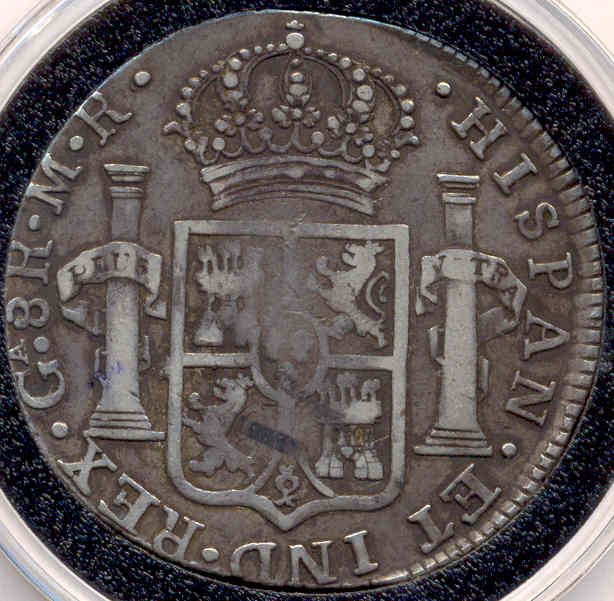
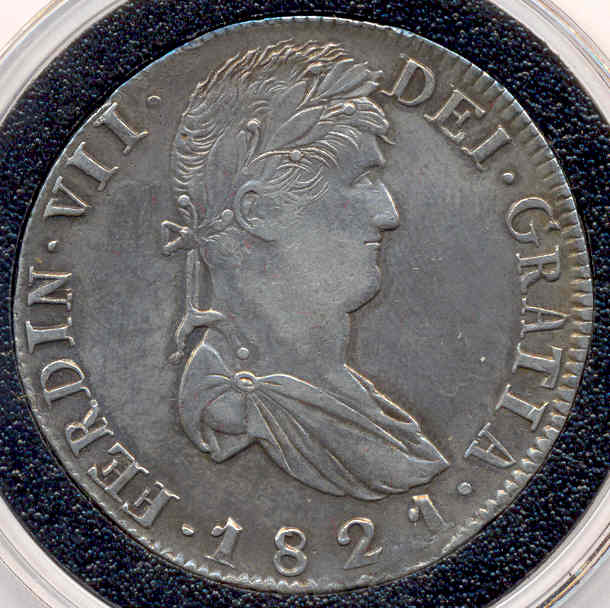
I'm sure swamperbob will be a long soon to comment on these. To me the 1814 doesn't look right, the lettering seems poorly done and the smile on the bust is strange. Krause states that there are various bust types for this year, that could be the case on this one, but my gut feeling is that it's a reproduction.
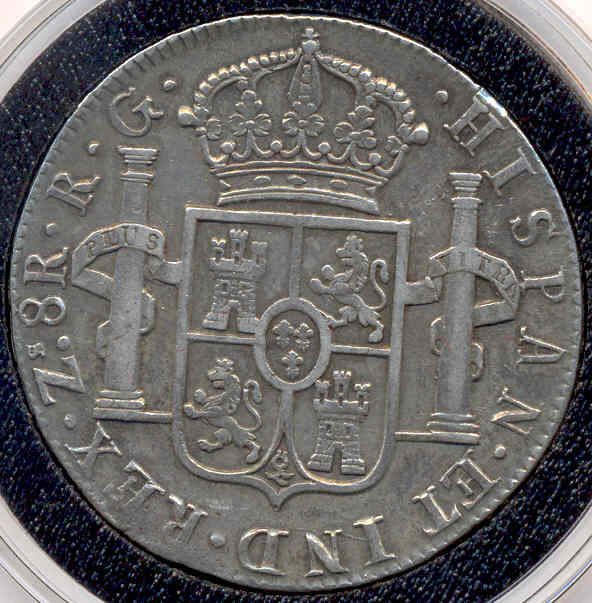
The 1821 on the other hand looks to be real.
Real or not they are both nice coins.
Edited by echizento
09/21/2007 03:27 am
|
|
Valued Member
United Kingdom
240 Posts |
Beautyful coins. The 1821 looks cleaned.
|
|
Pillar of the Community
Czech Republic
803 Posts |
I like the Guadalajara piece. This War of Independance Mint was always one of my favorites and I have 2 different varieties of 1814 in my collection. Nice strong VF, too. I assume it's properly edged? What's the weight?
Edited by TwoKopeiki
09/21/2007 09:21 am
|
|
Pillar of the Community
 United States
2703 Posts |
Hi TwoKopeiki!
The 1814 weighs 26.70g, and the edge is alternating rectangles and circles. The coin is not fully circular. You can see this in the picture at 6:00 near the "IND" on the reverse, but the edge pattern is complete here so there is no evidence of clipping or mounting or other damage. There is a small flat spot (one repeat) in the edge pattern at 9:00 (relative to the obverse). It is stuck slightly off center. It is not as flat or as regular as the 1821 and is overall more crude looking than the 1821 (which I like).
The 1821 weighs 27.01g with a similar edge, but more regular. There are two flat areas on the edge with some marks at 5:00 and 11:00 (relative to the obverse), so it looks like it may have been mounted at one time. Probably it was lightly cleaned, since it is a bit too light in color, but not washed out, and there are traces of luster in the legend on the obverse and above the crown on the reverse.
Edited by t360
09/22/2007 10:17 am
|
|
Member
United States
3242 Posts |
|
|
Pillar of the Community
United States
2703 Posts |
Thank you everyone for the feedback.
Now for the book(s). The seller identified the 1814 as Calbeto 109. Is Calbeto a good reference for these, what is the full title of the Calbeto book and where can I buy it? (I don't care if it is in Spanish.)
|
|
Pillar of the Community
United States
2703 Posts |
I found this book for sale for $125 (ouch). Here is the seller's description:
--------------------------------------
Calbeto de Grau, Gabriel
Compendio de las Piezas de Ocho Reales Volume 1; San Juan, PR: Ediciones Juan Ponce de Leon; 1970; 1st edition; Hardcover; VG/No DJ; 4to; 356pp.; illus.; B&W; includes numerous photos; Spanish and English text; limited edition #1015 of 1500; this book is the classic reference on Spanish and Spanish Colonial and Republic 8 reales. Each coin is grouped by country and mint and then listed by year with a photo of the obverse and reverse of the coin, any over date or type or variation, the assayer and notes. The notes include either auction sale information or private collection information in regards to provenance. This work is a rare, true classic that should be in the reference library of every collector of 8 reales.
-------------------------------------
Looks like a scarce book. And this is only volume 1.
|
|
Pillar of the Community
United States
2703 Posts |
I see Swamperbob has the two volumes of Calbeto listed in the "reference books" thread. Looks like it might take some searching to buy the set. I guess it is really not that much money considering what my kids spend on their college textbooks.
If someone has the set, what exactly is covered in each volume? can you confirm the attribution of my 1814? Thanks!
|
|
Pillar of the Community
Czech Republic
803 Posts |
I use Calbeto as "THE REFERENCE" for my portrait 8 Reales collection. I don't regret spending the money to buy both volumes. If you inspect the edge pattern closely - can you see where pattern overlaps?
|
|
Pillar of the Community
United States
2703 Posts |
quote:
If you inspect the edge pattern closely - can you see where pattern overlaps?
Yes, I think I see what you mean at 3:00 (relative to the obverse) near the "G" of "DEI GRATIA". |
|
Pillar of the Community
Czech Republic
803 Posts |
Cool, now look exactly opposite and you should see another overlap - that would tell you that this coin was properly edged. :)
|
|
Pillar of the Community
United States
2703 Posts |
yes, looks like it near the N in FERDIN!
|
|
Pillar of the Community
United States
5362 Posts |
t360 - Nice looking coins. But you are buying in dangerous waters as both of these coins have in fact been copied. There are at my last cout 25 different counterfeit varieties of the 1821 8R alone. That number is always growing however. It is one of the most common dates for portrait forgeries. The 1814 has also been targeted recently by the Chinese who have injection castings of at least 2 varietes of the 8R and one of the 4R.
I believe that both of your coins are either REAL or they were made from transfer molds made from REAL coins. The patterns in both are correct.
Calbeto is a great reference for punch types but is incomplete as far as die types goes. I own the set and would never part with it, because it is the best book out there. I just hope that someday someone will expand the Portrait section to cover the full range of die varieties.
So far the clues you have explored look pretty good with one RED FLAG exception - the weight of the 1821. A weight of 27.1 g is too high. However, you said there is a trace of a mount - could that add about 2-2 1/10ths of a gram of weight? I would expect this coin to weigh 26.8 to 26.9 grams.
The weight of the 1814 is just a hair low but you refer to a flat spot on the rim. Was there metal loss?
The edge clues so far sound good. There must be TWO overlaps in the design exactly opposite one another and of IDENTICAL length. One overlap is a guarantee of a forgery.
Now to the more difficult part - the actual pictures of the face dies.
I do have serious concerns regarding the 1814 by virtue of the surface clues I seem to observe on the pictures posted. Even though the dies from the War era are rougher - I can not explain the depressions near the King's nose and on the neck near the colar line. If they purport to be corrosion - where is the "other" corrosion that you would expect to see as well. I am also bothered by the sides of the letters R in FERDIN for example that seem irregular.
Could you post pictures of the edges of both coins centered on the overlaps?
|
|
Pillar of the Community
United Kingdom
2217 Posts |
I would have put the engraver before the firing squad if he had made me out to look like the portrait in the first photo..or even the second one...
Edited by NumisMattyUk
09/23/2007 1:39 pm
|
|
Pillar of the Community
Czech Republic
803 Posts |
NumisMattyUK - there are quite a different varieties of Fernando VII's bust. That prompted me to create a small banner with a few I owned at the time :) Since then I acquired a few other types, so additions to the banner are necessary... 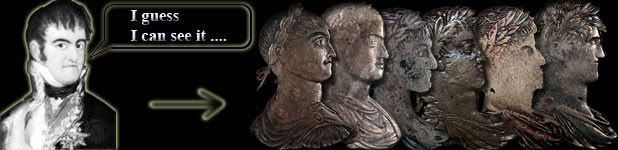 Keep in mind that Fernando VII was forced to abdicate the throne in 1808 in favor of Joseph Napoleon and was imprisoned in France for almost seven years afterwards. Spanish colonies refused to accept Joseph as a ruler and continued to mint coinage with the bust of Fernando. So master dies and punches were no longer provided by Spain during this time and had to be created at individual colonial mints. This led to a number of different variations of the King's portrait (see Inca-Hispanic bust at Lima or the 1809 Santiago bust, for example). Similarly, Royalist mints during the War of Independence in Mexico, had to improvise, since transporting dies / punches from Mexico City was not possible due to insurgent forces roaming the countryside. The weirdest one I have seen would have to be 1816-1818 Zacatecas pieces, as well as early Durango, like these:  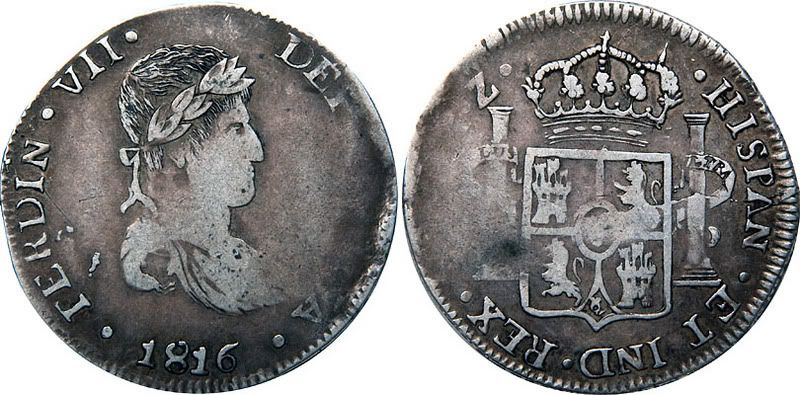
|
| |
Replies: 18 / Views: 4,323 |









 Posted 09/21/2007 02:19 am





