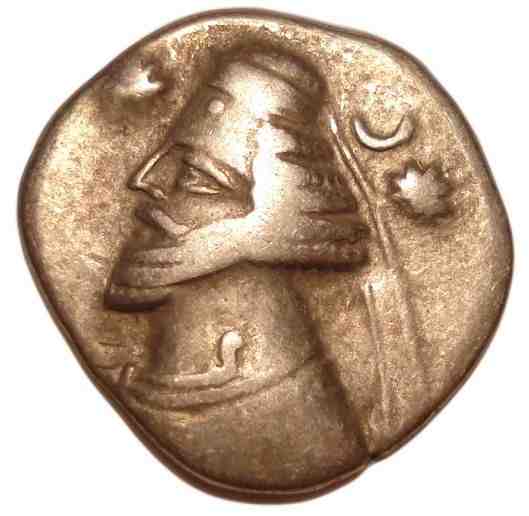
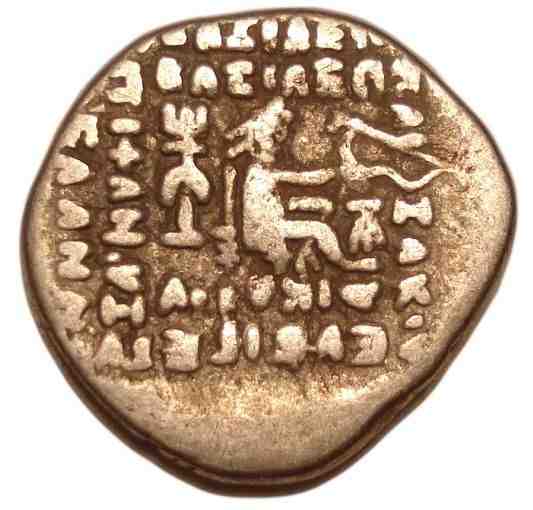
As another collector of ancients always on the lookout for astronomical themes, you'll pardon me if I babble on for a bit.
Coins with generic moons and stars on them are relatively easy to come by; perhaps the cheapest and easiest are the Late Roman Bronze "campgates" featuring stars attached to or hovering over the walls, such as
this one. Coins that make reference to specific astronomical / astrological objects or events are much rarer (and usually much more expensive). The "comet denarius" linked to by pishpash above is a good example.
Another aspect of "astronomical coin collecting" is the collecting of coins depicting deities for whom planets, asteroids etc are named after. In the Roman series, it's quite possible to collect all seven ancient planets (Sun, Moon, and the five "actual" planets excluding Earth itself out to Saturn); you can even throw in some of the planets, moons and asteroids that hadn't been discovered in ancient times (such as Neptune and Ceres). Saturn and Pluto are the hardest to find; not popularly depicted on coins, those guys.
You can also find their planetary equivalents on other coinage series. On Greek coins they are called Zeus and Hermes instead of Jupiter and Mercury, for instance, while the Kushan Empire coinages depict Mao and Ardoksho rather than Luna and Venus.
Specific non-planetary objects rarely get a mention on ancient coinage, but on Roman coins, there's Castor and Pollux, the mythical twins of Gemini, who
feature prominently in the Roman foundation myth and are usually depicted on coins with their stars hovering over their heads.
These Roman Republic denarii are nice and clear.
There are also some good candidates in the mediaeval period. Astrological imagery was one of the few exceptions the Islamic rulers granted themselves to the "no graven images" policy usually implemented on coins. My favourite is the Artuqid bronze dirham depicting a centaur-archer with a dragon attached to it's tail: astrological code for a solar eclipse in Sagittarius, specifically, the one that happened the year before the coin was struck (AD 1201) in which the path of totality passed through Mecca;
discussed in this thread.
There's also the sudden and short-lived appearance of stars on Byzantine gold coins that just happens to have occurred at the same time as the 1054 supernova.
This CoinArchives example will disappear in a few months, so click on it quick to see one.
Don't say "infinitely" when you mean "very"; otherwise, you'll have no word left when you want to talk about something really infinite. - C. S. Lewis







 Posted 01/23/2015 11:50 am