In the early days of coinage. The empire of Achaemenid Persia stretched to the Indus Valley. Sometime in the 6th century BC coinage came into use in Gandhara (Far Western India and Pakistan). This coin is one of the earliest types of coins ever. It is not well understood if the coin type developed independently in Gandhara or if the coin was minted to circulate with the earliest coins of Persia, around BC 550.
This coin has an ideal weight of 2 Persian sigloi valued at a Shatamana, estimated to equal to 100 Ratti. A Ratti is a system of measurement based on the ideal weight of a seed 0.12 grams. Ideally this piece would be a 100 x 0.12 = 10.20 grams.
This coin type went through several transformations throughout North and Central India until about BC 450. It represents one of the earliest types of "Punchmarked" coins. This is a distinct characteristic that would come to dominate the coinage of the region for nearly 3 centuries, known to be circulation when the Greeks arrived the in late 4th century BC.
I would attribute my coin as follows.
India,
Gandhara Janapada
Gandhara and Taxila
Archaic Shatamana "Bent Bar" 31 mm x 11.11 g
Obverse: 2 x 6 armed Gandhara Symbol with Pellets offset.
Reverse: Uniface
Ref: ACC #1.5.2 Rare. Very Late Billon Short wide type,
Rajgor 552,
For further reading on the various types. Please look here.
http://www.ancientcoins.ca/gandhara/gandhara.htm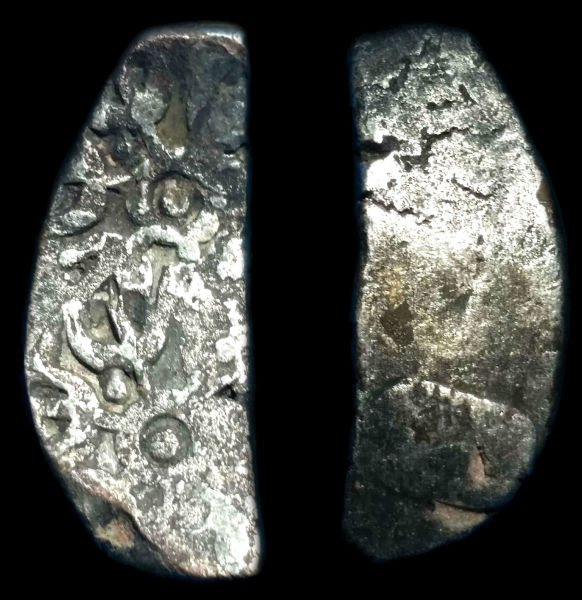










 Posted 02/08/2015 02:27 am


