 The following is a press release from NGCThe evaluation of style is paramount to establishing the desirability of an ancient coin.
To the best of our knowledge, all dies used to strike ancient coins were engraved by hand. There is evidence that hubbing may have been used in the production of some dies - but even then, the fine details would have been engraved by hand. The skills of the artists who accomplished this work varied considerably.
Since collectors tend to prefer coins of fine style over those of lesser workmanship, every coin sent to NGC for grading is evaluated on the basis of style. Any coin that, by our standards, is of superior style is awarded the designation "Fine Style", which appears on the label just beneath the grade.
We say "by our standards" because beauty is in the eye of the beholder, and to suggest there is a universal standard would be bold, to say the least. People are bound to disagree on what constitutes fine style, and often there is but a fine line separating the two. However, our approach is based not only on a general sense of esthetics, but also the context of the coinage. In some series there are no issues of fine style, whereas in others it is a relatively common occurrence.
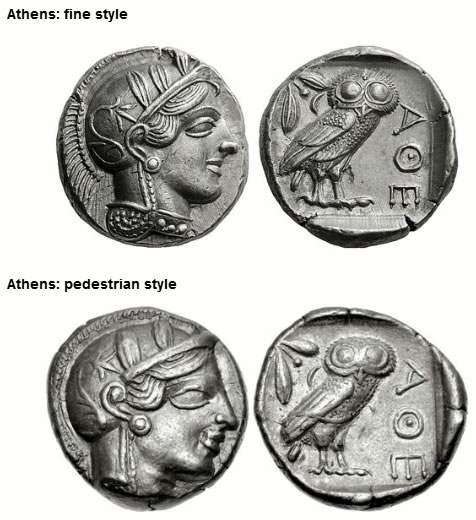
The style of an ancient coin may be defined as the visual impact the design, based upon the quality of its engraving and composition. These two silver tetradrachms of Athens, shown below, struck in the later 5th Century B.C., illustrate how two engravers produced dies of markedly different levels of artistry.
On our site we discuss three approaches to evaluating style, which is worth repeating here:
An "absolute" approach rates style from a single perspective, with coins being judged against some kind of universal standard(s).
The "relative" approach distinguishes a range of styles within a given series. As such, the best coins within a stylistically mediocre series would rate higher than average coins from a fine style series, even though the latter might generally be considered more attractive than the former.
The third seeks a balance between the absolutist and relativist schools of thoughts, incorporating the best qualities of each. This approach has been adopted by NGC.
It is also worth noting that even if a coin's dies were engraved in fine style, the appreciation of the artwork might be disturbed enough by negative aspects of strike and/or surface conditions that such coins could be denied the designation of "Fine Style" on that grounds alone.
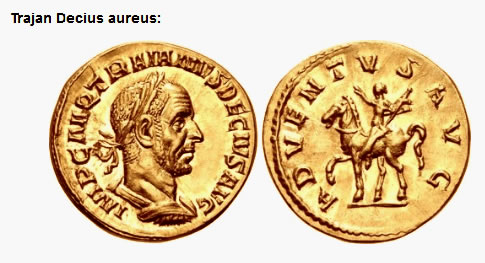
Another aspect to consider is that sometimes two tiers of artists cut dies used to strike a coin. With many coins of the Roman Empire, for example, the best artists cut the portrait dies, whereas second-tier artists cut the reverse dies. In those cases a pedestrian reverse die does not prevent a coin with a wonderful obverse die from being labeled as "fine style".
Here is an example: notice the great variance in style between the portrait die and the reverse die on this gold aureus of the Roman Emperor Trajan Decius (A.D. 249-251). The portrait is of accomplished, realistic style and the reverse is almost cartoonish:
We also must distinguish between style and composition. Composition concerns the format of the design, which, inherently, may be pleasing or displeasing. Two artists can work with the same design and yet achieve completely different results (as seen with the two coins of Athens illustrated above).
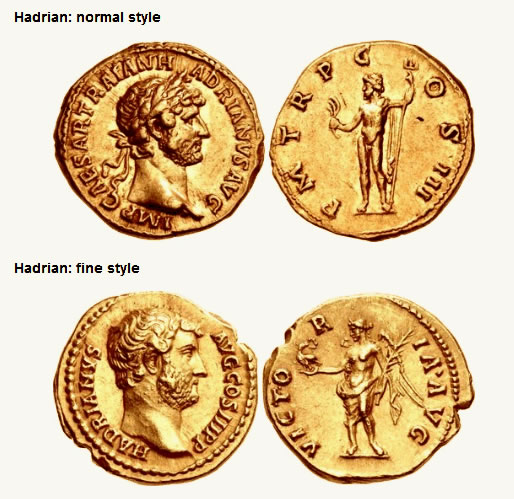
The high relief and the amount of detail on ancient coins often can be beguiling, especially to collectors of modern coinage. In terms of NGC's "fine style" designation, however, it is important to note that a highly detailed design, or one rendered in high relief, does not necessarily translate to "fine style". It takes time to become familiar with the range of styles encountered in ancient coinage, and to distinguish the gradations of style.
These gold aurei of the Roman Emperor Hadrian (A.D. 117-138) illustrate the point perfectly. One might consider the one on top to be of fine style, when, in fact, it is falls short. It is not until one compares it with an example of truly fine style, shown beneath, that it is easy to recognize the difference.
Finally, we must consider that there are many stylistic categories for ancient coinage - too many to discuss in an introductory article. Some styles found on ancient coins will appeal to some collectors, and yet will alienate others.
In the same way that a Jackson Pollock painting will impress some and cause others to shake their head, and an Impressionist painting will appeal to one person, yet another will prefer the work of artists such as Norman Rockwell or Charles Russell, there is no accounting for individual taste in ancient coinage. In some cases the newcomer (or even the advanced collector) may not understand or agree with why some ancient coins are awarded a fine style designation and others are denied.
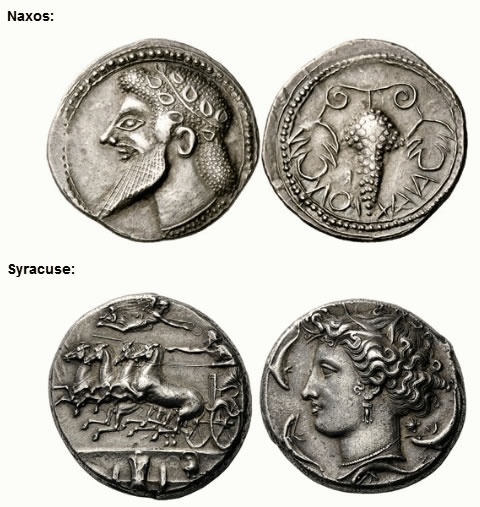
The two silver coins from Sicily shown below are an ideal way to end this introductory article. The first, a drachm of Naxos, dated to c.530-510 B.C., is a work of the Archaic period of Greek art. Despite its astonishingly good style, its appeal is a bit more selective than that of the accompanying piece, a decadrachm of Syracuse, struck soon after about 400 B.C., during the Classical period of Greek art. Both are equally accomplished works, though their artists had quite different visions in mind.





 Posted 02/18/2015 2:52 pm





