Hello! I live in Edmonton, Alberta, Canada. Edmonton is the fifth-largest city in Canada, and the northermost metro area with more than a million people in North America. One of Edmonton's nicknames is the "Festival City" (although "Deadmonton" is more popular) because of our wide assortment of annual events, all throughout the year (even in winter... and it's a long winter). Of these festivals, the oldest is
Klondike Days. Edmonton's first major wave of settlers came during the Klondike Gold Rush in the Yukon Territory. For these gold rushers, Edmonton was the last town to stock up on supplies at before the terrible journey up North. Decades ago, somebody thought "that's good enough!" and created "Klondike Days", a week-long festival with a nostalgic 1890s theme. Starting in 1968 and ending in 1986, "Klondike Dollar" tokens were issued every year with a different design. They would be worth $1 for the duration of the festival. All of them have "Klondike Mike" (the show's mascot) on one side.
I can't find anything on the Internet about Klondike Dollars, but after some conversations with local collectors and dealers and completing my collection by type I feel qualified to write my own long post on the subject.

1968 was the year of the first Klondike Dollar. It has some differences compared to the others - the edge is plain, not reeded, and the mintage is the lowest by far at just 45,000 (all other years were at least 100,000).

Panning for gold was an eternally popular Klondike Days event - sadly, the gold-panning rigs have since been dismantled. Of course, the "nuggets" were artificially seeded.

1970 has my favourite design.

1971 saw the first use of the Sherritt Mint's hexagonal mint-mark (look after "CANADA"). The Sherritt Mint (based in Fort Saskatchewan, a town next to Edmonton) seems to have encouraged cities and towns all across Canada to use their services to manufacture
Trade dollars throughout the 70s and 80s. Nowadays, it seems to be defunct.

1972 saw a new gimmick. Every Klondike Dollar from 1972 onwards bears one of four "mint-marks" - a cane, a hat, a pick, and a shovel. During the festival, people would be stopped by show staff and asked to present a dollar featuring a certain mint-mark. If they had the right mark, they would win a candy or a little prize. This also means that the "complete" Klondike Dollar collection contains four coins for every year, not counting other varieties (100 tokens would be somehow defaced every year, and anyone with a defaced token would get a BIG prize - these are enormously rare).

Every year, a very limited number of Klondike Dollars would be struck in .999 silver and 24K gold to be distributed as very special prizes. Silver mintages usually ran between 200 and 300, while the number of gold tokens produced was always below 30. Most of these have probably been melted down over the years, even though they're fantastically rare. A great loss for exonumia.

Some changes were made in 1974. The mint-mark finally moved from the reverse to the obverse, the magic word "SOUVENIR" was added to the obverse, and a tradition began where every Klondike Dollar would specifically commemorate a certain person or event.

Edmonton and Calgary are Alberta's two largest cities. Alberta was created by a Liberal government, and Edmonton had more Liberal supporters, so Edmonton was made the capital despite being slightly smaller than Calgary (to this day, it's not quite as big). Edmonton was also chosen over Calgary to get a railway line.
The station pictured here is now a trendy restaurant/nightclub.

1976 has the highest mintage - 230,000 tokens were made in this year.

Many hopeful prospectors traveled along the coast through Alaska to reach the Yukon. Hey, that's cheating!! This token commemorates those who didn't.

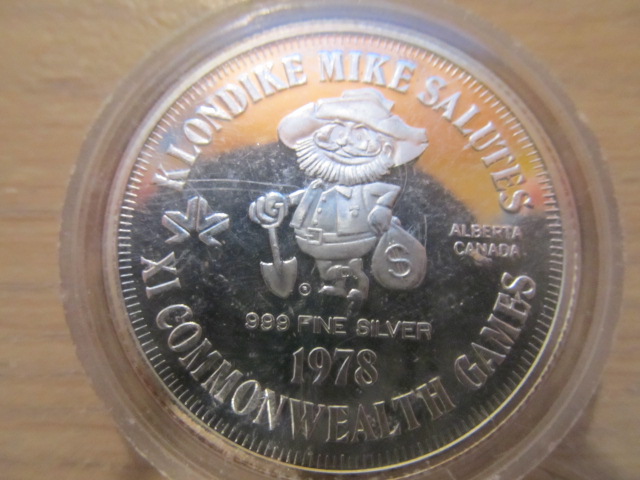
For three years, all Klondike Dollars were made out of brass instead of nickel-bonded steel. Maybe it had something to do with the commemoration of the Commonwealth Games in Edmonton, and they kept it going for another two years? These brass dollars aged very badly and it's not easy to find ones that are still shiny and unblemished.
It's also the beginning of a five-year series, all of which commemorate "Edmonton's Great Pioneers".

In 1979, the effigy of Klondike Mike was changed for the first time. Instead of a pickaxe and a bag of gold, he's now waving to the camera. In my opinion, this effigy isn't as nice, especially because of that tiny, sad bag of gold.

1980 was the 75th anniversary of the Province of Alberta. All schoolchildren in Alberta were given a commemorative medallion for the event (similar medallions were given out to kids in 1955 and 2005). So the 1980 Klondike Dollar also commemorates this event.

In this year, Klondike Mike was changed once again. Now he has a pickaxe, but no gold, and his mischievous cartoon smile has been toned down even further.

This is the last "Great Pioneers" issue.

Another B-grade sporting event hosted by Edmonton! The World University Games (a.k.a. the Universiade) aren't the Olympics but they aren't too shabby either, especially because we managed to get the British Royals to open the event.
These last three years are quite rare, as public interest in collecting Klondike Dollars seems to have waned and mintages dipped down to 100,000 (from a high of 230,000 in 1976).

We've come full circle! This is the same rafting event commemorated in 1972.
I was saying something about B-grade sporting events? The Grey Cup is the annual championship for the Canadian Football League, which uses rules that are slightly different than American football. Although it's not quite as exciting as the Stanley Cup, Canadians can always rely on a Canadian team to take home the Grey Cup.

Most of the Klondike Dollars are surprisingly well-designed for privately minted tokens. But this year's design is just plain creepy.

This is the last of the real Klondike Dollars, and the design is appropriately somber. The new management of Klondike Days decided to end the series as the Sherritt Mint wound up its operations - later, they would even rename the festival to "Capital X", a very unpopular decision. It has been renamed again to "K-Days", but once again the general public have yet to accept this new name. Nowadays, people are getting nostalgic about a festival about nostalgia.

However, there was one more issue in 1989. This new management did not permit the issue of actual, good-for-$1
Trade dollars, but they did like the "profitable souvenir" aspect of the Klondike Dollar program. So, this final token was released. All the text pertaining to its value has been shoddily removed, but apparently people still tried to spend them as $1 at the festival. The 18-year program had been squeezed dry to extract one last quick buck for the festival management. Overall, it's an ignoble end to an interesting series of tokens.
Thank you for reading! I know that collectors of Canadian trade tokens are rare, but hopefully this will help someone out someday.









 Posted 02/19/2015 9:49 pm