First Page


 Posted 02/25/2015 8:55 pm


Quote:
Ardent believer that the longest hair on a man's body should always be on his chin.
Ardent believer that the longest hair on a man's body should always be on his chin.
You can learn a lot about the coming and going of facial hair fashion in the Roman period via the coinage.
Early Roman emperors are beardless; the early Romans copied the ancient Greeks after they conquered Greek territory. The first bearded emperor was Hadrian, who apparently had a skin condition that meant he preferred not to shave. Of course, once the emperor went around bearded, everyone else did too, and the beard soon became a badge of office of the emperor. There are even examples of people who became emperor while still very young, whose coins show a beard even though they were physically too young to grow one. Beards did not disappear from the coinage until the time of Constantine.
An exception to the "nobody wore beards" in Greek culture were the philosophers; a beard was in effect part of their uniform. Emperor Marcus Aurelius fancied himself a philosopher in the Stoic tradition, so you find him with a long, philosopher's beard on his coins.
Julian II also fancied himself as a philosopher so, as part of his "pagan revival", wore a very prominent bead on his coinage.
Quote:
A common theme of my collection is the debasement of money... I think I would like to do the history of the Roman civilization and their debasement of silver coinage and the decline of the empire / republic / etc.
A common theme of my collection is the debasement of money... I think I would like to do the history of the Roman civilization and their debasement of silver coinage and the decline of the empire / republic / etc.
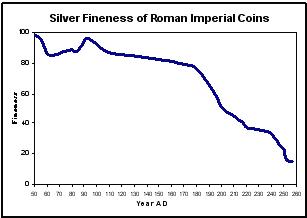
You might find this graph I drew up some time ago to be of interest. It show the typical fineness of the Roman denarius/antoninianus over time:
Quote:
I think it would be an interesting display to have 30 of the pieces of silver of the type Judas received.
I think it would be an interesting display to have 30 of the pieces of silver of the type Judas received.
We don't really know what kind of coins Judas was likely to have received, or even if they were thirty actual coins or an amount of money that weighed thirty shekels. The coins usually sold as "Judas coins" are the Shekels of Tyre, as it is known that the Jewish Temple authorities preferred payment in these, rather than the more debased Roman coinage.
Needless to say, any coin that can be marketed as a "Biblical coin" can command a hefty premium over a coin that is equally old and scarce that didn't get a mention in the Bible. If you want 30 of them, be prepared to pay thousands of dollars.
Quote:
I would really like a Viking coin if there is such a thing too.
I would really like a Viking coin if there is such a thing too.
The Vikings mainly stole and used other people's silver - Viking silver hoards contain anything and everything, including Islamic silver dirhams all the way from North Africa. But they did make a few very scarce coin types in Denmark and Norway itself, many of which depict their famous longships. Ironically, we had someone post one just recently.
Of course, "Viking" is a broad term. You can include coins the Viking colonists in Ireland and England issued, which are cheaper and more readily available then the Scandinavian types.
Don't say "infinitely" when you mean "very"; otherwise, you'll have no word left when you want to talk about something really infinite. - C. S. Lewis