| Author |
 Replies: 12 / Views: 3,499 Replies: 12 / Views: 3,499 |
|
|
Valued Member
United States
194 Posts |
Hey guys, I'm looking for some info on this. I inherited an entire bag full of paper money from my great grandfather who was a paymaster for the army. This is one of my favorites from his collection and I can't find much info on it. Any idea of rarity or value? Thanks in advance. 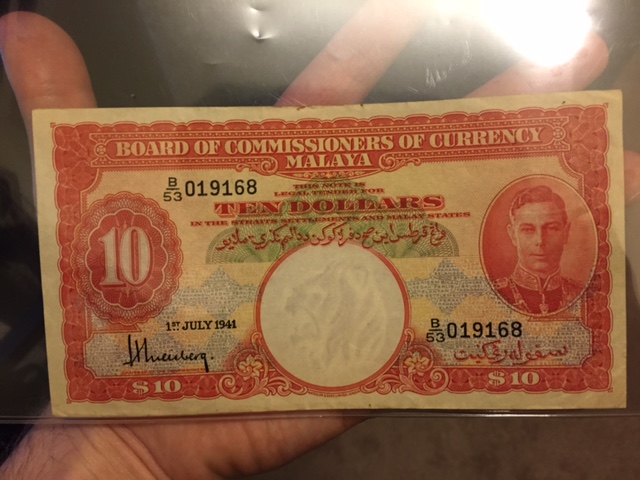 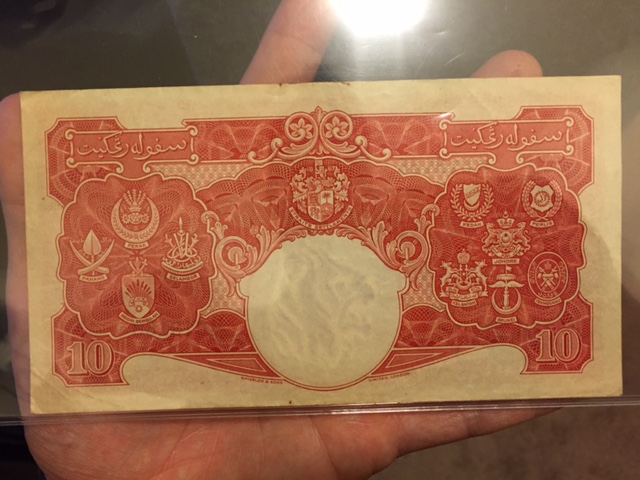 |
|
|
|
Pillar of the Community
Canada
2805 Posts |
|
|
Pillar of the Community
Canada
695 Posts |
This banknote (P13)is not very common and more details can be seen at these links:- http://www.banknote.ws/COLLECTION/c.../MAY0013.htmhttp://www.banknotes.com/mly13.htmLooking at some of the auction houses the selling price ranges from US$50.- to in excess of US$200.- but the value will depend very much on the condition of the note and what a collector is willing to pay for it. Other members, here, may have differing opinions. |
|
Valued Member
 United States
194 Posts |
Thanks for the great info guys. It seems to be in very good shape in hand, but I have zero experience grading these. Any ideas of grades? The bottom left corner is very slightly wrinkled but the rest of it seems to be very crisp.
|
|
Pillar of the Community
Canada
695 Posts |
|
|
Pillar of the Community
United States
992 Posts |
Some dealers would grade that as an AU note, but I'd give it an XF+, myself. I'm a pretty conservative table vendor, though.
It's a fairly scarce note, not rare, but not common, either. It's in nice clean condition. I'd tend to price it, from the photos, at midrange between XF and AU, but not be shy about giving a little discount in a face to face transaction. I would price it at $225 and sell for $175-$200, or try to. If I had it in hand, the price could be higher, or lower, once condition was verified.
I don't see the permitted three light vertical folds or one horizontal fold for XF grade, but AU allows for a single light vertical fold. While I don't see that, the corner creases, bends, and aging paper drop it below AU, to me.
Notes from the British Empire, including early QE II notes, are always collectible and sell well.
Leave it in the holder, and don't clean it or iron it, you'll just lose a bunch of the value.
|
|
Valued Member
United States
194 Posts |
Thanks for the great info paxbrit. I collect coins and not paper money, so I know very little about grading of paper money. I will say that in hand it looks and feels very crisp. The holder it is in isn't in the best shape and it makes the bill look worse than it really is. I have a WWII military bag full of paper money from all over the world from that era, and I'm still trying to decide what to do with it!
Edited by tbolts10
04/07/2015 2:23 pm
|
|
Pillar of the Community
United States
992 Posts |
Depending on the breadth of your holdings, you could be sitting on a lot of nice collectible notes, or just a pile of Japanese Invasion Money (JIMs).
Go online and get yourself a copy of the latest edition of Krause Publications' Pick Catalog of World Paper Money, 1900-1960, that sounds like just the one volume will cover your material. Then open it up and see what's what. Lots of good info inside, too, like official grading standards.
Just to let you know, any note with a portrait of King George VI on it is quite collectible, not because of the portrait, but it's British Empire, you'll see it on India, Malaya, Burma, Australia, Fiji, and the rest of the colonies and dominions of the time. Go through your stuff and set those aside, it's popular in just about all grades except the bottom rungs. Just little Five Rupee notes from India, in AU condition, that were five or ten dollars 40 years ago are now $75 and up. Fine (less than stellar condition) copies of a Fiji Ten Shilling note that was two dollars is now a good deal more.
|
|
Valued Member
United States
194 Posts |
Thanks for more great info! I will definitely pick up that catalog. Most of the notes are from Japan, the phillipines, and China although there are others mixed in. The only one I found with king George is a 1940 India one rupee.
|
|
Pillar of the Community
United States
747 Posts |
You don't need a current copy of the Pick catalog. Any recent edition will suffice for notes of this era and cost significantly less than the current one.
|
|
New Member
Australia
40 Posts |
The Indian one rupee 1940 (P25) could be a gold mine as well.
It is all to do with the serial numbers
If the prefix is W and the Serials are black and have the letter A You have a notes worth 4 figures - Pick is no where near correct with these.The last auction to sell one achieved 1000 British pounds for a VF version. An incorrectly described note on e-bay about 8 weeks ago sold for US 132.00 I know I was the second highest bidder. The winner relisted the note (could tell by serial number) at US$3000+ correctly and I believe it sold!
If the serial numbers are Red then you have a mid 3 figure note
If the serial Numbers are green and you have the letter A then the note in XF worth around $20-40.
If the serial numbers are black and the A is not present then you have a common worth about $5
|
|
Valued Member
United States
194 Posts |
cats25 , the serial number is in green lettering and there is a large A after it. As well as an A/70 previous to it.
|
|
New Member
Australia
40 Posts |
If the serial Numbers are green and you have the letter A then the note in XF worth around $20-40.
Catalogue Number P25d Nice find.
|
| |
Replies: 12 / Views: 3,499 |
|










 Posted 03/15/2015 5:33 pm


