| Author |
 Replies: 18 / Views: 3,811 Replies: 18 / Views: 3,811 |
|
New Member
United States
44 Posts |
|
|
|
|
Pillar of the Community
Canada
4944 Posts |
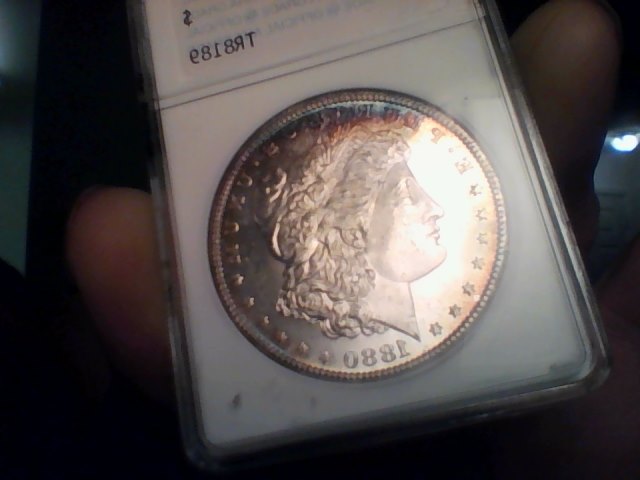
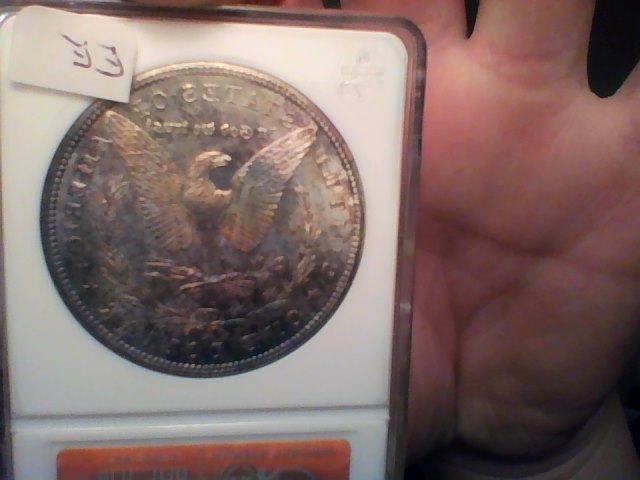
It looks like a nice coin, however I don't think the toning would add much of a premium.
|
|
Pillar of the Community
United States
7390 Posts |
Maybe a slight premium but nothing major. Good colors forming on the obverse just not enough and the reverse looks splotchy. The major premium rainbows are like my avatar or better. Whats the slab say?
|
|
Bedrock of the Community
Australia
21794 Posts |
Rainbow toning is just a form of surface corrosion that is so very slight, that a visually beautiful coin can be the result.
It must be remembered that rainbow toning is an unstable transitory state, and if that toning can be stopped dead in it's tracks, the beauty of the coin will remain.
I notice that this coin is slabbed.
Question:
Are there any slabs that are truly airtight, and are capable of stopping any further toning stone dead?
|
|
Pillar of the Community
Canada
4944 Posts |
Quote:
Question:
Are there any slabs that are truly airtight, and are capable of stopping any further toning stone dead? As far as I know, there are no TPG's that have fully airtight slabs. |
|
Bedrock of the Community
Australia
21794 Posts |
If there are no slabs suitable for the purpose, the only other approach I can think of is to spray the coins with 2 coats of acryllic laquer, allow to thoroughly dry, then enclose in an acryllic screw capsule.
If you wish to change your mind about the spray laquer, it is very easily removed with an acetone bath. The toning will then contine further, eventually to an even gray over a couple of decades or more, depending on the protection of the storage.
Just spraying the coins is no good. The acryllic layer can partially spall off, if exposed to even very slight rubbing. The capsule is needed. Without the capsule, patchy toning may be possible.
|
|
Pillar of the Community
United States
6478 Posts |
I disagree. You ruin coins with actone. Just let it tone naturally, don't try to supplement the coin.
|
|
Moderator
 United States
23522 Posts |
Quote:
I disagree. You ruin coins with actone. That's untrue, and I can't allow the spread of disinformation. Acetone is a benign organic solvent which is incapable of damaging metal. The only consideration aside safety when using acetone on a coin is whether you really want to remove what it removes, because sometimes removing a partial layer of crud leaves behind surfaces which look obviously cleaned. Every single raw coin I acquire gets an acetone washing the moment it enters my house, and I recommend that step for every collector. |
|
Pillar of the Community
United States
4433 Posts |
I basically agree with SsuperDdave on the acetone issue. That said, acetone can, in effect, dull the surface of some lustrous coins. Been there, done that, but the coins used were experimental and of little value.
|
|
Rest in Peace
United States
4078 Posts |
Quote:
You ruin coins with actone. False statement. SsuperDdave is correct. There has been a ton of discussions here about using acetone. Do some research. |
|
Moderator
United States
23522 Posts |
Quote:
That said, acetone can, in effect, dull the surface of some lustrous coins No, it can't. The laws of physics and chemistry do not allow. Something else had to be involved, because acetone affects luster as much as water does. It is physically impossible for acetone to alter the metal surface of a coin, with one exception: acetone is quite miscible, and in the presence of water vapor and bright light it is capable of affecting copper by forming acetic acid. This is not possible in the absence of light. |
|
Pillar of the Community
United States
7390 Posts |
Since we're on the topic SD what about acetone causing rainbow toning to dull almost muting the colors to a flat look?
|
|
Pillar of the Community
United States
4433 Posts |
SsuperDdave .... I witnessed a dulling effect on a silver half dollar. The coin was not rendered dull, per se, but the luster was dulled or lessened by the treatment. I can't recall if I used a 40% or a 90% half. Also, there was a similar lessening of luster witnessed on an uncirculated nickel. I do not know if the experimental coins had previously been dipped in another substance by a previous owner. Regardless, they were not as bright, following the acetone treatment.
|
|
Pillar of the Community
United States
937 Posts |
Do you use Acetone from the hardware store or some more pure type?
|
|
Moderator
United States
23522 Posts |
Quote:
SsuperDdave .... I witnessed a dulling effect on a silver half dollar. The coin was not rendered dull, per se, but the luster was dulled or lessened by the treatment. I can't recall if I used a 40% or a 90% half. Also, there was a similar lessening of luster witnessed on an uncirculated nickel. I do not know if the experimental coins had previously been dipped in another substance by a previous owner. Regardless, they were not as bright, following the acetone treatment. I don't doubt your experience, and trust your observations with the coin. You're hardly a rookie. On the other hand I know as scientific certainty that acetone is incapable of doing it. So this is of interest to me because it would seem something which acetone can remove was enhancing the true luster. You're not going to mistake polishing or clearcoat for luster. |
|
Pillar of the Community
United States
4433 Posts |
My acetone came from the hardware store. I funneled some into small bottles for ease of use. While I wouldn't use it on a coin like the OP has, I typically use it to remove contaminants from old copper and coins that appear to have PVC on the surface; especially so, the coins that come in mylar flips. I view this as a favorable conservation; especially so, as contaminants tend to settle well within the recessed counterstamps!
I'd be curious to see if anyone has an attractively toned, P-L Morgan, akin to the one the OP has, who would try the experiment of treating it with acetone? I'd not ...
|
| |
Replies: 18 / Views: 3,811 |






 Posted 03/22/2015 11:12 pm





