| Author |
 Replies: 15 / Views: 5,941 Replies: 15 / Views: 5,941 |
|
|
New Member
United States
15 Posts |
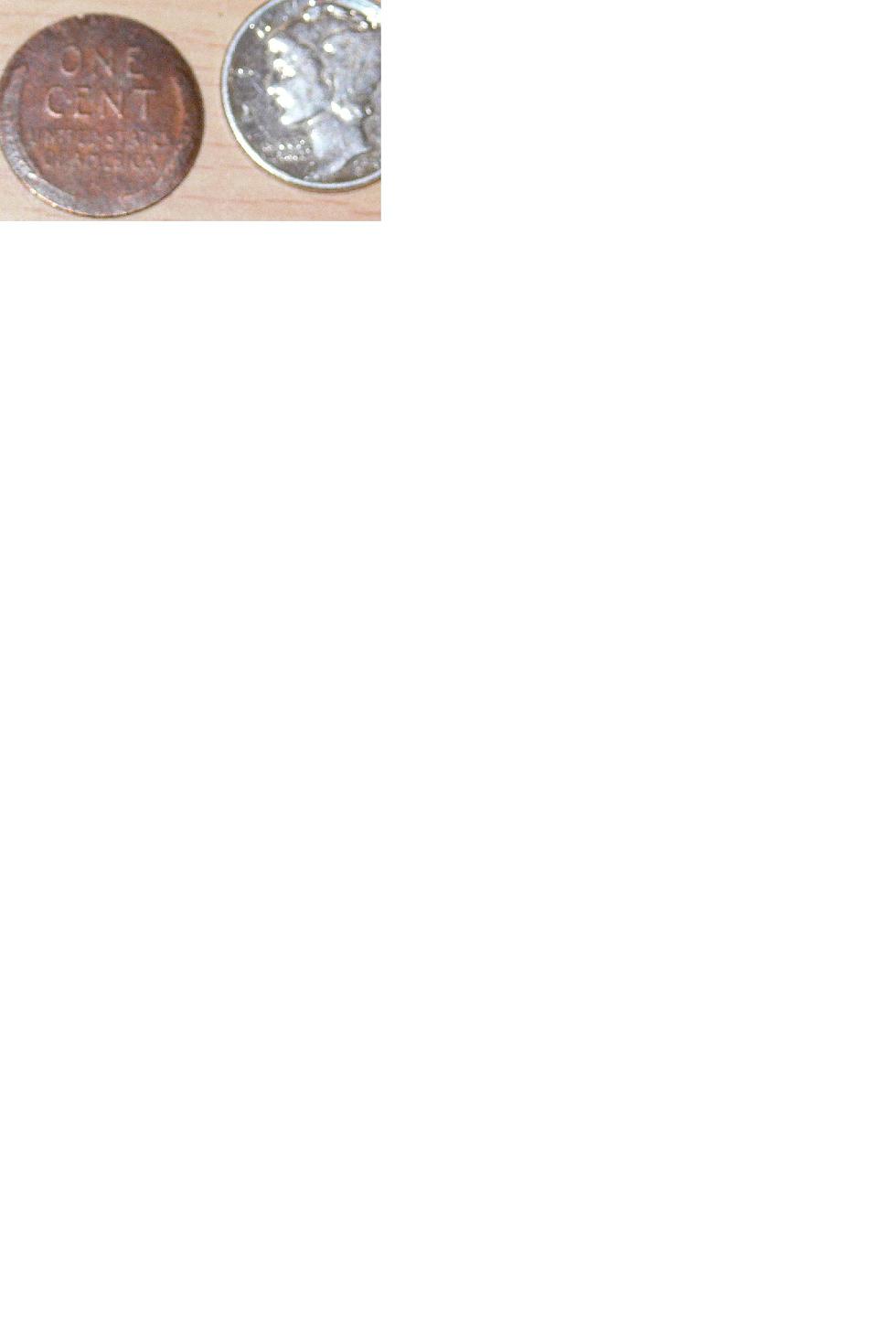
Hey Guys & Girls, Check out this 1944 Wheat , What do you think of the planchet ? Image:  obverse.jpg obverse.jpg62.33 KB Image: reverse.jpg39.86 KB Image: side.jpg34.64 KB |
|
|
|
Pillar of the Community
United States
673 Posts |
Interesting coin, I have no idea what is going on there. You can definitely see the thinness of the planchet, and it has no rim ...Hmmm... Trying to put combinations of planchet/dies in my head..nothing could work that I know of. For this to work I think it would have to be a copper dime or a clad cent, and with the thinness of the planchet I don't think it would strike up anyway. I would wait for an expert opinion though- I am no expert - but I got an opinion:
I am gonna have to say post mint, a close up of the edge of the coin would help to see any separation lines if it was sliced and glued or something of that sort. Very cool though !
|
|
New Member
 United States
15 Posts |
no seperation, it's too thin, under magnification it is solid, even with signs of silver? I'm stumped... But excited
|
|
Valued Member
United States
90 Posts |
Well, I'm in no way an expert on the minting process, but Here's something that popped into my mind... Copper is a relatively soft material, so it doesn't take as much to strike it as it would say, a silver coin. Is it possible, that the coin was some-how compressed in a dime dye machine, but with a Wheat penny dye... the extra force might push the material out, and give you a really thin coin... Just a thought. |
|
New Member
United States
15 Posts |
Mystery Solved ! This is the classic Acid-Coin, Worthless but cool looking
|
|
Pillar of the Community
United States
1713 Posts |
My grandfather also has a coin like this. However he keeps all his coins in a bank vault and he does not take them out very often. The next time he does, I'll make sure to get some pictures and update this topic. I did make a topic on my when I first joined up. Here's the link: http://www.coincommunity.com/forum/...PIC_ID=16794Knowing more about coins than I do now I should mention some details that I left out in the topic. Like yours mine was definitely a copper coin. Also like yours mine had details and was not worn smooth. Edited by arthrene
12/02/2007 11:05 am
|
|
Pillar of the Community
United States
5318 Posts |
Hmm...if that's a trace of mint luster I see, would an acid bath coin retain that feature? Similarly, if under microscopy this penny shows strike flow lines around the rim, it cannot be an acid coin. Obviously, the same goes for strike sharpness around the letters/date which I cannot discern by photo resolution. --Just my inexpert .02
Edited by KurtS
12/02/2007 3:05 pm
|
|
Pillar of the Community
United States
3507 Posts |
Absolutely an acid dipped coin. This is the classic example of how they look.
|
|
Bedrock of the Community
United States
62064 Posts |
OK, you might wonder why they would do that? Being from the 60's generation, I know why. They would do this to make a Cent the size of a dime. Why? In the 1960's you could buy a soda for Ten Cents out of a machine. Making the Cent thinner and smaller in diameter they could be used in a Pop machine to get a soda for 1 Cent. They would do this in chemistry class and didn't cost anything extra that way. If you look very close at the fields, they looked very rough and the rim is always missing. Details still show as the acid eats off evenly the surface. But that is why it was done.
|
|
Valued Member
United States
90 Posts |
Huh, how interesting... I've never heard of such a thing. I mean, I have a penny we hollowed out with acid in Chem class, but that was a modern penny, with a zinc core.
|
|
Pillar of the Community
United States
5318 Posts |
quote:
Details still show as the acid eats off evenly the surface. But that is why it was done.
I politely beg to differ. Consider how much thinner this planchet is, how much metal would need to be eaten away, combined with the fact that small features such as letters would be dissolved at a faster rate due to more surface area. Sharp corners would be removed. Of course, it's all theory in the absence of sharper photos. |
|
Bedrock of the Community
United States
62064 Posts |
Edited by coop
12/04/2007 5:51 pm
|
|
Pillar of the Community
United States
1713 Posts |
Acid dipping seems the more obvious solution, but is a thin planchet such as this one actually possible as a mint error? If so, what happens to cause it?
|
|
Valued Member
United States
346 Posts |
Aaahhh The ten cent coke. tasted a lot better in the bottle. even got Two Cents return on it after you finished it. so you spent one penny (altered:) and got Two Cents back on the bottle return along with a coke so that equaled a pretty good deal. hey, remember the old rotary pay phones that even had a penny slot along with the dime and nickel slots ? hey, good idea for a forum. how change was used in so many diff. ways years ago :) legally of course :):) in those "wild" man made machines. pay phones, coke, car wash, vacuums, etc. |
|
Pillar of the Community
United States
3507 Posts |
Arthrene,
Occasionally coins do get struck on planchets that came from a portion of metal strip that was rolled too thin or too thick.
So, on another coin , other than the one on the top of this thread, it is possible.
Acid dipping such as seen on the coin at the beginning of the thread and then in all the examples posted by Coop, show that wavy, fuzzy appearance. It is typical for that type of damage on a cent.
A coin struck on a thin planchet will appear weakly struck but will not have that wavy , bumpy, fuzzy look.
Between the veterans here, we've seen enough of them to identify them in our sleep, so to speak. That's why we know that the coin at the top of the thread is a classic example of an acid dipped cent.
Thanks,
Bill
|
|
Bedrock of the Community
United States
62064 Posts |
Remember Josh Tatum? Not the football player. But a notorious user of dishonest gain. Maybe you will get a nick name that still fits today? http://www.thegavel.net/2009.html |
| |
Replies: 15 / Views: 5,941 |
|







 obverse.jpg
 reverse.jpg
 side.jpg

 Posted 12/02/2007 12:36 am





