Paper Money Guaranty -
Due to an absence of a uniform currency, cotton merchants and planters of the Apalachicola/Chattahoochee River relied on banknotes of the region during the antebellum period.There are countless ways that banknotes can inform us about the past. The imagery used in the vignettes found on banknotes can often serve as poignant and powerful metaphors for significant social, cultural, and economic forces at work in the various spaces these agents of commerce circulated at certain points in time.
A particularly interesting tale could be told by the antebellum currency of the Apalachicola/Chattahoochee River valley. A complex story highlighting the unique ways in which economic and social systems of relatively isolated regions of the South during the antebellum period is indeed printed on the very banknotes themselves. Even a cursory examination of the banknotes issued in places such as Apalachicola, FL or Columbus, GA will reveal the crop underpinning and penetrating nearly every aspect of society in the Apalachicola/Chattahoochee River valley. That crop is - of course - cotton.
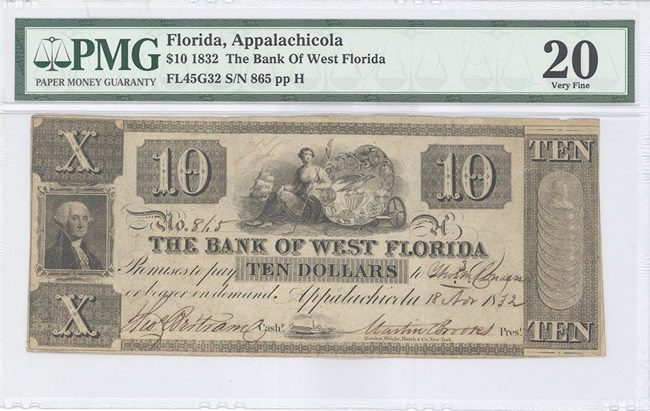
As a foundational element of the economy of the Lower South, cotton constituted the primary means through which most businessmen made a living. Given that communication using overland transportation was unreliable at best, often resulting in the isolation of entire geographic regions, major economies located on river systems typically thrived while simultaneously developing their own idiosyncrasies. In the case of the Apalachicola/Chattahoochee River valley, the cotton trade tempered economic and social development. Since the river system begins in Georgia, flows through Alabama and ultimately finds its terminus in Florida, these developments were fractured and complicated. Specifically, banking policy and regulation was a profound source of the unique character of the cotton economy on the Apalachicola & Chattahoochee Rivers.
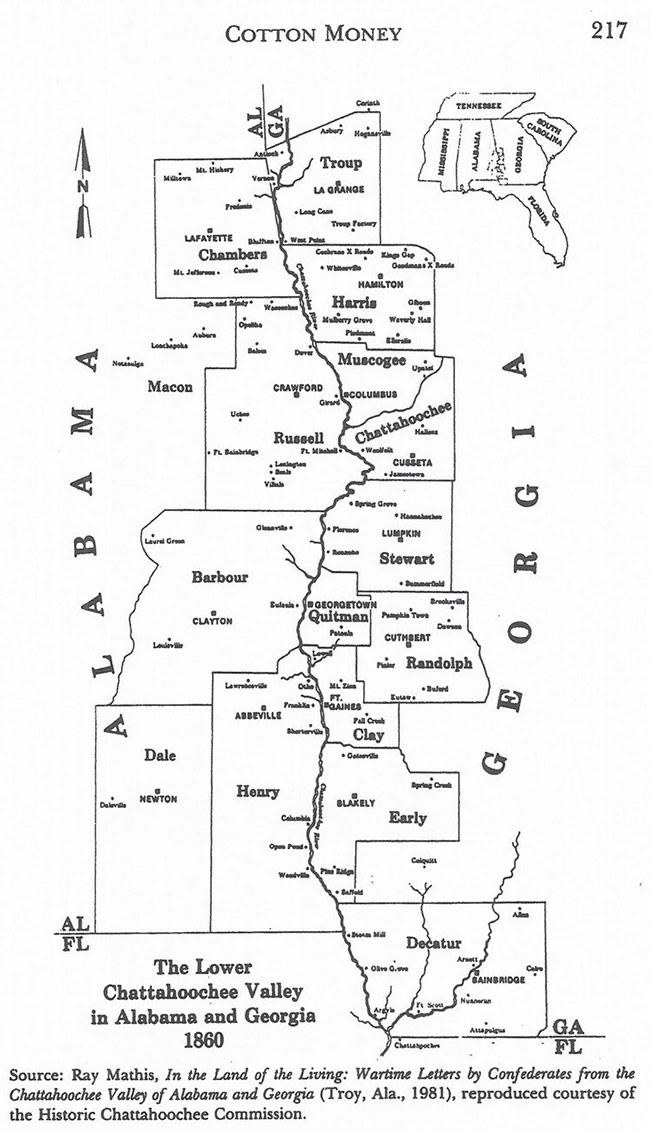
Due to the extremely volatile boom & bust cycle that developed during the antebellum period and the lack of a unified form of exchange provided by the federal government, local economies were reliant on an entirely fluid media of exchange. The currency of each region thus took on similarly distinctive qualities as the larger socio-economic systems in which it circulated. The Apalachicola/Chattahoochee River valley was no exception and consisted primarily of paper money supplemented by foreign and native coins.
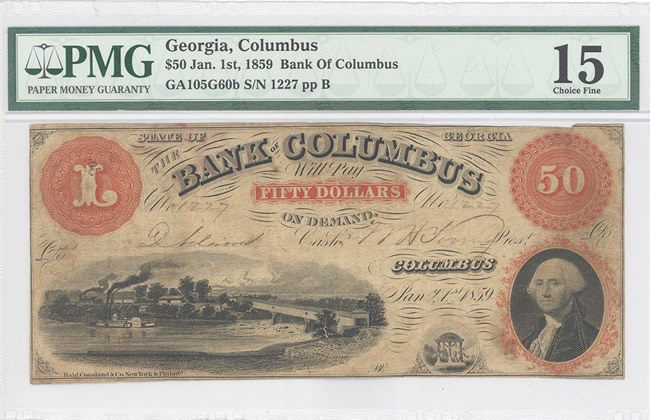
Although specie and scrip notes formed a portion of the region's currency, their scarcity and relatively low denominations respectively did not meet the demands of cotton merchants. Instead, a supply of notes issued by the banks of the valley was relied upon to grease the wheels of the cotton economy. As mentioned above, the river flowed through three states - each with its own set of banking regulations. As a result of this variegated regulation and the turbulent nature of the antebellum economy at large, the valley's currency was generally uneven and complicated. Additionally, banknotes often traded at a discount the further from the issuing bank a bearer attempted to use a note. These combined factors often led to frustrated relations between cotton merchants and planters. J.W. Sutlive, a merchant at Fort Gaines (the halfway point between Columbus and Apalachicola) voiced such frustration stating:
Managers of Steamboats on the Chattahoochee River, are desired to take notice, that any freight consigned to me, at Fort Gaines, will be paid in any money that is received at this place at par, without respect to its value in Columbus. Those boatmasters who will not accede to this, will not receive freight consigned to me, as I will not obligate to pay (what they call) bankable funds.
Given such complications and frustrations suggested above in addition to the absence of a uniform currency, cotton merchants and planters of the Apalachicola/Chattahoochee River were reliant on the banknotes of the region as much as was feasible but - just as often - they also relied upon promissory notes and a well-kept ledger.
In many ways the banknotes of the region during the antebellum period reveal the essential roles played by cotton and river travel in the economy which they circulated. However, much more than vignettes of cotton bales and steam boats, the banknotes of the Apalachicola & Chattahoochee River valley are artifacts of a system of exchange; physical reminders of a means of commerce and communication that no longer persist beyond tech's and foundations of the current state of affairs in the present. Much like the significance of cotton to the economy of this unique river valley, the antebellum banknotes of the Apalachicola & Chattahoochee Rivers should surely form an essential part of any broad-scoped collection of Southern obsolete currency.










 Posted 04/25/2015 09:15 am


