Stack's Bowers - World Coin of the Week, Struck in silver, this is the rare first variation of the "dragon in clouds" style with smaller more robust characters and blunt floral leaves. This type is referred to as the "ordinary obverse" as the characters resemble the later adopted standard design 1911 Empire Dollar. The Central Mint in Tientsin - operated by the Board of Revenue in Peking - was set to produce a standard currency system that would circulate throughout China, and replace the multiple provincial mints producing coinage. Unfortunately, China's administrative disorganization (as well as a lack of sufficient funds) inhibited the reforms from gaining traction. The provincial Viceroys who stood to lose wealth and influence fought these reforms for years. Despite this resistance, the Imperial Government attempted coinage reform multiple times, with the final attempt occurring mere months before the final collapse of the Imperial Regime to the Revolution of 1911.
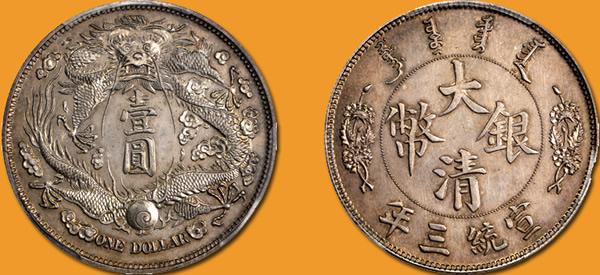
The design for this new coinage would share many elements with preceding Imperial and provincial coinage but would have many simplified elements meant to impart the message of continued Imperial authority throughout China. This was an important message as the reigning Emperor Hsuan Tung was only six years old at the time. This new coinage would bear an Imperial dragon (with five toes on each foot) much like its provincial forbears, but this dragon would dominate the entire face of the coin. The dragon glares out from 12 o'clock, its body wrapping and twisting throughout the periphery of the coin while in the center is the denomination of one Yuan essentially encircled and protected by the symbol of the Emperor. The inscription and legends also send a stripped down message of Qing sovereignty.
The reverse design contains the Chinese and Manchu legends expressing all of the necessary information for the piece. Between the outer crenulated border and the inner pearled ring the Manchu and Chinese characters form the outer legend. Four Manchu characters appear above, and four Chinese characters below which state: "Hsuen Tung, 3rd Year" (1911), and these sets of characters are separated by ornate floral sprays. This example contains raised veins on leaves closest to the central inscription. The central Chinese legend states: "Ta Ch'ing Yin Pi" meaning: Great Ch'ing (Dynasty) Silver Coin.
Read the Entire Article 









 Posted 04/29/2015 11:00 am


