



Coin Community Family of Web Sites Join Thousands of Coin, Bullion, & Money Collectors
Coin, Banknote and Medal Collectors's Online Mall Vancouvers #1 Coin and Paper Money Dealer 300,000 items to help build your collection! Royal Estate Auctions - $1 Coin AuctionsRoyal Canadian Mint products, Canadian, Polish, American, and world coins and banknotes. Specializing in Modern Numismatics Join Thousands of Coin, Bullion, & Money Collectors


Username:
Password:
Save Password
Forgot your Password?


This page may contain links that result in small commissions to keep this free site up and running.

Welcome Guest! Registering and/or logging in will remove the anchor (bottom) ads. It's Free!

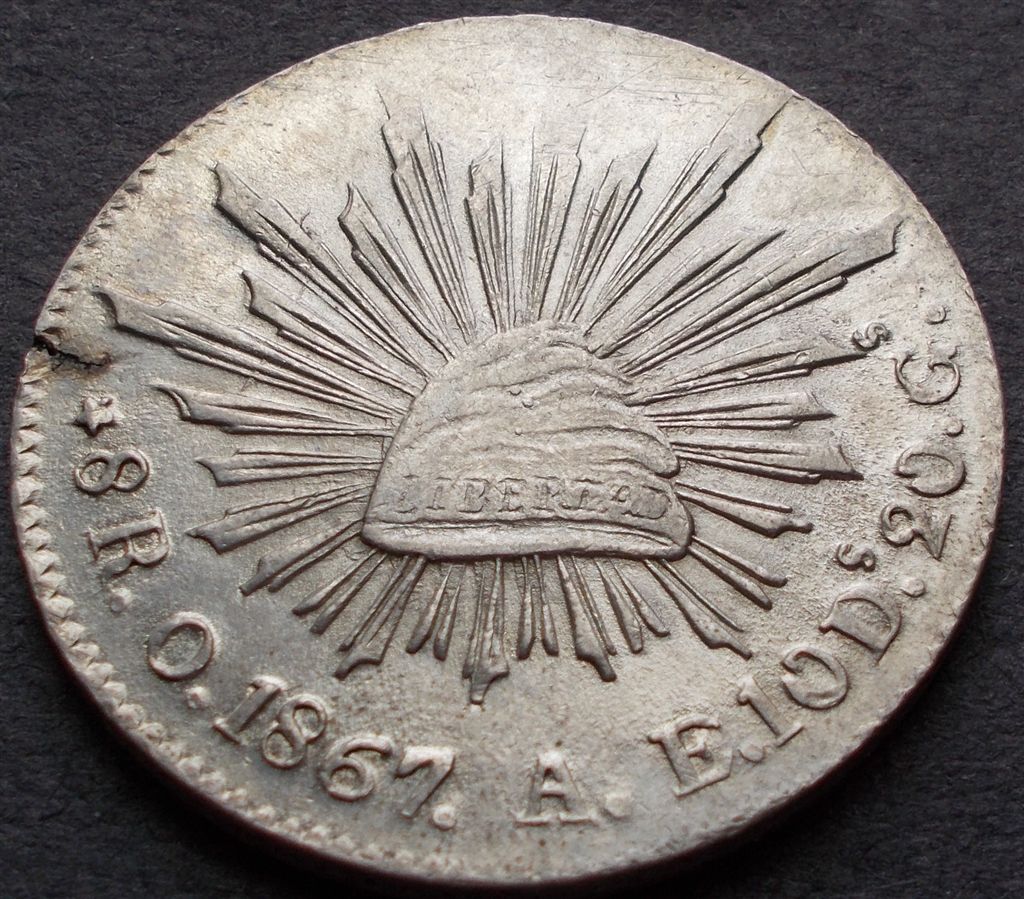
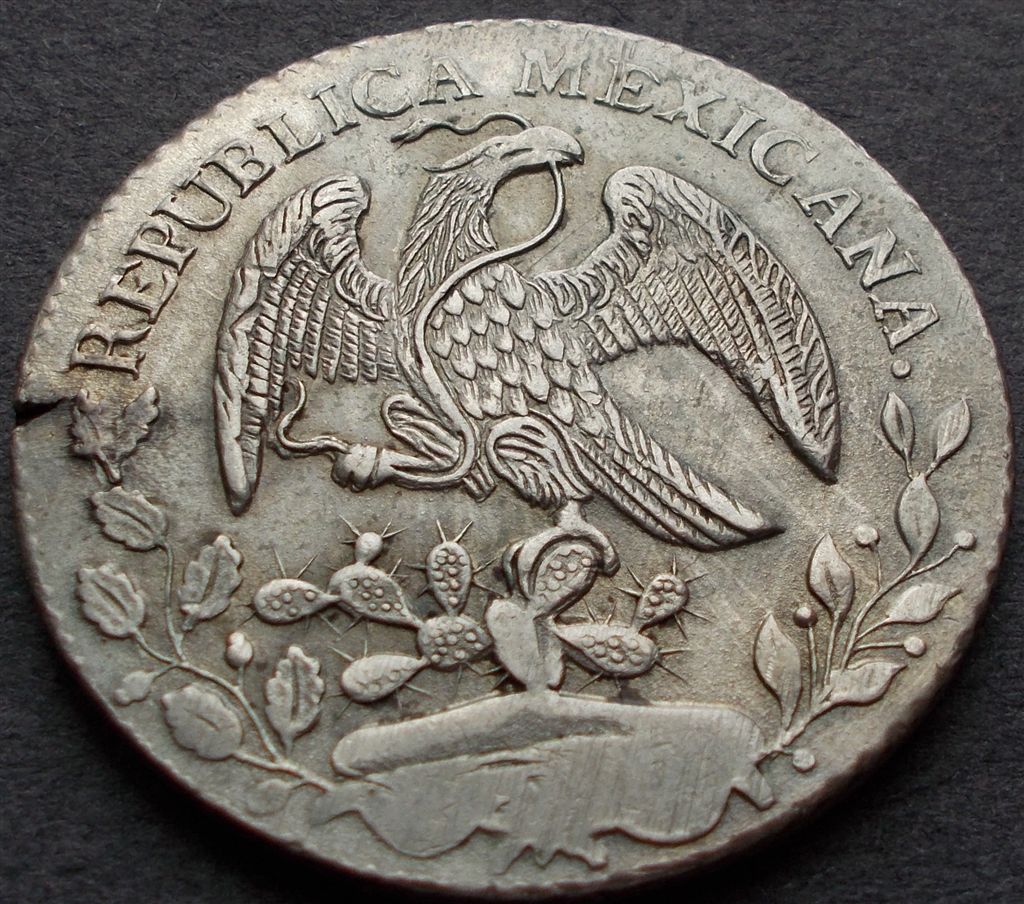
1867 O (Oaxaca) 8 Reales

To participate in the forum you must log in or register.
Author Previous TopicReplies: 5 / Views: 1,411Next Topic  
Pillar of the Community
Lucky Cuss's Avatar
United States
4883 Posts
 Posted 05/11/2015  6:12 pm Show Profile   Bookmark this topic Add Lucky Cuss to your friends list Get a Link to this Message Number of Subscribers
To quote Respandores regarding this date: "They were usually well struck on high quality planchets that seldom required the adjustment marks that are so characteristic of other Oaxaca issues."

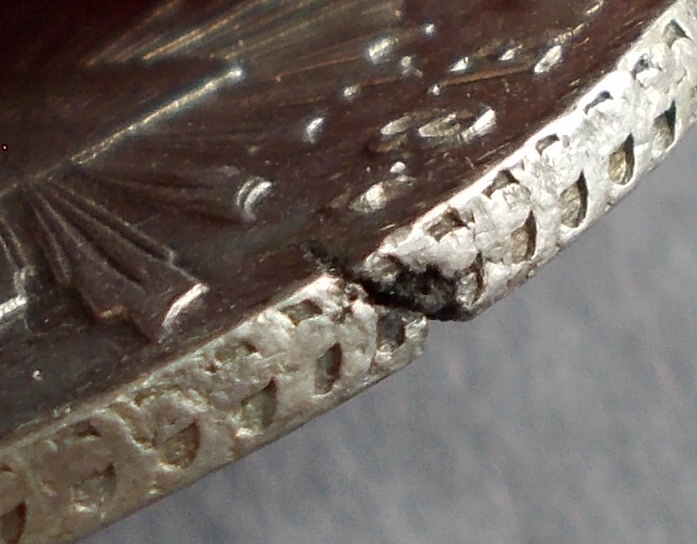
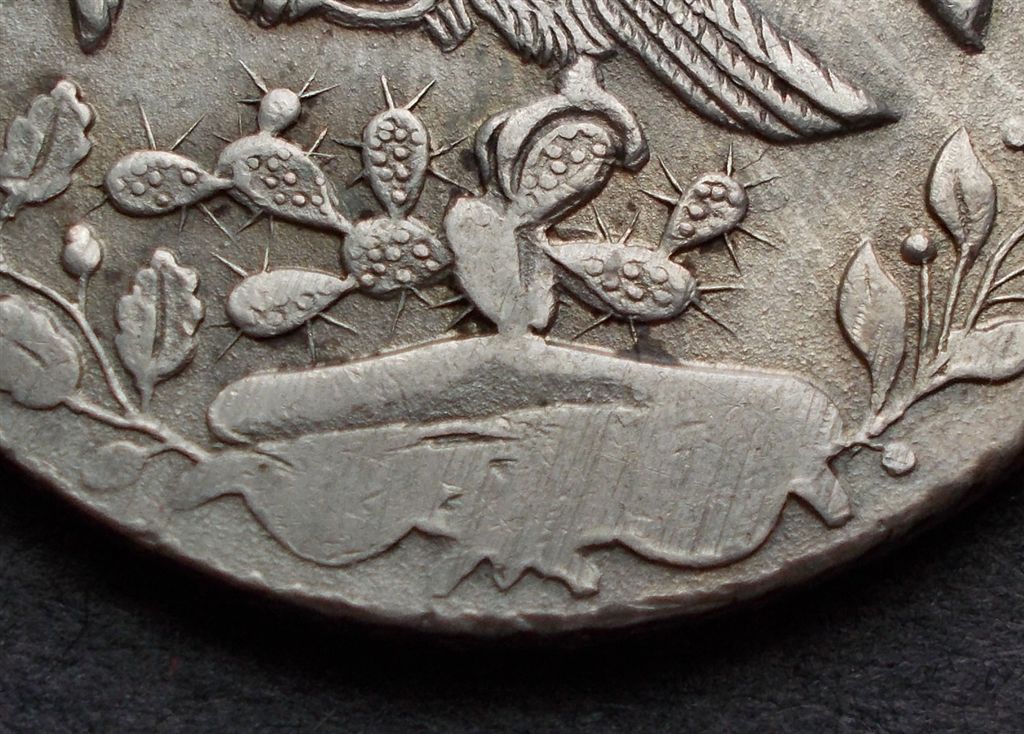
I'm not seeing those attributes with repect to this specimen. Besides the obvious flan flaw at the edge, since the weight is spot on at 27.07 grams, I'm puttong down the pronounced flatness below the eagle (as well as to other high points in general on that side) to its having been adjusted rather than to wear.

1867-O-Oaxaca-8-Reales

1867-O-Oaxaca-8-Reales

1867-O-Oaxaca-8-Reales

1867-O-Oaxaca-8-Reales
Colligo ergo sum
Edited by Lucky Cuss
05/12/2015 08:58 am
Pillar of the Community
Lucky Cuss's Avatar
United States
4883 Posts
 Posted 05/13/2015  11:27 am  Show Profile   Bookmark this reply Add Lucky Cuss to your friends list Get a Link to this Reply
Some additional thoughts with respect to this specimen. First, if it has been adjusted as I've suggested, why couldn't that have been done before rather than after going through the press? That would've made more sense. Second, I suppose the split at the edge, which I initially assessed as due to an imperfection in the planchet (as there appears to be some cavitation present), could also have been induced by expansion occurring during the striking process. Perhaps it's not a case of one or the other cause, that it came about owing to a combination of both factors?
Colligo ergo sum
Pillar of the Community
swamperbob's Avatar
United States
5362 Posts
 Posted 05/14/2015  12:33 am  Show Profile   Bookmark this reply Add swamperbob to your friends list Get a Link to this Reply
Adjustments were made before not after the strike. So eliminate adjustment as a cause of the edge weakness.

The coin has weakness at the extremities. The centers are very well struck up on both faces indicating full pressure (note the centering points on the cap and extremely clear breast feathers) - it is the edges where pressure did not develop adequately to fill the dies. The hill the cactus stand on lacks central detail becuase of lack of infill. So how can that happen?

There are two likely causes, improper grinding of the die camber or improper upsetting of the rim.

In the case of improperly cambered dies the distance between the dies when they impact the planchet vary. If the centers are too close only the center detail shows fully - if the edges are too close the edges will be strong and the center weak. This is not a really common situation but in some cases it is the only theory that makes any sense. I use it as a last resort because a failure to upset the edge properly is much more common.

The strike pressures are highest at the center of the die faces and pressure drops toward the edges. This loss of pressure is caused by no retaining collar. Metal flow goes in the direction of least resistance - outward between the dies and not up or down to fill the dies.

The fact that the edge of the planchet is upset by the addition of the design. This is the normal reason edge details come out well at all.

To determine if edging is the cause of the perimeter weakness I checked the edge design. It is very weakly impressed. This would lead to very little upsetting of the edge.

This leaves the edge weakness as most likely attributable to the edge being poorly applied. I once owned a MS 63 1860 Oaxaca that had equally weak perimeters and virtually no edge design at all.
Pillar of the Community
Lucky Cuss's Avatar
United States
4883 Posts
 Posted 05/14/2015  02:40 am  Show Profile   Bookmark this reply Add Lucky Cuss to your friends list Get a Link to this Reply
Thank you for the explanation. I was having a hard time getting a handle on just why this specimen presents as it does, and realized my initial interpretations were likely off base (hence my supplemental post). Is it wrong to suppose that the area where the mound & water design details are wholly lacking would represent what the planchet surface looked like prior to striking? If so, what do you make of the striations there (which originlly suggested adjustment to me) - are they simply an artifact of the process of rolling the silver into sheet form?
Colligo ergo sum
Edited by Lucky Cuss
05/14/2015 08:10 am
Pillar of the Community
swamperbob's Avatar
United States
5362 Posts
 Posted 05/14/2015  3:41 pm  Show Profile   Bookmark this reply Add swamperbob to your friends list Get a Link to this Reply
The striations that appear clearly on the unstruck portion of the hill and water are in fact features that were present on the planchet BEFORE the coin was struck. There is no doubt there at all because the area shows no real wear. A much fainter impression survives in some struck areas (like the edge of the hill where it meets the field. That sloping surface seems to retain at least some of the stria.

These stria could be from the rolling, lapping or adjustment phase of the creation of the blank. Not many folks even recognize that these marks actually represent the originl surface of the planchet let alone make the attempt to differentiate the root cause.

In my opinion - the majority should be simple adjustment marks. They are there because the adjusters filed the face of the blank to reduce weight. The reason is simple. Most are cut INTO the blank. In the laminating step the silver bar is drawn through a rectangular die to smooth the surfaces of the strip. Die damage would be in the form of nicks in the die which would produce RAISED stria not incuse stria on the silver strip. A nick with a "tail" would for a brief time create a double line part raised part incuse but these tails should wear off quickly because they would be very weak.

The rolling phase should not really leave long parallel lines on the strip - because the rollers act perpendicularly to the axis of the strip. I could see raised or incuse bumps or both but not long sctatches on the rollers.

So I think in most cases stria that are ALL incuse are due to adjustment and stria that are raised are due to lamination.
Pillar of the Community
Lucky Cuss's Avatar
United States
4883 Posts
 Posted 05/17/2015  4:11 pm  Show Profile   Bookmark this reply Add Lucky Cuss to your friends list Get a Link to this Reply
As much as I'm inclined to believe my specimen is technically in uncirculated condition, how I wish it looked more like this beautifully struck one:

http://www.coinfactswiki.com/wiki/M..._AE_8_reales

I guess I'll have to take consolation in mine being rather more interesting and a lot less expensive.
Colligo ergo sum
Edited by Lucky Cuss
05/17/2015 9:51 pm
  Previous TopicReplies: 5 / Views: 1,411Next Topic  

To participate in the forum you must log in or register.


Disclaimer: While a tremendous amount of effort goes into ensuring the accuracy of the information contained in this site, Coin Community assumes no liability for errors. Copyright 2005 - 2026 Coin Community Family- all rights reserved worldwide. Use of any images or content on this website without prior written permission of Coin Community or the original lender is strictly prohibited.
Contact Us  |  Advertise Here  |  Privacy Policy / Terms of Use

Coin Community Forum © 2005 - 2026 Coin Community Forums
It took 0.26 seconds to rattle this change. Forums