Heritage Auctions - Operating in a coinage capacity in 1852 and 1855, Wass, Molitor & Company produced gold coins of an extremely high intrinsic value, consistently the highest of any private gold issues struck during the Gold Rush period. This factor aided in the firm's ability to compete with the United States Assay Office, notwithstanding the fact that Wass, Molitor & Company also paid off their depositors significantly sooner than did the government office (two days versus eight days).
Samuel Wass and Agoston Molitor were well-educated in the trades of mining, assaying, melting, and refining, having been highly trained in such things in Hungary before being exiled to California during their country's war for independence, and their refining and assaying equipment, procured from the United States and London, was of the highest quality. Wass, Molitor & Company initially started simply as an assay office, but a shortage of small denomination gold coins in 1851 ultimately prompted the firm to acquire coinage dies and begin filling this void in early 1852. Wass, Molitor & Company's gold pieces were of slightly inferior fineness compared to those of the U.S. Assay Office, which also began producing small denominations during this period, but they were also slightly heavier overall, with the result that these private issues could easily compete with their federal rivals.
Most private coinage operations in the San Francisco region were dissolved after the San Francisco Mint became operational in April 1854, even those of the United States Assay Office, which was intended to exist in a provisional capacity only until the federal branch mint could take over. However, steady coinage at the new federal facility was periodically interrupted in 1854 and 1855 by shortages of the refining acids needed to work gold dust and copper alloy into coinable metal. This was a problem for bankers and gold interests who were deeply involved in the fast-moving cash-flow business of the period. To alleviate tensions, in 1855, Wass, Molitor & Company produced a brief issuance of ten, twenty, and fifty dollar gold pieces which were readily accepted by the banking sector and were tradable on par with the federal issues when their steady coinage was later resumed. Today, all of these issues are rare, with the ten dollar piece being extremely so.
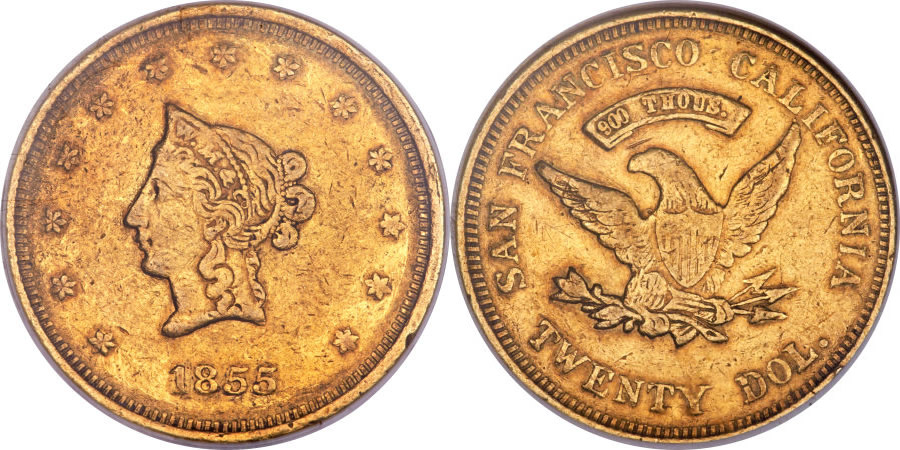
The Wass, Molitor & Company twenty dollar gold piece of 1855 was produced in two different types, differentiated by the size of the obverse Liberty Head portrait. The Large Head variety, similar in appearance to the federal double eagle, is almost uncollectible today, although the Small Head variant can be obtained with patience. Our current July 9 - 12 Summer FUN
US coins Signature Auction features one such example, graded AU53 by NGC.
This example shows light, consistent wear, with the usual array of scattered abrasions that is characteristic of private gold issues from this period and region. The surfaces are olive-gold in color and there are no significant distractions. Weakness on the eagle's feathers is seen on all examples of this issue, and should not be mistaken for wear. Overall, this is a highly appealing example of one of the final gold issues produced by one of the most successful Gold Rush-era private coiners.








 Posted 06/22/2015 11:42 am


