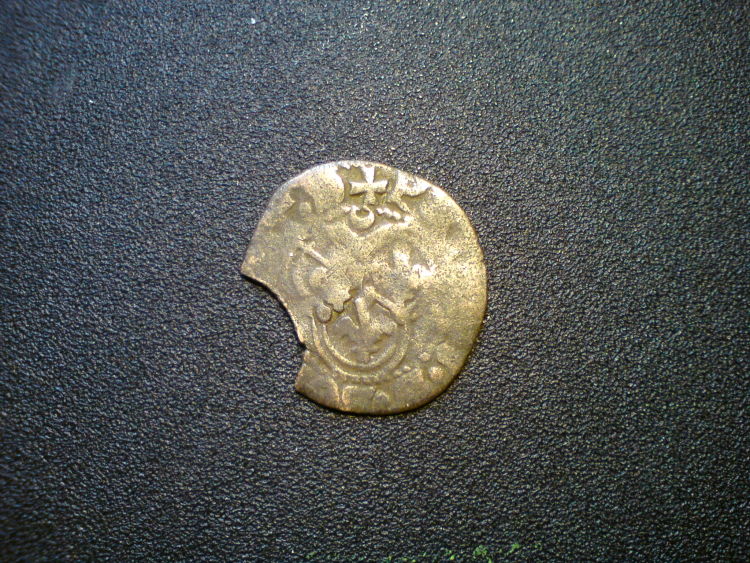
Do you see how these aren't just the three fleurs-de-lys of the French arms? Your first pic is the obverse, and the cross at the right of your photo is the top of the coin. There is a diagonal bar running across the fleurs-de-lys. In heraldry, this is called a mark of cadency (a "brisure" in French), in this case, a baton or bendlet. It differences the arms of the Dukes of Bourbon from the royal arms of France.
The legend ends to the left of the small cross with the letters T D. This is the abbreviation of the Latin "Trevolcii Dominus," meaning "lord of Trevoux." This is a blanc, or double tournois, of the Dombes, a principality in southeastern France, once held by the House of Bourbon, with Trevoux as the principal city.
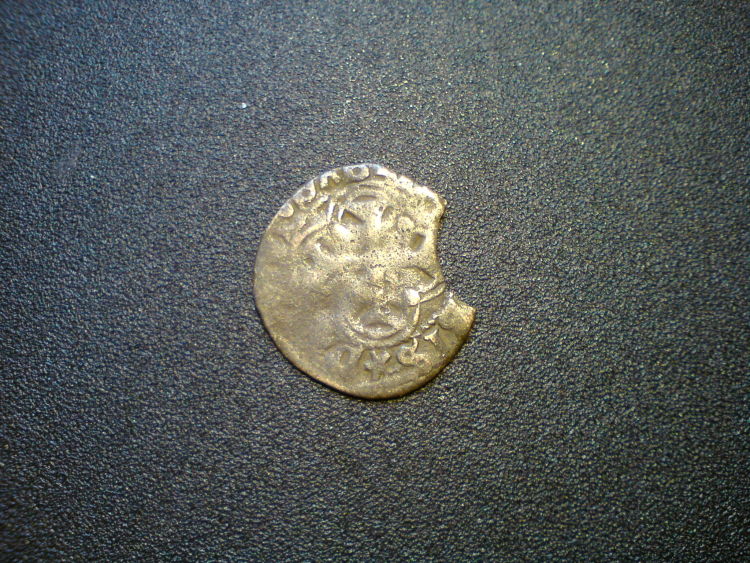
The legend on the reverse begins with D-- and ends with--BIS. The full legend should be DATE ET DABITVR VOBIS, from Luke 6:38; "Give, and it shall be given unto you." This legend, with the three obverse fleurs-de-lys within a trilobe, was introduced on coins minted in the name of Jean II, Duke of Bourbon. However, the first letter in the obverse legend is clearly a P. In 1483, control of the Dombes passed from Jean II to his younger brother Pierre, and in 1488, on the death of Jean, he became Pierre II, Duke of Bourbon in his own right. I believe the name here is PETRVS. Prior to 1488, Pierre minted the following coins under the title of Count of Clermont, but I'm not sure if the legend on yours might read D BORBONI, or DVX BORBONI, for a post-1488 issue, with Pierre as Duke.
http://www.cgb.fr/trevoux-seigneuri..._0441,a.html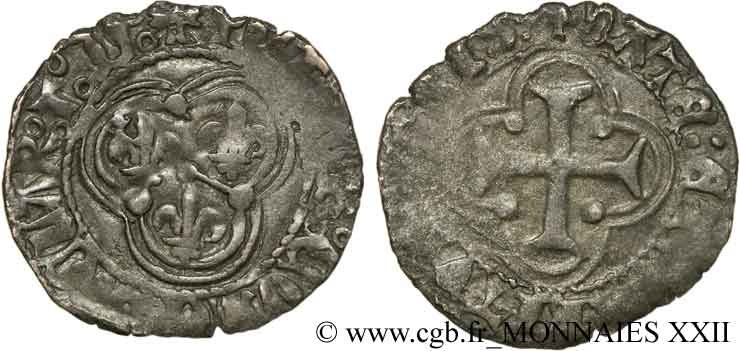












 Posted 07/06/2015 09:41 am


