| Author |
 Replies: 32 / Views: 9,984 Replies: 32 / Views: 9,984 |
|
|
|
Valued Member
United States
144 Posts |
Thanks, CM. First nickel I've seen with PIDT. Gonna look for it from now on. :)
|
|
Pillar of the Community
United States
5964 Posts |
|
|
Bedrock of the Community
United States
62064 Posts |
I added the 1957-D to my PIDT images. 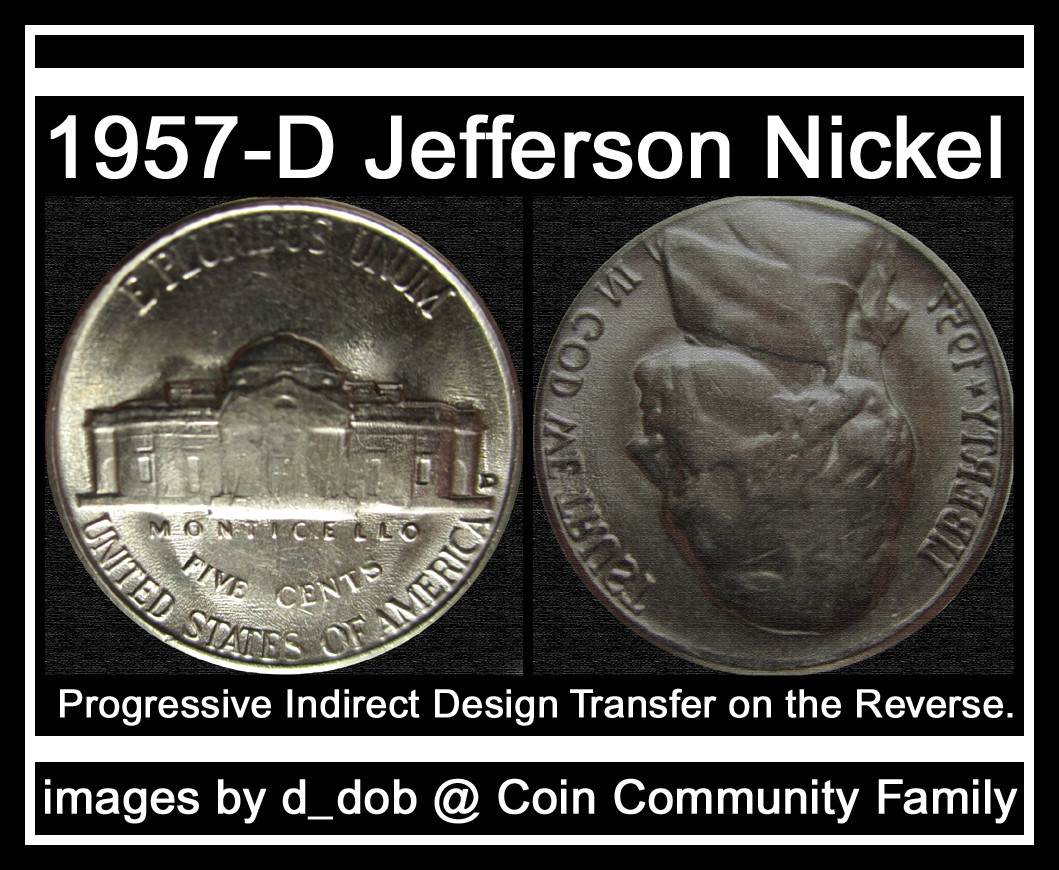 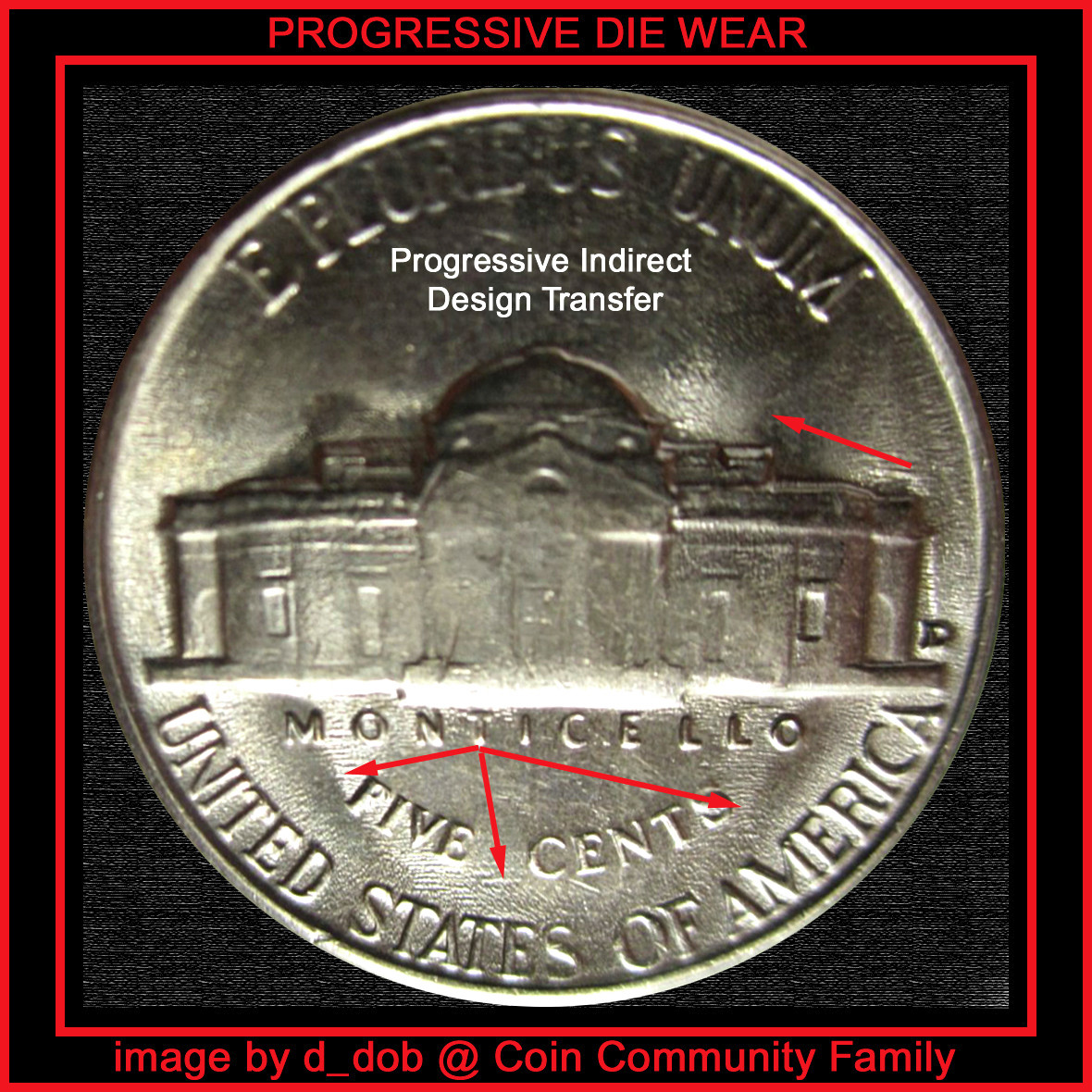 I didn't have examples of the nickel yet. |
|
Pillar of the Community
United States
1781 Posts |
Here is an example of "Ghosting" on a 1947-S Lincoln Cent or what the late Alan Herbert coined Internal Metal Displacement Phenomenon or Heavy Die transfer. The description can be found in the CONECA Glossary of Error-Variety Terms ( http://conecaonline.org/content/glossary.html)as follows: "Heavy die transfer - When a die nears the end of its usefulness, often it exhibits the major central design of its opposing mate. This design is transferred from one die to the other through the striking of the coin metal. Alan Herbert gives this illustration: "The best example I can offer of this phenomenon is the toy which you've all seen which has five or six metal balls hanging in a row, touching each other. When you pull back the end ball and allow it to strike the row, it causes the ball at the far end to swing away from its neighbor. The same thing occurs with design transfer, the outline of the design being transferred from one die to the other." (Alan Herbert, Minting Varieties and Errors, fifth edition, New York: House of Collectibles, 1991, page 158). This variety is fairly common on the early wheat cents. It is often called the "ghost of Lincoln." The technical term for this is IMPD (Internal Metal Displacement Phenomenon)."
 |
|
Pillar of the Community
United States
3362 Posts |
Thanks for those images, Ken! Are you (or is anyone) aware of instances where this ghosting appears on the Obverse?
|
|
Bedrock of the Community
United States
62064 Posts |
The wheat cents design are not strong enough to create this. It is usually the bust that creates this. But we might watch for the Shield cents to see if it tranfers there. The dies are rotated to the opposite position that was used before. (now the obverse is the anvil die and the reverse is now the hammer die) So looking for these on the obverse is where we should be looking now. (same for MAD coins now also)
|
|
Pillar of the Community
United States
3362 Posts |
Quote:
the obverse is the anvil die and the reverse is now the hammer die Is there a list somewhere for US Mint coins which gives this information? |
|
Valued Member
United States
144 Posts |
I have a few lincoln cents with PIDT on obverse. You can see the outline of the memorial building from reverse there. 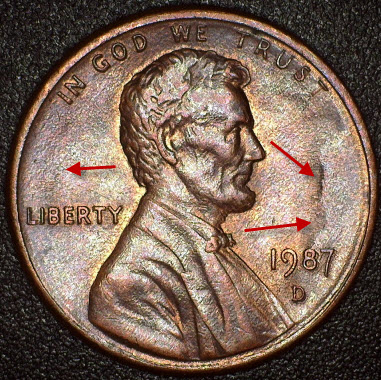 |
|
Bedrock of the Community
United States
62064 Posts |
Here is an overlay: 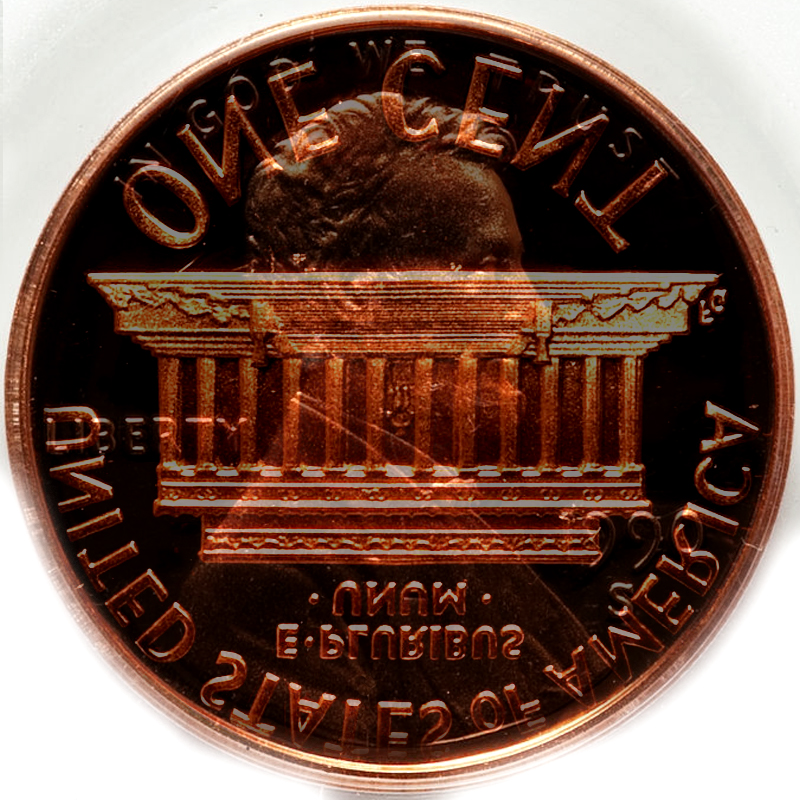 Looks like what we have been seeing and didn't know why it appear on the obverse. Edited by coop
08/18/2015 1:57 pm
|
|
Valued Member
United States
144 Posts |
Thanks for that overlay supplement, Coop. My only guess is that this PIDT is limited to one die set to this particular year and mint. I have a a few of these 87-Ds but not on other years. The die was just getting really tired. The area where the upper right arrow points to is extremely worn and about ready to crumble or break away.
Edited by profiler
08/18/2015 2:07 pm
|
|
Pillar of the Community
United States
3362 Posts |
Thanks for the image, profiler! That answers my question!  |
|
Bedrock of the Community
United States
12437 Posts |
Quote:
I guess that it is considered an error? No, a coin exhibiting late stage die wear should not be considered an error as the Mint routinely tries to get as many strikes as is practical from a die pair. Most dies will strike a few hundred thousand coins before retirement and tens of thousands of those coins will be LDS/VLDS. Multiply that by the several thousand die pairs used during an annual mintage run and you can see that LDS/VLDS coins are quite common. |
|
Valued Member
 United States
193 Posts |
coop, I'm extremely honored that you used my images as an example! Thanks you!
|
|
Bedrock of the Community
United States
62064 Posts |
 It was the first nickel one I've seen posted. So I just had to keep those images. |
|
Valued Member
United States
144 Posts |
It was the first time I'd seen PIDT on a nickel, as well. They are seen far less frequently because the nickel planchet is much thicker and harder material than copper cents. All in all, nice find.
|
| |
Replies: 32 / Views: 9,984 |







 First Page


 Posted 08/17/2015 9:59 pm





