| Author |
 Replies: 11 / Views: 2,392 Replies: 11 / Views: 2,392 |
|
|
Pillar of the Community
United Kingdom
2624 Posts |
The batch of three coins I recently bought have not much in common except that I wanted to share the postage and buy from a single dealer. This coin I bought for the singular reason that it has a galley on the reverse. That it has some eye appeal and a cheap price tag also have their part to play. 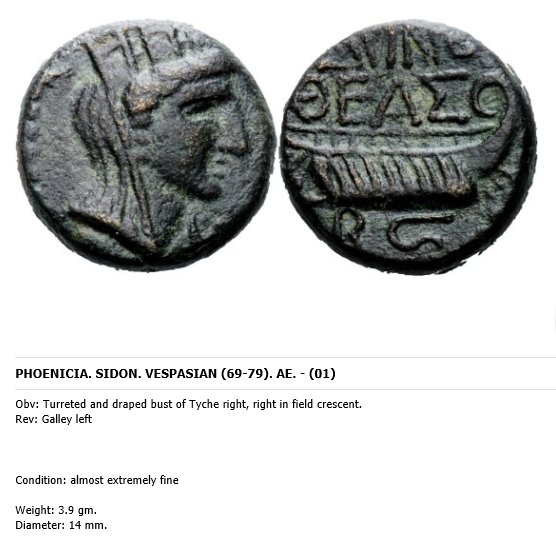 Does this coin belong with my Greek coins or my Roman ones, it looks Greek but was minted under Vespasian? Looking for more information on it I found this one 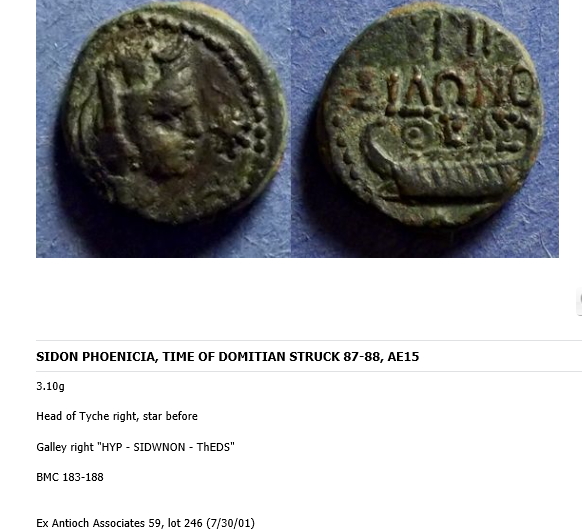 Which is a similar type with a bit more of the reverse legend showing. My coin shares the same words? Can anyone translate? The middle word is probably Sidon - but what do the other two mean? Also I wonder what unit of currency it represents. Edited by DavidUK
08/23/2015 04:24 am
|
|
|
|
Pillar of the Community
Spain
629 Posts |
Under the roman empire, the east continued striking their own coinage in parallel with the imperial denarius, sestertius, asses etc...
This was done to show some kind of "independence" in the ancient greek cities now under the rule of Roma.
All these coinages are usually called "Greek Imperial coins"
|
|
Pillar of the Community
United States
3496 Posts |
Under the Imperial system of government local government was always the preferred method of rule. As long as the taxes got collected and the locals refrained from chest thumping the Romans were happy to have Kings and local magistrates take care of things like fixing pot holes collecting garbage and supplying the locals with mostly bronze coins for the market place. Antioch minted silver but they were rather the exception. Direct rule was reserved for very important places like Egypt or troublesome places like Judea (one headache after another).
Roman imperial coinage is believed to have been primarily used to pay the troops which even at the height of the military never accounted for more than approximately 5% of the population and the great armaments operations which supplied the legions with swords and shields etc. Money spent by the soldiers on everything from haircuts wine and ........ entertainments (ahem) would have been insufficient to supply all the areas outside of heavily populated large cities.
Local currency filled up the needs of the local market place and no doubt was used to pay the local government employees.
The two currencies must have circulated side by side. In the Bible you have the story of the widow's mite and also the tribute penny (denarius of Tiberius). Likewise the story of the money changers outside the temple whom Jesus failed to appreciate. Money used inside the holy temple precinct could not bear graven images ! So it was necessary for the visitor to exchange that nasty silver with the face of Tiberius for the locally approved coins of Judea. Apparently the business was quite profitable.
|
|
Pillar of the Community
 United Kingdom
2624 Posts |
Interesting stuff.
And can anyone give me a catalogue number for my little coin? It looks like it could be BMC 179 judging from wildwinds page, but I wonder about these shapes underneath the galley.
|
|
Moderator
 United States
23731 Posts |
Two very nice coins. I also like Galley type coins but sadly only have one. It's interesting that the Phoenician galley's don't show sails, but the Roman ones do. 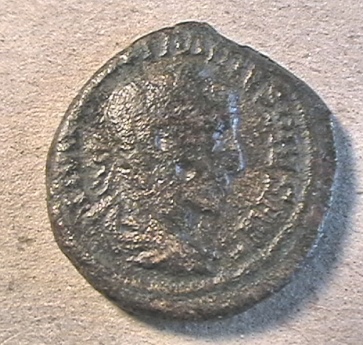 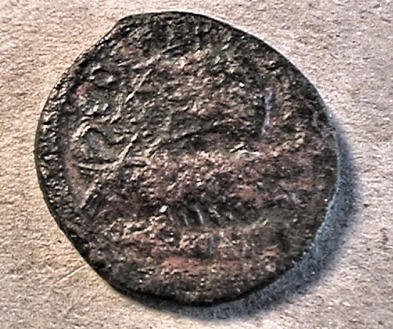 Maxininus I Deultum, Thrace. |
|
Pillar of the Community
United States
7067 Posts |
David, Here's one with the same devices below the galley, found at http://rosenblumcoins.com/38d (number 55 on that page). Description reads, "c.70 AD. AE15 (2.92) . Hd of Tyche right, LX countermark on cheek/War Galley left. Coin of Sidon. Barak Group IV, on BMC-180. VF. I can't recall offering this coin before. $200 [image]" 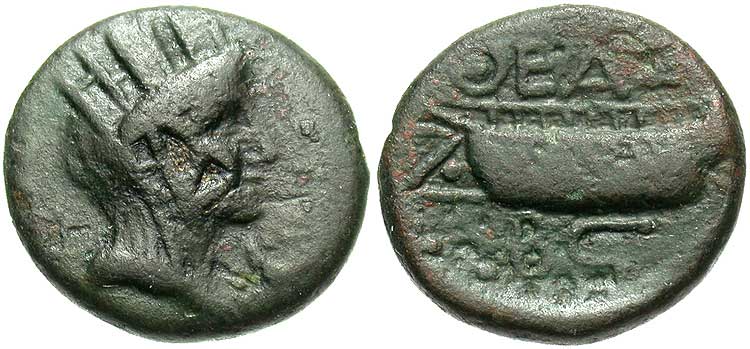 |
|
Pillar of the Community
United Kingdom
2624 Posts |
Thanks Bob, you keep coming to my rescue ^^ BMC180... I wasn't far out :)
Good to see that my coin which is in better shape was also considerably cheaper.
|
|
Pillar of the Community
Australia
1006 Posts |
|
|
Pillar of the Community
United States
5010 Posts |
not much to add but nice coin DUK, the galley is great. a coin of this type is on my list.
when I've already payed for shipping on one coin, I always look and see if there is something else I can throw in there from the same seller.
i picked up three coins recently with the same thing in common!
|
|
Pillar of the Community
United States
949 Posts |
The lettering on your coin immediately above and below the galley form a single word. The broad looping character in the bottom row is a final sigma. The curve to the right of the internal sigma just above the galley is part of the tail of the ship. The word in question appears to be TH-E-A-S // OS, which is the genitive feminine singular reading "of the Goddess" which was a term commonly used in reference to things "belonging to" the goddess , presumably the goddess depicted on the obverse, Tyche (Fortune), who appears frequently on city coins of the Hellenistic period. The markings above all this are too incomplete for me to make out. While I am inclined to suppose a word that may be a reference to the city name, it does not appear to have all the forms of the lettering for that as we see it on the coin example DavidUK found. S-I-D-O-N-Omicron. Nonetheless, there it is immediately above the same possessive Quote:
Likewise the story of the money changers outside the temple whom Jesus failed to appreciate. Money used inside the holy temple precinct could not bear graven images ! So it was necessary for the visitor to exchange that nasty silver with the face of Tiberius for the locally approved coins of Judea. Apparently the business was quite profitable.
Two comments on this. 1. The prohibition of graven images on coins was an aspect of Jewish devotion to the Jewish second commandment which forbade graven images. Most ancient coins had images, but Greek coins in particular featured images of deities. In principle they were all forbidden and needed to be exchanged for temple currency which alone was acceptable for use within the Temple precinct. One notable exception to this was the Tyrian didrachm (Shekel of Tyre) which bore an image of Melqart. These were approved due to the fineness of their silver. This inconsistency was not lost on the more conservative Jews, such as the Pharisees, who conflicted with the Sadducees on such things. Jesus was more akin to the Pharisees with regard to this aspect of Sadduceic business. Hence: 2. the outburst against the moneychangers and sellers of offerings was certainly not a failure to appreciate the need for someone to do what they did, but rather reflected the revulsion to the ways the Sadducees twisted the law to their own advantage. Historians have asserted that the moneychangers were not outside the Temple as Jesus and traditional Law would have them, but rather had set up shop in the outer levels of the Court of the Gentiles - which some did not regard as truly Temple precincts at the time, though it was provided for in the Law and was on Temple property. In terms of final authority, the Sadducees oversaw the entire operation. Jesus would have none of the self-serving business practices adopted by the Priesthood, even if the profits were going to the Temple. His outburst directly contributed to the sentence against him inasmuch as it was an outrageous public criticism of the very group that would ultimately try him. As they would have seen it, he was a loose cannon they didn't need. Edited by lrbguy
08/25/2015 07:58 am
|
|
Pillar of the Community
United Kingdom
2624 Posts |
Interesting information... thanks for taking the time to share that with us.
|
|
Pillar of the Community
United Kingdom
2624 Posts |
Sadly been refunded the amount of this coin and told it is not available anymore.
It's the first time such a thing has happened to me and I wonder exactly what the circumstances were, but the long and short is this one won't be joining my collection.
|
| |
Replies: 11 / Views: 2,392 |
|










 Posted 08/23/2015 11:26 am


