Continuing my series of topics on dollar tokens from various Albertan municipalities, we arrive at Peace River, a town of 6,729 in the province's far northern reaches. No points for guessing which waterway the town sits on the banks of.
As previously touched on in Grande Prairie's thread, the Peace River's drainage basin is unusually fertile and the "Peace River Country" (straddling northern Alberta and B.C.) is the furthest north grain-producing region in the world. The first Europeans to show up in the Peace River area were the fur traders, but real settlement only began in 1886 with the establishment of the Anglican Church's mission. What turned Peace River into a town was the arrival of the railway in 1910.
The town issued only four trade tokens. One was produced in brass during the period of Centennial-mania in 1967, and the other three are typical nickel Sherritt Mint tokens produced in the late 1970s. It is a short set to complete, but the 1967 issue is somewhat elusive.
All four issues depict 12-Foot Davis, who was born in Vermont, a state that seems to consistently turn out real characters. 12-Foot Davis, born Henry Fuller Davis, was not particularly tall - rather, his name comes from the way in which he found his wealth during the Cariboo Gold Rush in British Columbia. Walking through the gold fields, presumably with some kind of surveying equipment in hand, he discovered two adjacent claims that were both 6 feet wider than regulations permitted. So he staked his own 12-foot claim between them, and found $30,000 worth of gold in it ($30,000 in 1800s dollars!!). All this money was invested in a trading post in Peace River (before the railway came), where he became one of those friendly local personalities - friend to men in need, door was never locked, rugged but kindly, probably drank a lot, etc. His grave sits on top of a hill overlooking the town.
Interestingly, the Peace River area actually did relatively well during the Great Depression. It was one of the last areas in North America to have good farmland that was still unclaimed, and many farmers fleeing their dried-up homesteads in the southern badlands went to the Peace Country, which was entirely unaffected by the Dust Bowl (but still affected by the economic Depression). Because the Peace Country was settled late and has always been fairly remote, numerous cohesive minority communities exist in the area around Peace River, including Francophone Falher (which has issued one trade token), and the Low-German-speaking Mennonites and Hutterites (a semi-obscure and communal sect found mostly in Alberta - they are known for running huge farming operations and showing up at provincial tourist attractions in their 1800s-style outfits). If you truly believe that the global collapse of society is coming any day now, you'd better start learning medieval Low German so that you can join the Hutterites.

The 1967 issue is pretty clear - there's 12-Foot Davis, there's the logo of Canada's Centennial, and there's Peace River's nice coat of arms, featuring two moose and a Canada goose. This token was struck by Universal Emblems, a long-defunct company that I don't know much about. U.E. produced brass tokens and was especially active during Canada's centennial, producing tokens for many municipalities (many of which would never issue tokens ever again due to their general insignificance - some, like Strome/Wavy Lake, had populations under 1,000).

The 1976 issue is also pretty clear and simple - in fact, it depicts the exact same things as the 1967 token, but without the Centennial logo. I think the difference between the overall quality of the 1967 and 1976 tokens (especially looking at '67 Davis' cartoonish face) illustrate why the Sherritt Mint quickly became Canada's dominant private mint.

The 1977 issue depicted a nice landscape - here's the river, a bridge, and a grain elevator. Too bad that my example of this year is a bit dirty.

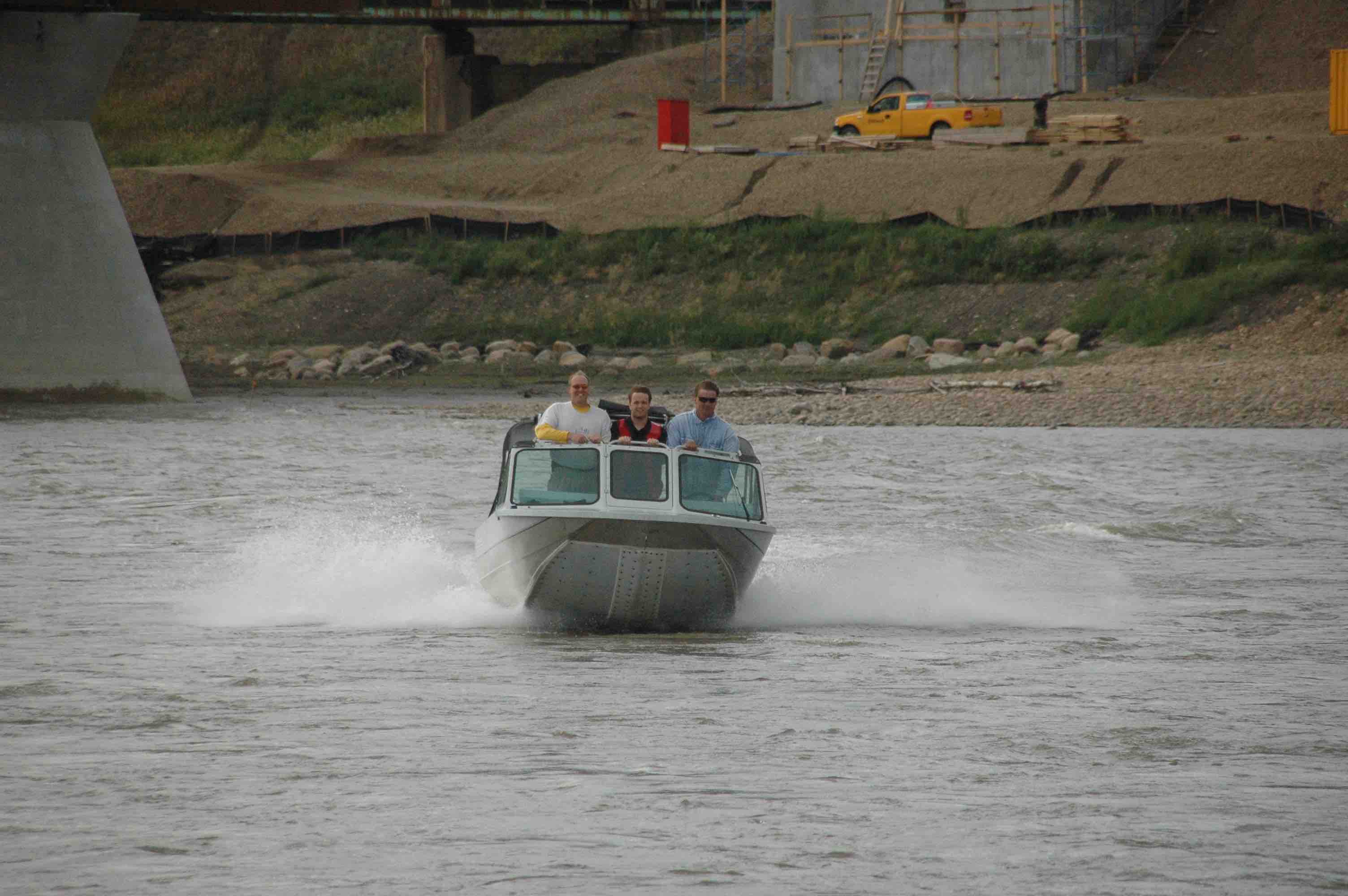
The final issue in 1978 showed a boat on the Smoky River, a tributary of the Peace. The Smoky River is just one of our province's great but useless rivers - wide, shallow, and too remote to do anything with. I can tell you that there are a lot of speedboats in Alberta, especially sitting in people's suburban driveways. The province is landlocked, but don't tell anyone that! Grande Cache, mentioned in the design, issued only two tokens - that's for another thread.
Unusually, no silver or gold tokens were ever struck from the same dies (silver tokens would be sold at-cost while gold tokens would be presented to the mayor, the MLA, the MP, etc.), so once you have all four Peace River tokens, you have truly assembled a complete set.






 Posted 09/13/2015 1:37 pm