NGC - Coins produced by the three of the largest ancient civilizations offer a range of historical and artistic inspiration.
Many different types of coinage fall under the encompassing umbrella of 'ancient coins'. The three main cultural units, however, are Greece, Rome and Byzantium. These civilizations produced the greatest number of ancient coins, with each having its own, individual charm.
To limit the choice to just Greek, Roman and Byzantine, of course, is to bypass the many other civilizations that issued coins - Celts, Scythians, Etruscans, Persians, Phoenicians, Jews and Nabataeans, just to name a few. However, for the purposes of this discussion we'll focus on the big three.
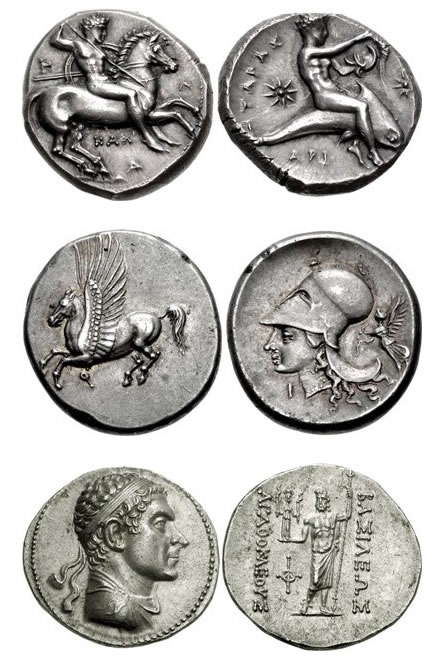
Greek. The ancient Greeks produced coins over a long period at mints located from Spain to the near the border of India. The variety of types is bewildering since they were issued by a great number of independent city-states, leagues, confederacies and kingdoms. In the eyes of most collectors, their principal charm is their artistry, which often is arresting. Though there is much history to be enjoyed through the study of Greek coinage, it certainly is a lesser consideration, especially when compared with the particular value of that aspect in Roman or Byzantine coinage.
Below are three Greek coins bound to appeal to collectors who enjoy fine art. The first is a didrachm of the Greek city of Tarentum (in modern Italy), struck in the late 330s B.C. The second is a silver stater from the Greek city of Corinth, issued in the 4th Century B.C. The third is a silver tetradrachm of Agathocles, who ruled the Kingdom of Bactria (principally modern Afganistan and Pakistan) from c.185 to c.180/70 B.C.
 Roman.
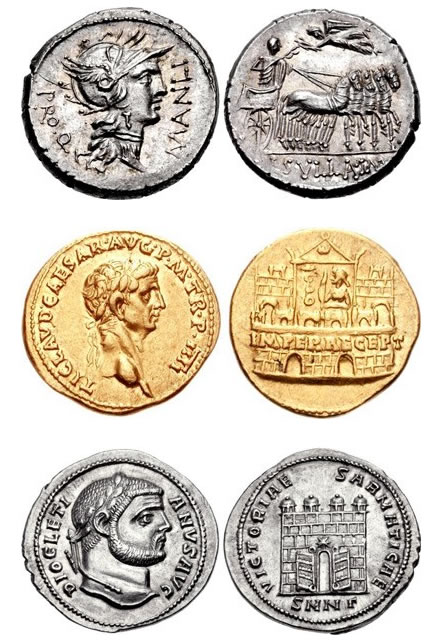
 The culture that originated in the city of Rome and eventually spread its influence throughout the ancient Mediterranean world would be responsible for an enormous quantity of coins that for centuries supported much of the economic transactions from Britain to India. The earliest Roman coins were struck under the Republic, and after a violent period of civil war, the balance were issued under the Roman Empire. The principal interests for collectors of Roman coins are the portraits of rulers and connections that may be drawn to historical events.
Below are three Roman coins that have the dual-merits of excellent designs of historical interest. The first is a silver denarius of the dictator Sulla, who ruled Rome by force from 82 to 79 B.C. The second is a gold aureus of the Emperor Claudius (A.D. 41-54) on which he acknowledges the support he received from the Praetorian Guards when he was hailed emperor. The third is a silver argenteus of the Emperor Diocletian (A.D. 284-305) on which he celebrates victories over the barbarian Sarmatians.
 Byzantine.
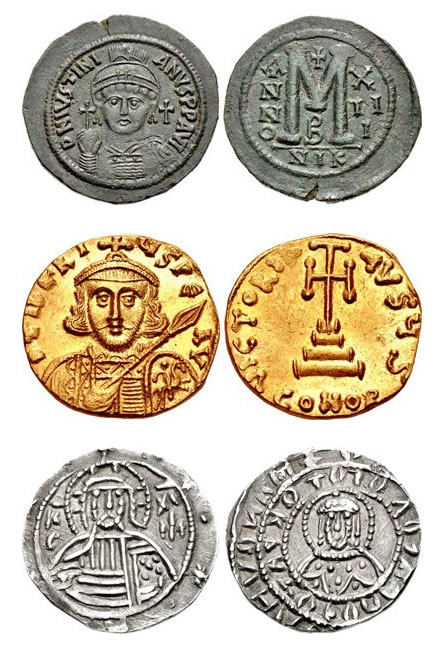
 The successor to the Roman Empire was a civilization that today is known as the Byzantine Empire. That name is a modern invention, and the people who lived within its realm never considered themselves anything but Romans. However, there was enough of a cultural transition following the collapse of the European territories formerly ruled by the Romans that the people of the Byzantine Empire merit a distinct identification. In truth, all Byzantine coins were struck after the period of Late Antiquity, and thus are issues of the Dark Ages and the Medieval world. Even so, yet they are avidly collected by ancient coin specialists who enjoy them as a continuation of the legacy of the Roman Empire. The artistry of Byzantine coins is generally considered to be cruder than on Greek and Roman coins, and their principal charm is, in fact, their 'crudeness' and their historical value.
Below are three pieces that any collector of Byzantine coins would surely enjoy. The first is a large copper follis of the Emperor Justinian I (A.D. 527-565). The second is a gold solidus of the Emperor Tiberius III, who ruled from A.D. 698 to 705. The third is a silver stavraton of the Emperor John V (A.D. 1341-1391), depicting on its obverse Jesus Christ and on its reverse the emperor.








 Posted 10/18/2015 10:42 pm


