











 Posted 10/19/2015 2:27 pm


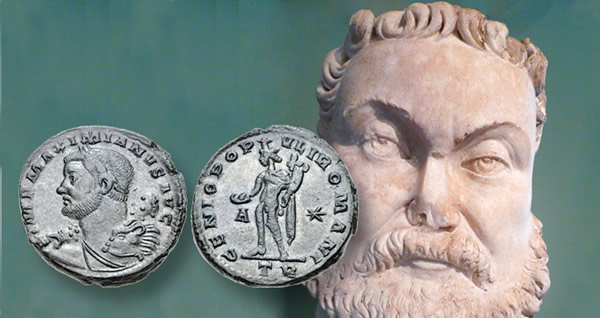
David Vagi is a well known and respected writer who uses coins to tell history. His vision of numismatic "lives" for Maximian is clever and entertaining. It is also a good overview of the history of Maximian. However, I have to take issue with the conception of the five NUMISMATIC lives of Maximian he presents in the article. [emphasis mine]
In this article Vagi presents the reader with five partitions of the political history of Maximian, which he discusses through coinage, but calls each a "numismatic life." The implication is that we are getting a numismatic history of the life of Maximian. However, if we look at his first "life" we see too many numismatic divergences:
I think the numismatic partitioning of this period is better reflected in the arrangement of material in RIC, in which the material from before the Diocletianic reform (about which Vagi says, "...seemingly...") is placed in volume V and everything post reform is in volume VI. After that, Sutherland defines numismatic periods partially on the political history, and mostly on alterations in the coinage. If one follows that approach, then the number of numismatic "lives" for Maximian is closer to a cat-like nine.
It's still a good read.
In this article Vagi presents the reader with five partitions of the political history of Maximian, which he discusses through coinage, but calls each a "numismatic life." The implication is that we are getting a numismatic history of the life of Maximian. However, if we look at his first "life" we see too many numismatic divergences:
Quote:
1.
With this promotion we enter the first of Maximian's five numismatic lives (no coins are known for him with the title of Caesar): the period 286 through 305.
1a
Initially they were of the denominations that had been used by his immediate predecessors,
1b
but seemingly in 294 Diocletian revamped the coinage system. He created new denominations for the base metal and billon coinages and he reintroduced silver coins, which had not been used in the Roman world for perhaps 40 years.
1c
In the midst of this era Diocletian expanded upon his system of shared rule: on March 1, 293, he raised two younger men, Constantius I and Galerius, to the rank of Caesar.
2.
On May 1, 305, after more than two decades at the helm, Diocletian compelled his junior associate Maximian to retire as well, thus allowing the Caesars Constantius I and Galerius to replace them as emperors.
Upon his abdication, Maximian entered his second numismatic life. The coins now being struck for him usually are called "abdication" issues.
1.
With this promotion we enter the first of Maximian's five numismatic lives (no coins are known for him with the title of Caesar): the period 286 through 305.
1a
Initially they were of the denominations that had been used by his immediate predecessors,
1b
but seemingly in 294 Diocletian revamped the coinage system. He created new denominations for the base metal and billon coinages and he reintroduced silver coins, which had not been used in the Roman world for perhaps 40 years.
1c
In the midst of this era Diocletian expanded upon his system of shared rule: on March 1, 293, he raised two younger men, Constantius I and Galerius, to the rank of Caesar.
2.
On May 1, 305, after more than two decades at the helm, Diocletian compelled his junior associate Maximian to retire as well, thus allowing the Caesars Constantius I and Galerius to replace them as emperors.
Upon his abdication, Maximian entered his second numismatic life. The coins now being struck for him usually are called "abdication" issues.
I think the numismatic partitioning of this period is better reflected in the arrangement of material in RIC, in which the material from before the Diocletianic reform (about which Vagi says, "...seemingly...") is placed in volume V and everything post reform is in volume VI. After that, Sutherland defines numismatic periods partially on the political history, and mostly on alterations in the coinage. If one follows that approach, then the number of numismatic "lives" for Maximian is closer to a cat-like nine.
It's still a good read.


