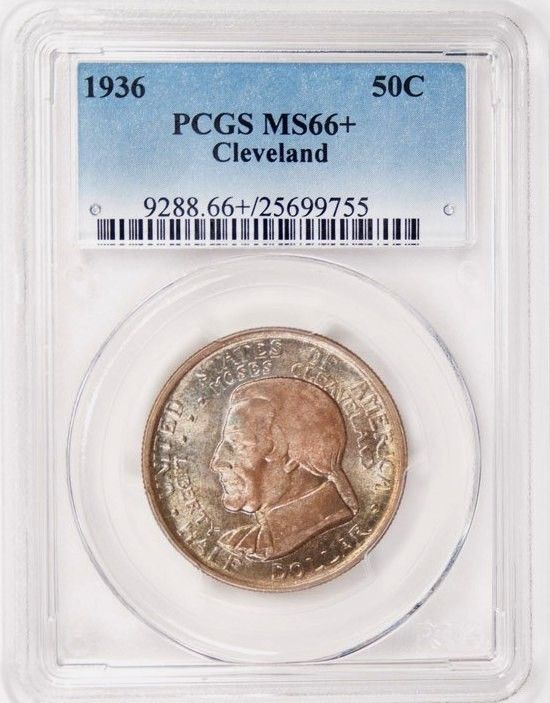
Arrived a few days ago:

Some History:
1936 mintage of 25,015 with 15 coins for assay and 25,015 coins minted in 1937 with 15 coins for assay. 86 coins melted. Designed and modeled by Miss Brenda Putnam and distributed by the Cleveland Centennial Commemorative Coin Association, Thomas G. Melish, treasurer. The cost of one coin was $1.65, postpaid.
"The background of the coin is of considerable interest. Moses Cleaveland, whose portrait occupies the obverse of the coin, was born in Canterbury, Connecticut in 1754. He attended Yale College, was admitted to the bar and in 1796 became a brigadier-general in the United States Army.
 General Moses Cleaveland before 1885. Courtesy Sketches of Western Reserve Life (Wiki Media Commons), Harvey Rice, 1885.
He owned a number of shares in the Connecticut Land Company which had just purchased from the state of Connecticut a large tract of land in north-eastern Ohio. Accompanied by fifty emigrants from Schenectady, New York, he set out to survey this land and reached the mouth of the Cuyahoga River on June 22nd, 1796. Finding a favorable site for a town he decides to settle there. Although a trading post had been established there ten years previously, no attempt had been made to build a permanent settlement. Cleaveland surveyed the territory and laid out what is now the present city of Cleveland.
Though the place was originally called Cleaveland in his honor, the spelling was to undergo a minor change. When the first newspaper, the 'Cleveland Advertiser' was established the head-line was found to be too long for the form and the editor cut out the letter 'a', a revision that was readily accepted by the public.
In 1800 the entire Western Reserve was erected into the county of Trumbull and a township government was given to Cleveland. Ten years later Cleveland was made the seat of government of the new county of Cuyahoga, and in 1814 it was incorporated as a village. Its growth was slow. But the opening of the Ohio canal and the improvement of the harbor soon brought it into prominence. In 1836 it was incorporated as a city. The most notable event held there previous to the Great Lakes Exposition was the elaborate celebration of the centennial of the city in 1896. At that time many medals were struck, many of which are highly prized by collectors today.
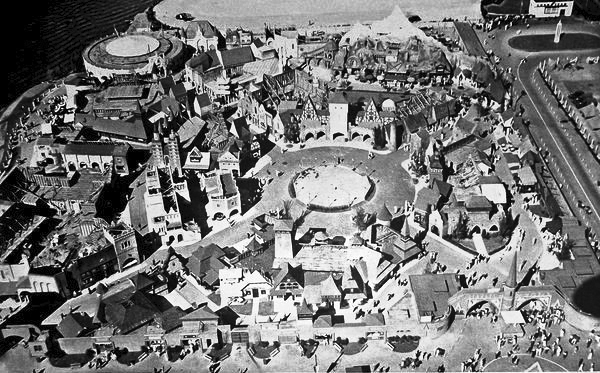
The exposition which was the occasion of striking this coin was notable for its splendid exhibits in the motor and agricultural departments. The main celebration was held at Cleveland, but other cities around the Great Lakes contributed much to its success. These cities are indicated by the stars on the reverse of the coin and are as follows: Duluth, Milwaukee, Chicago, Toledo, Detroit, Buffalo, Toronto and Rochester. The large star upon which rests the tip of the compass point, represents the city of Cleveland.
"11. The Coin Collector's Journal, Cleveland Great Lakes Exposition Half Dollar, January 1939, p. 175.







 Posted 11/04/2015 11:19 am