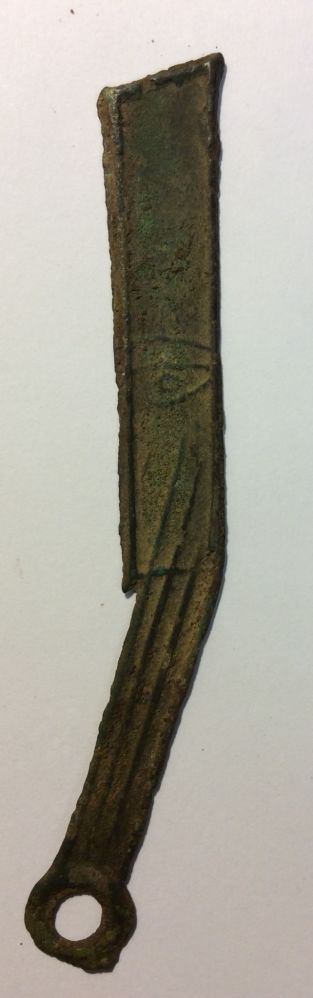
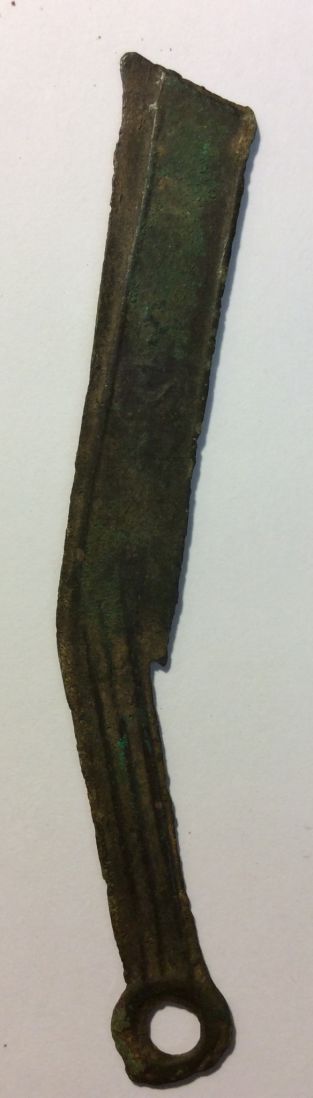
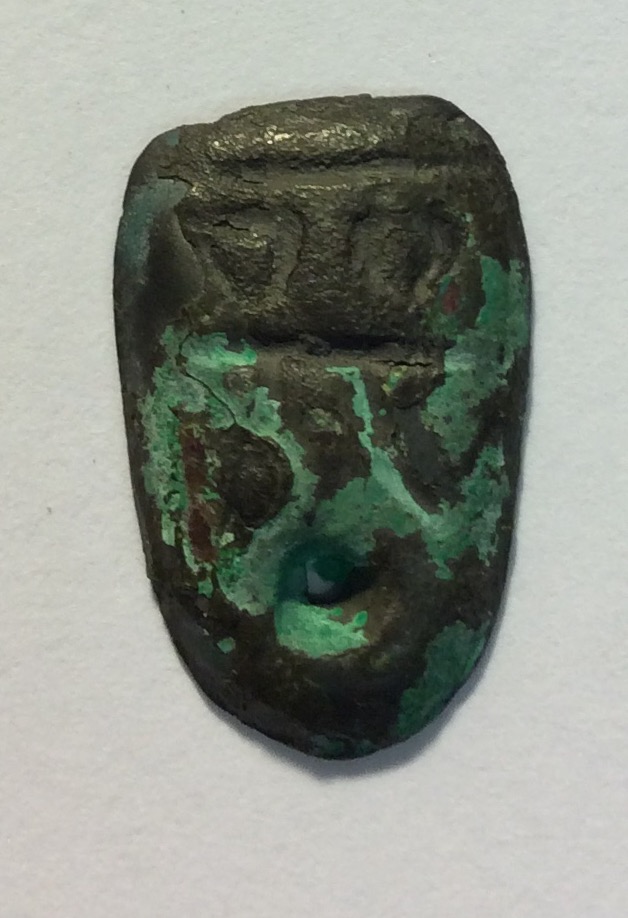
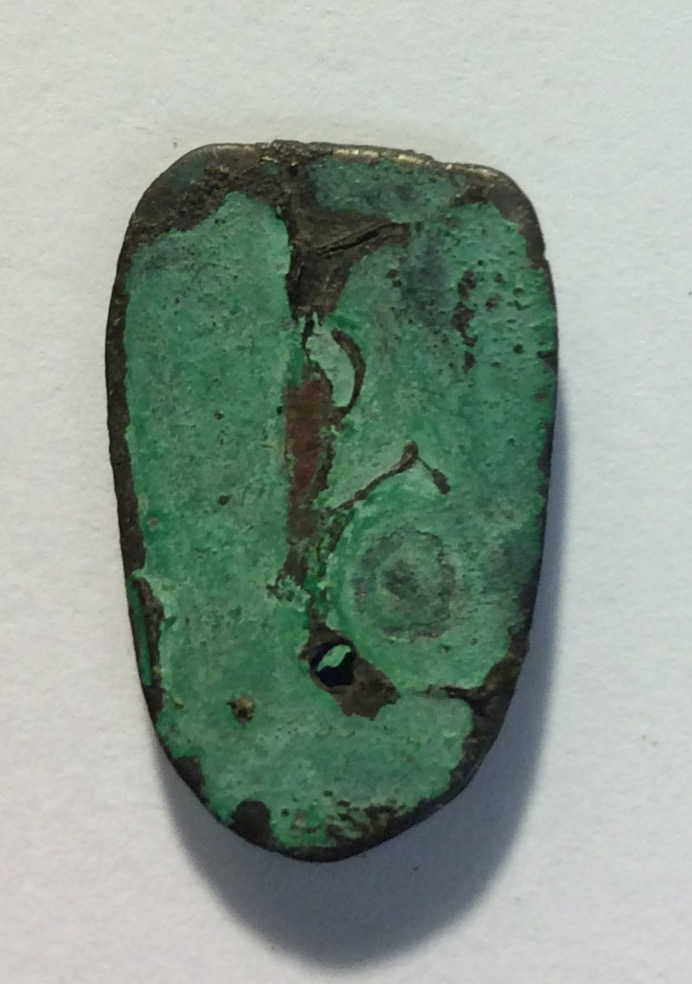
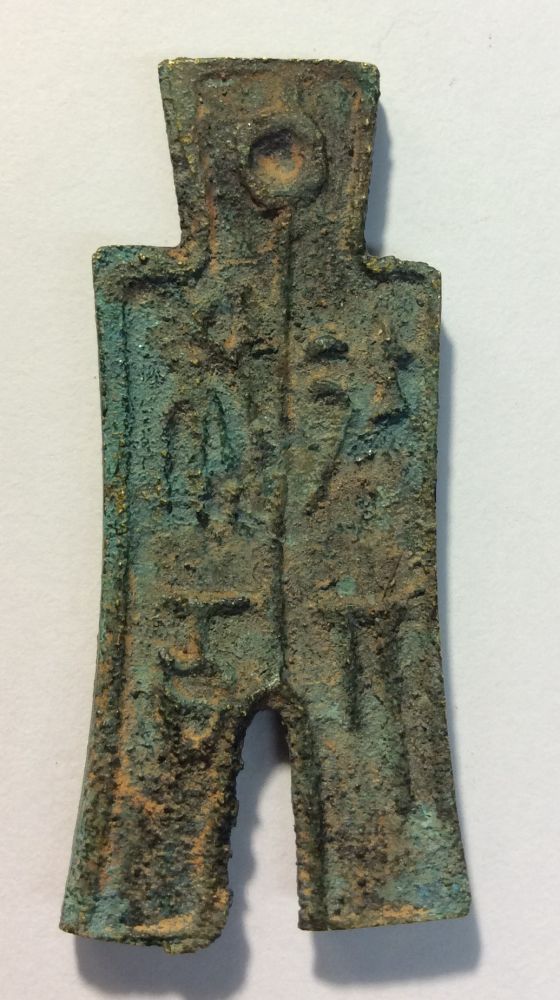
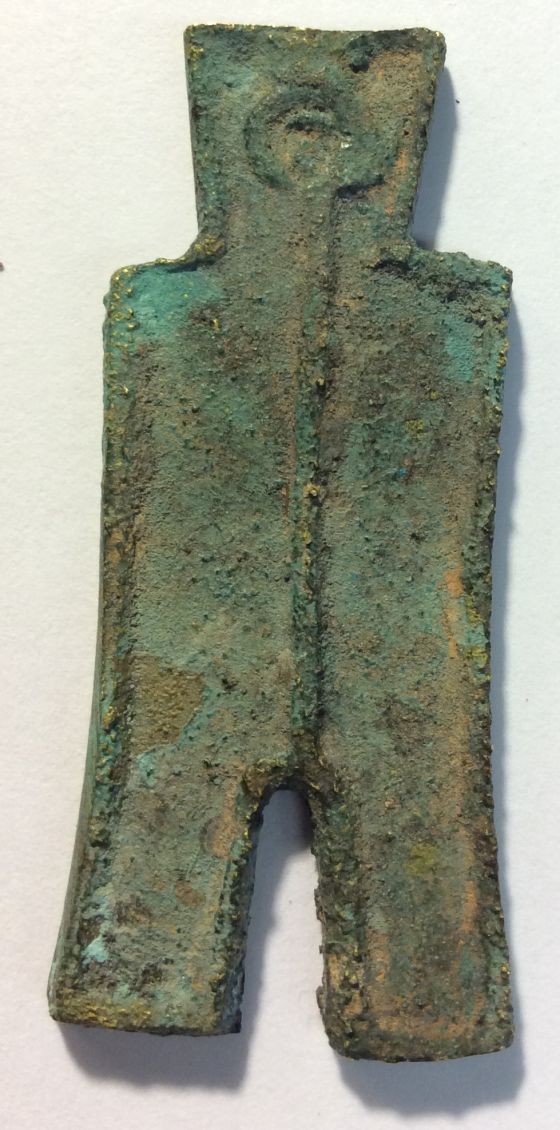
I have my own opinion, and I want to see of you all agree with me. If you don't feel comfortable assessing the coin itself, comment on the patina. This is for a friend who entusted me to authenticate this coin.
You know the world has gone topsy-turvy when TypeCoin971793 asks for OUR advice on a spade coin. This is like Meryl Streep asking for acting lessons from Susan Lucci.
Oh well, I'm game. I suspect you must think something is amiss here but, if so, I can't spot it. The patina looks legit to me...but, then, I believe I have handled only one spade coin in my life, so my opinion is probably worthless here.
The only thing I can declare with any confidence is my ignorance on the subject.... but that patina does lead me to believe that it is at least a few hundred years old... I can't see that being made last week...
What material is it supposed to be? It looks like cast iron...
Ok, so its bronze - which can take on many looks, brown, green, gold or black. The reason I mentioned iron was the coarseness of the surface, the bobbles and pitting.
So I went looking for some examples of ancient bronze corrosion. It seems that this is a normal feature particularly with items that have been buried.
To the Original Poster: He has left you with a large responsibility.
I know nothing on how to spot fakes with these, but if I was interested to buy, I would feel under an obligation to myself to make an 'all out' effort to find out all that is possible on how to distinguish fake or not.
So far, most have commented on the patina, and that has to be one of the steps to authentication. Find out for yourself how to distinguish a genuine piece from artificial patination of a fake. Ask - 'Where did the owner get it from?' ---------'Do you know of the excellent reputation of the seller? Provable, verifiable provenace IS important with these. ---------'What does it weigh, and what are the dimensions?'
Find all you can on line on the the history of these and their issue. Get as many pictures as you can of known genuine examples.
At this point, in what I know about these pieces (which is very little), I would expect that that almost all of those available for sale are fake. I would imagine that huge profits could be made on selling fakes of these, but proporting to be genuine. It certainly would not cost much to make fake examples of them. Without knowing, I would expect that the genuine examples are quite valuable.
Like I said above, you have taken on a large responsibility.
I have already asked all of those questions, and I have compared this coin to numerous coins from the collections of foreign experts and auction archives. The coin was obtained decades ago by the owner's deceased husband, and was given to me with a purchase of a Ming knife and a Nose ("Ant-Nose") coin, given that I do whatever in my power to authenticate and possibly sell the coin for the owner. From what I can tell, those two coins are genuine. Also, I have had some experts look at pictures of this coin to get their take on authenticity. The owner sent it to me to examine, so I know size and weight.
I'll wait for a few more replies and comments before I reveal my conclusions and why. I was asking about the patina as that is the hardest part in authentication gor me, and the ancients experts here would be more familiar with genuine patina than I.
Due to the lack of new comments, I will reveal my conclusions and why:
I said counterfeit. I posted here trying to see if there was any chance that this was genuine (or even a contemporary counterfeit). However, I am still conlude that this coin is a modern counterfeit for a variety of reasons.
1. Composition: As I said earlier, this coin should be bronze, but it is made of brass. That may have been hard to see from the pictures. This is a major red flag that cannot be ignored.
2. Patina: I asked about patina because I was hoping for some chance that it could be real for the owner. However, the pictures do not accurately capture the true colors of the patina. (Sorry, I didn't notice that until well after I had posted the pictures.) The true colors are more like a light tan, electric blue, and a darker brown, all three are colors I constantly see of fake Chinese coins. My mind immediately said fake when I saw it for the first time.
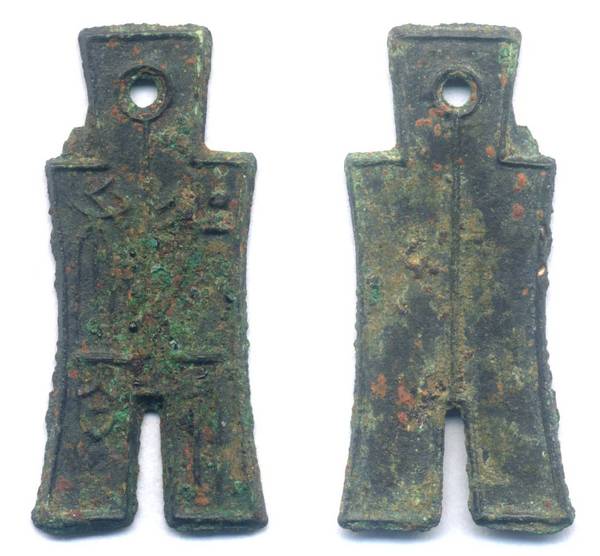
3. Style: These were very well cast when they were made in 10 AD. All of the edges, corners and characters were very sharp and defined. As you can see, the entire coin is very rough and the characters are very hard to make out. All of the corners are rounded. The edges of the coin has heavy file marks, whis is very much like what a I have seen on other fake Wang Mang spades. Also, the hole is filled, which should be empty.
Here is a picture of a real one for comparison:
4. Metallic ring: I found this one yesterday. I was setting the coin down on my desk, and noticed that it had a very bright metallic ring, like on a modern ingot. I then compared it to a Wang Mang spade I know is genuine, and that one was much duller. That means the metal in the questionable spade hadn't crystallized as like in the genuine spade as I would expect for a 2000-year-old coin. This is enough evidence that it is of a modern make.
@Sel
There was no documented provenance prior to what I have already said. I know the importance of provenance with these coins and actively try to obtain that information whenever I buy Chinese coins.
I've been awaiting your verdict, TC971793. Excellent, cogent analysis. Every point makes perfect sense, and the sum total is damning. I know who I'll be asking for advice from if ever I hope to purchase one of these.
Disclaimer: While a tremendous amount of effort goes into ensuring the accuracy of the information contained in this site, Coin Community assumes no liability for errors. Copyright 2005 - 2026 Coin Community Family- all rights reserved worldwide. Use of any images or content on this website without prior written permission of Coin Community or the original lender is strictly prohibited. Contact Us | Advertise Here | Privacy Policy / Terms of Use












 Posted 12/12/2015 12:30 pm