| Author |
 Replies: 11 / Views: 1,856 Replies: 11 / Views: 1,856 |
|
|
Valued Member
United States
79 Posts |
Hello all! I bought this proof set that looks like it was put together somewhere other than at the mint. The nickel is awesome looking! It has great blue toning but it has a strange circle mark towards the center of the reverse. You can see the circle I am talking about on the center of the picture of Monticello. Has anyone seen anything like this before? I have seen that blue nickels like this bring decent $$$ on the BAY... I was just wondering what may have caused this marking on this nickel. P.S. the pics do not do the toning justice. 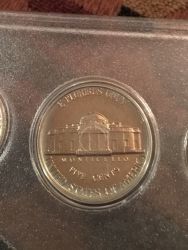 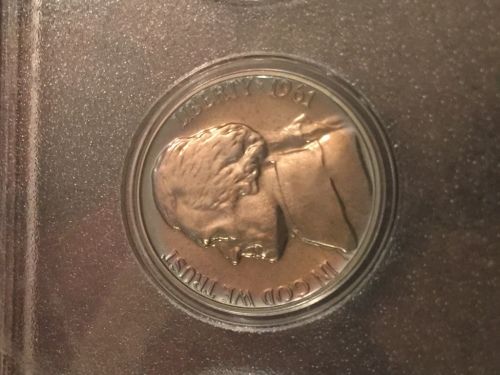 |
|
|
|
Valued Member
 United States
79 Posts |
One more pic of the reverse blown up. I know it is a little blurry but I'm new to this whole posting pictures thing. 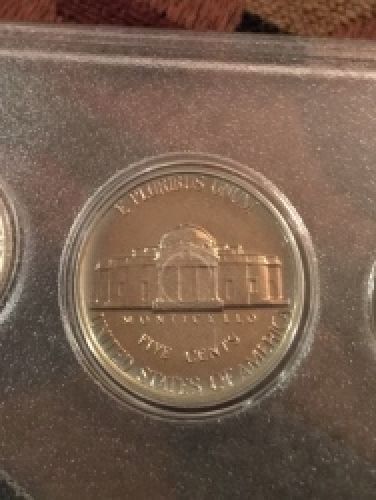 |
|
Pillar of the Community
Canada
4227 Posts |
This may be a stupid question, but are you positive the circle is on the coin and not the holder? I've seen circle marks in plastic holders just like that before.
|
|
Valued Member
United States
424 Posts |
The toning is known as halo toning. I don't have any ideas what the circle on the reverse is. This does not appear to be in OGP, I believe a 1961 proof set would have been in a Mylar package or some sort of cardboard holder. I think the mint started using hard plastic holders for proof sets in 1968.
|
|
Valued Member
United States
79 Posts |
10 points to CHEQUER!  I never even cracked open the plastic case. I just did after reading your post and you have made the correct diagnosis! Which means the coin is clean!  Now, any ideas as to what this might be worth? P.S. I feel a little bit dumber after this experience. haha |
|
Moderator
 United States
56855 Posts |
Quote:
P.S. I feel a little bit dumber after this experience. haha Or a little smarter,we learn a lot on this great site don't we? John1  |
|
Pillar of the Community
United States
6130 Posts |
I think that's a Littleton holder. It should pop apart at the corner--no need to break it to get to the coins.
As for the nickel, we would need to see some closer pictures. If the nickel has no contact marks whatsoever, it can he worth a few bucks. Generally, when a proof coin is broken from its original packaging, it is considered "impaired". Most collectors only pay face for impaired base metal proof coins.
|
|
Moderator
United States
194256 Posts |
The photo to me indicates that the mark is on the holder. Easy to confirm by popping it apart. Quote:
Generally, when a proof coin is broken from its original packaging, it is considered "impaired". Most collectors only pay face for impaired base metal proof coins. I have to disagree. I would not call a single one of the proof coins in my Dansco albums impaired.  Most came from my own proof sets (which I broke apart), but there are more than a few that I had to buy singly. I wish I could have bought them for only face.  |
|
New Member
United States
47 Posts |
An impaired proof is one that grades below 60. Has nothing to do whether the coin has been removed from OGP.
|
|
Moderator
United States
194256 Posts |
I agree with that definition.
|
|
Pillar of the Community
United States
4963 Posts |
Most of the proofs in my 7070 are from a 72 proof set I cracked (the OGP was already coming apart) and 75 set my uncle gave me from which he had already taken the bicentennials. I would not call them impaired.
|
|
Pillar of the Community
United States
1006 Posts |
Some of these third-party "Proof sets" are not actually Proofs but actually circulation coins culled from mint sets and rolls. These days Proofs are made in San Francisco with the "S" mint mark so it is not really an option but before that there would be sets that resemble Proofs that were anything but.
|
| |
Replies: 11 / Views: 1,856 |
|





 Posted 12/30/2015 10:52 pm





