Thanks for chiming in with your comments, tenbobbit. I will respond to what is new in them.
Quote:
Coin 3 - Constantinople
I believe you intended that as an answer to the question about the "other" mint pairing the your obverse with a GE reverse. Constantinople it is.
Quote:
Coin 5 - Letters either side of the stars, I'm stumped.
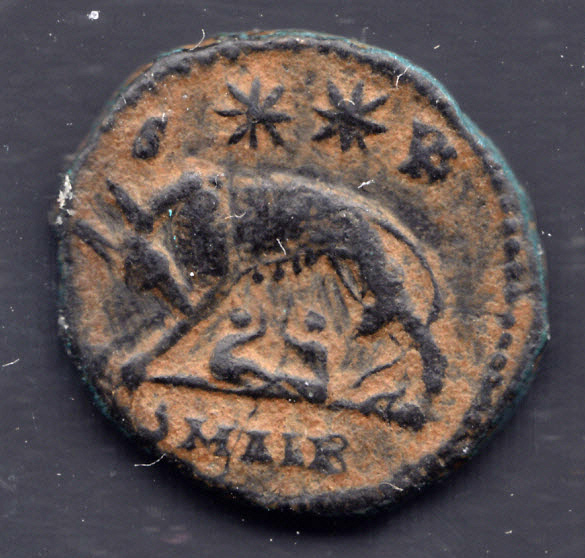
The post-Constantine issue of the your from the mint at Alexandria in 337-40 featured the S|R field marks in the left and right fields respectively (RIC VIII 10). Letters as field marks were not often used on the your coins from any mint, and in that sense they are anomalous for the issue. I thought it would be good to show it, even though it is not an error in any sense.
Quote:
Coin 6 - If that is a PINE tree between the stars then its a rarity ( r4 or r5 )
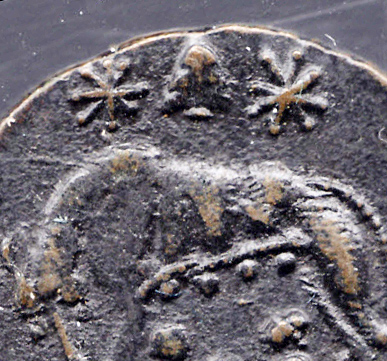
You are referring to the field mark between the stars. The figure in RIC for this mark does resemble a two tiered pine tree, and the example on this coin seems to have that character. But I have another example where it is more spread out vertically, suggesting that the schematic in RIC is possibly a military standard. Bruun did not say, and I am not at all certain about my interpretation and could easily be convinced otherwise. In any event, marks of this kind, in a variety of symbols, were used with this series at Trier and Arles (as here). Other mints also issued special marks occasionally. I am considering doing a thread for these special pieces.
Coin 7 - Clashed die maybe, with it being off centre struck + an oversize flan the proper strike has left the helmet decoration visible only ?
My understanding of die clashes is that they occur when there is no planchet between the dies when they are "struck" resulting in damage to one or both dies. Clashed dies are more common in the age of automation than when the hammer die was handheld, as all dies were in antiquity. A great variety of striking errors are seen from back then, including some coins which seem to have been deliberately mis-struck.
Be all that as it may, I certainly would not rule out the possibility of a die clash, but tend to lean toward multiple striking, off axis strikes, and problems associated with planchets jammed in one die or the other as the first line of inquiry. Perhaps that's just me. I do think that striking errors could be a topic for another thread.
If there is any interest we could explore some of the variations I have mentioned in another thread or two. To me that kind of discussion is yet another thing that makes these coins fascinating.






 First Page


 Posted 08/01/2020 1:01 pm


