| Author |
 Replies: 14 / Views: 1,713 Replies: 14 / Views: 1,713 |
|
|
New Member
United Kingdom
29 Posts |
Hi guys,
I'm here to show you a very mysterious coin I got recently in a lot purchase. I can say looks "in the family" of the Syracuse Greek coinages, but To be honest I never found any similar one...
Diameter: 250mm
Weight: 8/9 grams.
Material: Bronze I guess.
Link removed, please use the upload image feature provided here for your pictures-echizento
Could you help me to identify it?
Many thanks!
Gasp Edited by Gasp
01/03/2016 06:15 am
|
|
|
|
Pillar of the Community
United States
7067 Posts |
Gasp, welcome to the board. Best to upload the pic here...there's a CCF rule (see Rules button above) that states that new members should refrain from posting links to external sites. So, if possible, please upload an image, and we'd be happy to offer up opinions.
|
|
Moderator
 United States
23731 Posts |
 to the community BobL is correct, please use the upload image feature here for your pictures. |
|
New Member
 United Kingdom
29 Posts |
Hi @Bob L and @echizento many thanks for your reply! Below the images uploaded here :) the link I posted before, is a direct folder from my onedrive account with a full detailed photo set. Sorry if I broke the rule    Edited by Gasp
01/03/2016 11:27 am
|
|
Moderator
United States
23731 Posts |
It's an interesting piece that I haven't seen before. I think the image on the left side is not a figures to me it looks like a triskeles. What is the large hole at the bottom, does it go through all the way?
|
|
Pillar of the Community
United States
7067 Posts |
Hmmm. I too have not seen one like this before. I think the reverse may be referencing the "slinger" type of reverses on some Pamphylia issues (slinger with triskeles). Looks genuinely ancient, but with crude style for an ancient Greek...may be an imitative of some type. I assume, Gasp, you meant 25mm for the size?
|
|
New Member
United Kingdom
29 Posts |
Thanks @echizento for your interest. Unfortunately the coin is not in the best condition, there's a strange "hole" in the bottom side of the reverse as you already said, and the bottom section of both sides looks like have condensation of material (bronze) compared with the top part... quite hard to describe, Attached a couple of images:    @Bob L, my mistake, 25mm  |
|
Moderator
United States
23731 Posts |
I don't know what to make of this one. I can't seem to find anything that matches.
|
|
Pillar of the Community
United States
7067 Posts |
Quote:
I don't know what to make of this one. Me either. I do feel confident that the reverse imitates the slinger/triskeles types of Aspendos, Pamphylia, like below. But, of course, those issues always have the wrestlers on the obverse...so one would expect that an imitative would have the same. And yet the fabric looks genuinely ancient, so I hesitate to call it a modern fantasy.  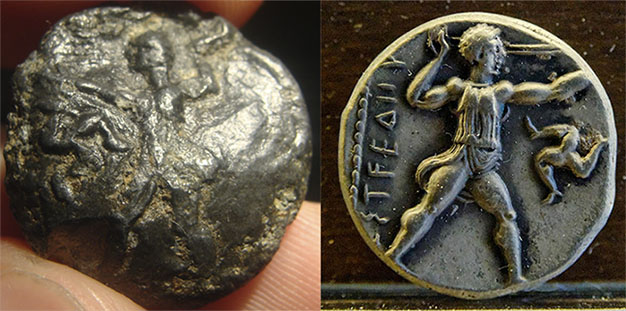 Edited by Kamnaskires
01/03/2016 12:50 pm
|
|
Moderator
United States
23731 Posts |
I've been searching on and off all day and I still haven't found any match. The coin looks old and not aged artificially so I don't feel that it's modern. Either I'm looking in the wrong places or this may be an unrecorded coin.
|
|
New Member
United Kingdom
29 Posts |
Guys, thanks so much for the time dedicated. I really appreciated it. I spent ages too, and that's the result of my research: Front: I found a strong similarity with the Syracuse coniages, in particular the profile of Hieron II:  And generally, is also similar to this type of coins:  Ainianes, Thessaly, AE Dichalkon, 18 mm, 5.97 g. Head of Zeus left / AINIANWN, Slinger wearing chlamys, standing left, slinging right, sword around waist, two javelins behind him. Rogers 137; Lindgren Collection 1392. -------------------- Also, I tried to flip the Pamphylia coin using Photoshop, and there's no evidence of similarity between both coin... no lengend, also the triskele is not in the same position and the general manifacture is quite poor:  I think is an ancient copy, maybe celtic? Actually the flipped reverse can be explainable in a simple way: if you try to engrave a subject and then create a mold from it, the result will be flipped, naturally. Can be the reason of this obsolete attempt?  |
|
Pillar of the Community
United States
949 Posts |
Fascinating! Perhaps the artist who created this emulation was just testing, and not trying to fashion an actual counterfeit. What can you tell us about the circumstances of its discovery? Was it found in a hoard or a context that lends credibility to thinking of it as money? Or may it have been some other kind of art piece?
The arrangement of details in the two designs suggests that actual coins were used as models. I suppose light impressions might have been used as starting points which were "worked over," but the execution is crude enough to suggest they were done freehand. Certainly they are not coin impressions alone.
I do see similarities with the Pamphylian reverse, including a light trace of the sling ahead of the eyes of the slinger, and an exaggerated version of the deformation of line where the hand cradles the load in the sling. The position of the triskeles is too similar to that on the coin to dismiss the parallel.
At the same time the Syracusan obverse looks closer than the other examples. Might this have been a composite of the two? Perhaps not as an actual counterfeit so much as a practice piece of some kind?
Somebody trying out the "lost wax" method of casting? I don't know, but it is intriguing.
|
|
Pillar of the Community
United States
7067 Posts |
I do think the reverse imitates the slinger/triskeles type. The fact that it is "backwards" reflects the overall crudeness of the die engraving. I have in my own collection a Parthian coin with the reverse archer backward - the work of what I've referred to in the past as "a die engraver asleep at the wheel."
I spent some looking at Celticized examples of multiple types, but there's no match I could find. In any event, if were Celtic, would it not have a consistent obverse and reverse that match an original type that it emulates? I don't know of a standard type that convincingly fits both the obverse and reverse in this case. If I'm right about that (not saying I am...this is just speculation), that might be ammunition for someone who argues that the coin is a modern fantasy or tourist piece, aimed at a potential buyer who would not attempt to dig like we are...and who would not be looking for a legend on the reverse, and who would not know that the slinger is backwards. The goal would simply be to create a generic, ancient-looking piece based on available examples.
But it does look ancient. I'm stumped. This may be one of those "the world may never know" examples. Frustrating!
|
|
Moderator
United States
23731 Posts |
I don't know where in the UK you are but if your close by the British Museum it might be worth a trip there to have it checked by them.
|
|
New Member
United Kingdom
29 Posts |
Unfortunately I don't have clear informations about circumstances of discovery.. I bought it in a lot of Roman and Islamic coins...it was in the middle!
Also, I even doubt about the material..., how can I know if is bronze or something else? I though it looks quite light to be 25mm coin :/ only 9 grams, it's quite thick too.
Tomorrow morning I will try to email the seller, just to know if he can give me a few more informations and I will let you know :)
About the British Museum coin identify, I tried to contact them as I live in London, but I don't have any proof of discovery and for this reason they cannot help me... I've only the invoice of purchase
Thanks again
|
| |
Replies: 14 / Views: 1,713 |
|





 Posted 01/03/2016 11:17 am





