American Numismatic Society - On January 6, 1838, American polymath Samuel F. B. Morse and his partners Leonard Gale and Alfred Lewis Vail hosted a successful private trial of their new electric telegraph system. Morse was a celebrated painter who became fixated on the idea of creating an expeditious means of long-distance communication when his wife fell ill and died while he was away (the news, delivered by mail, arrived only after the fact). Morse's signature contribution was adding extra circuits or relays to the existing electromagnetic systems, which ensured that the telegraphic signal would carry over longer wires. The first message that was transmitted that day was an aphorism: "A patient waiter is no loser." (The more famous phrase associated with the telegraph, "what hath God wrought," was sent in 1844 as part of a public demonstration of the new commercial telegraph line between Baltimore and Washington, D.C.)
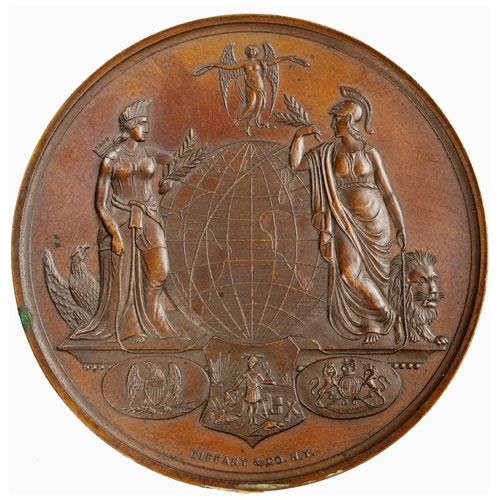
The electric telegraph expanded exponentially in the mid-nineteenth century, transforming commerce and communication throughout the United States and eventually around the world. The key to the globalization of the technology was overcoming the challenge of manufacturing underwater cables that were durable enough to survive and transmit signals across vast distances. The first successful effort to lay a trans-Atlantic cable was undertaken by the Atlantic Telegraph Company headed by Cyrus W. Field. On August 16, 1858, the first message was sent from England to the United states, which read: "Europe and America are united by telegraphy. Glory to God in the highest; on earth, peace and good will toward men." Shortly after, Queen Victoria and President James Buchanan exchanged congratulatory messages, but the cable failed after just a few short weeks.
 Read the Entire Article









 Posted 01/22/2016 11:34 am


