| Author |
 Replies: 9 / Views: 1,787 Replies: 9 / Views: 1,787 |
|
|
Moderator
 United States
23731 Posts |
Constans was the Byzantine emperor from 641-668 AD. He has been mislabeled as Constans II, in actuality he is Constans III. There were two other Constans before him. Constans I 337-350 AD the son of Constantine The Great and the extremely rare emperor Constans II 409-411 AD. The Byzantines considered themselves as Romans along with the rest of the world so they are just a continuation of the Roman empire. The AE coins of Constans III especially those struck in Constantinople are among the worse struck of the whole Byzantine series. These coins are usually over stuck on earlier coins and a struck on clipped flans. This is one of those example. He spent most of his reign in constant war with the Arabs and the Slavs. He also faced revolts in Italy and North Africa which he put down. Towards the end of his reign he lost confidence with the people of Constantinople and move his capital to Syracuse under the guise of keeping an eye on Africa. There he was assassinated by being hit over the head with a soap dish by one of his attendants. AE Follis Constans II (III) 641-668 AD Constans standing facing holding long cross. Reverse is large M with date and mint officane and date. Sear #1000 Constantinople mint Date looks like regnal year 6 which is either 647/48 or 662/3. I tend to believe this is the later date. 23mm x 3.8g 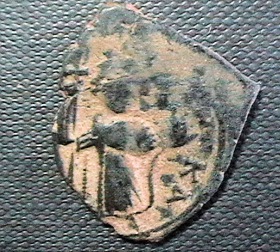 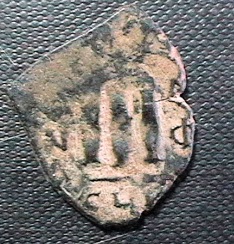 |
|
|
|
Pillar of the Community
United States
7067 Posts |
Good write-up, Ron. You inspired me to look at a number of examples of Constans "II" folles online over at grifterrec, Wildwinds, and VCoins. Many have not held up well and, of course, suffered from evident low minting standards to begin with. Yours seems like a decent example of the type, better than many I spotted. Thanks for the history lesson...very interesting.
|
|
Moderator
 United States
23731 Posts |
Thanks Bob. I realize these are not the best looking series, but as I have said in the past the Byzantines had an interesting and colorful history that has been overlooked by most collectors.
|
|
Pillar of the Community
United States
5010 Posts |
nice to see some byzantines, good pick up ski! this guy has a style that is pretty easy to pick out...little dude, big head, big cross, globus cruciger. here's mine...  instead of a year, this coin has "NEOS" running vertical. isn't that greek for "new"? does it mean that here? hey ski, I'm likely going to need your help with a trachy attribution soon...just giving you a heads up! |
|
Moderator
United States
23731 Posts |
The letters NEOS are and abbreviation of the word Ananeosis- Renewal. Constans renewed the theme of Constantines I command that he received in a dream "In This Sign"
Chris I'll be glad to look at you coin, whatever I can do to help.
|
|
Moderator
United States
23731 Posts |
Bob in reference to your thread "Too much yellow", whats your opinion on this one?
|
|
Pillar of the Community
United States
7067 Posts |
Quote:
...whats your opinion on this one? Ron, I'm not sure if you're asking me whether I think the sand patina is "too much" with regard to its aesthetic appeal - in which case the answer is definitely "no" since it helps define the devices...it looks nice. Or whether you're asking if I think it's artificially applied, in which case I can't tell. However, if you meant the latter, here's a suggestion: go to the most popular online forum for buying coins, where dealers adhere to a code of ethics. Click on the "ancient coins" box there, and then click on "48 hours" to bring up the last two days of ancient coins that have been uploaded. About four pages of coins will come up. Scan through all of them. You'll see one dealer's bronze coins all come up with supposed desert patinas: these include, over the four pages, his Romans, Islamics, Greeks, Judaeans. This happens day after day, week after week...he does this with nearly every dark AE that he lists. It's ridiculous. Anyway, if you purchased from him I'd say that yes, it's probably an applied patina. Otherwise there's just no way to tell that I know of. Having said that, however...I once ran a small Elymaean by Mike Godier of ECIN. Mike has a really extensive knowledge about ancients, of course, and he's a good guy. I asked him if he thought the patina was fake (applied) - in this case it was a greenish, sort of grainy, patina. He actually brought the coin up to his nose to sniff it. I sure wasn't expecting that. And then he said he thought that, yes, it had an artificially applied patina. I guess maybe he got a whiff of whatever adhesive material was used for the application(?). Blew me away. Now there's a guy who knows his ancients. |
|
Moderator
United States
23731 Posts |
Thanks Bob, I was asking if you thought it was a fake patina. I'm going to check those coins now.
|
|
Pillar of the Community
United States
7067 Posts |
When you get the name of the store, then go his store page and click on "New Items"...I think you'll see what I mean.
By the way, sorry to be so coy. I just don't want to name names...especially given how widespread this practice is. I'm not even condemning the practice - though I could, of course (esp. in light of the code of ethics) - but rather the excessiveness of it in this case.
Edited by Kamnaskires
01/24/2016 4:30 pm
|
|
Moderator
United States
23731 Posts |
That's OK, I figured it out.
|
| |
Replies: 9 / Views: 1,787 |
|







 Posted 01/23/2016 9:00 pm





