...because it´s not usual to receive this kind of gift (at least I´m not used to...).
 THE MAN
Marcus Cassianius Latinius Postumus was a Roman commander of provincial origin who assumed the title and powers of emperor in the provinces of Gaul, Germania, Britannia and Hispania, founding the "Gallic Empire".
The early life of Commodus is unknown; it´s supposed to have been batavian due to some of his coins honouring deities who would have been popular among the batavians (Hercules Magusanus and Hercules Deusonensis).
Postumus built his career through the ranks of the army until he held command of the Roman forces "among the Celts". It´s posible that he may have been promoted by the emperor Valerian (father of Gallienus) to Imperial Legate of Lower Germany and after that seized to consulship.
While Valerian was campaigning in the east against the Persians, he was encomended to protect the Danuvian frontier, taking care of Saloninus, the son of Gallienus.
To say that there were some problems is euphemistic.
The Alamanni allied with the Franks started an invasión while the news said that the emperor Valerian had been defeated and captured by persians; his whole army destroyed.
Rumours said that all was lost in the east, Gallienus was probably dead.
The result was a rebellion of the Army in Gaul that proclaimed Postumus as Emperor when the son of Gallienus tried to get the spoils of an army of germans who were defeated by Postumus troops.
Saloninus was besieged in Cologne (Colonia Claudia Ara Agrippinensium), defeated and beheaded.
Postumus established his capital in northern Gaul, probably at Colonia Claudia Ara Agrippinensium or Augusta Treverorum and then proceeded to set up many of the traditional Roman legislative and executive structures.
He always followed the roman traditions, assuming the office of Consul alongside a colleage, the office of Pontifex Maximus and the Tribunitian Powers each year of his reign.
He has his own Senate fullfilled with important people hailed from Gaul and his own Pretorian Guard.
(The following paragraph is taken from wikipedia)
"Postumus represented himself on his coinage as the restorer of Gaul (Restitutor Galliarum) and the bringer of security to the provinces (Salus Provinciarum) prior to 10 December 261, he also took the title of Germanicus maximus, a title that he earned after successfully defending Gaul against the Germans. His principal objective in assuming the purple appeared to be the restoration and defence of the Rhine frontier and the surrounding area, a task that he approached with vigour, earning the admiration of the ancient authors, who declared that he restored the security that the provinces had enjoyed in the past. So successful was he in the task of restoring peace and security to the provinces under his direct control that the coins issued by Postumus were of better workmanship and higher precious metal content than coins issued by Gallienus; his control of the Spanish and British mining regions was presumably crucial in this regard, as was his employment of master minters who would have come into Gaul with Gallienus. Postumus fought successful campaigns against the Franks and Alamanni in 262 and 263; following his victory over them in 263, he assumed the title Germanicus Maximus, after which his coin-types celebrated peaceful themes such as Felicitas Augusti for some time. After having spent much of the last four years pushing the Franks out of Gaul, Postumus then recruited Frankish troops to fight against other Franks, probably dispersed within existing Roman army units." Postumus never tried to conquer the whole roman empire, his objetives were to stablish a powerbase in Gaul, following the roman laws and traditions. The troops and taxes seized and collected in the "Gallic Empire" were going to be spent in defending the "Gallic Empire", not in wars against the persians.
Gallienus made two campaigns against Postumus, but failed in capturing or killing his enemy. After his second campaign he was too busy to try it again.
By the end of 265, Postumus' coin issues were triumphantly commemorating the victory over Gallienus.
As we have seen, the coinage of Postumus was of highter silver content than the coinage of Gallienus, this changed in 268, when a sudden debasement of the coinage shows that Postumus was facing increasing financial difficulties, probably due to the need to buy off an increasingly discontented army.
Such discontent probably due to the army's frustration with Postumus' failure to take advantage of a golden opportunity to move against Gallienus in 268 when Aureolus rebelled against Gallienus opening the doors to invade Italy.
Postumus missed his opportunity, Gallienus was assasinated, Aureolus was defeated and killed and a new emperor, Claudius II was seized to the throne.
In 269 the army in Germania Superior raised an usurper against Postumus, Laelianus. This usurper was besieged and defeated in Mogontiacum, but when Postumus tried to avoid that his own army put that city to the sack he was killed.
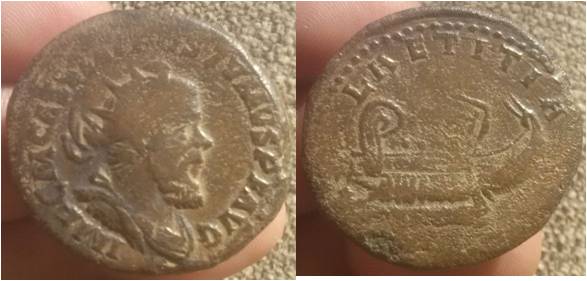
THE COINPostumus. Romano-Gallic Emperor, AD 260-269.
Double-sestertius (Bronze, 33mm, 25.4 g.)
Mint: Colonia (Cologne)
Year: 261.
Obv:
IMP C M CASS LAT POSTVMVS P F AVG Radiate, draped and cuirassed bust of Postumus to right.
Rev:
LAETITIA AVG Small naval vessel, a navis lusoria , sailing to right.
Ref: Bastien, Postume 87 (Colonia). Cohen 177. RIC 143 (Lugdunum).
The issues which couple the reverse legends FELICITAS and LAETITIA with scenes of a galley probably show that the emperor by no means neglected his navy, and perhaps that it achieved success.
The reverse of this bronze of Postumus shows a small ship designed for military use on the rivers of the Roman Empire, especially on the Rhine and its tributaries. They required a staff consisting of at least 30 rower-marines, a steersman and two sailors to manage the sail; highly maneuverable and quite fast, they were able to travel up to 100 km in a day. Well-known from their use in the 4th century, especially under Julian, after the great German invasion of c. 405/407 the fleet was progressively abandoned. In an amazing discovery while preparing the foundations for a new hotel in Mainz (Mogontiacum), five of these ships were found sunk in the mud of the riverbank, where they had rested since their abandonment in the late 4th or early 5th century. The ship on the reverse of this coin is surprisingly similar to those found in Mainz, save for the obvious shortening to allow it to appear on the coin.







 Posted 02/08/2016 08:26 am





