| Author |
 Replies: 24 / Views: 5,900 Replies: 24 / Views: 5,900 |
|
|
|
Pillar of the Community
 Canada
2845 Posts |
Rockfish I know exactly what you say. The very first live coin auction I went to I didn't bring a loupe, what was I thinking I have no idea. lol! But even on ebay I've bought what I thought were certain varieties that turned out not to be. But as you say, never too many. |
|
Pillar of the Community
Canada
1049 Posts |
This may be easier for the ones visiting your thread Wildflower, I know some prefer not to jump around with links. No design variety. 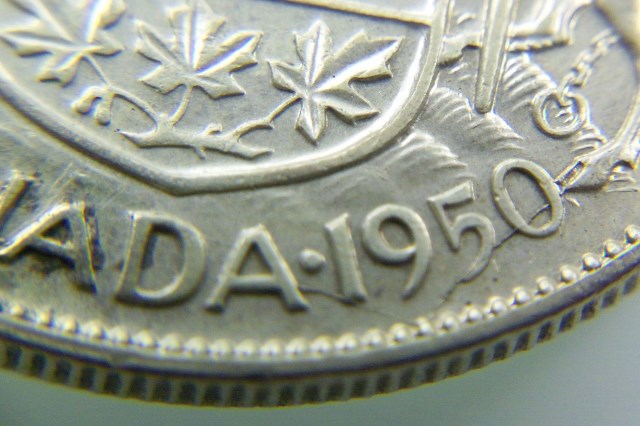 Edited by M_d_in_guy
02/28/2017 7:00 pm
|
|
Pillar of the Community
Canada
2845 Posts |
Quote:
No design variety.
Thanks for joining along m_d! A very nice one! All the various years with the die crack extending from the hoof are amongst my favorites as well. It reminds me of movement, as if the Uncorn was drawing attention to the date. Yes, all in my imagination I know but still.... |
|
Pillar of the Community
Canada
1049 Posts |
Same here Wildflower, this one is my favorite, did you click the link in the earlier post I did, this coin is riddled with d/c's all over the reverse, yet not a one on the obverse.
|
|
Pillar of the Community
Canada
2845 Posts |
Yes I sure did look at your other excellent link, and a very clear photo. Several of my die crack KGeo's are only on one side or another, not both as well.
Maybe pginrh (Paul) or someone will read here and comment, if it's known. Were the die pairs random and if so, why would one half become much more worn than the other?
|
|
Pillar of the Community
Canada
1049 Posts |
I may be wrong with this, it's a way back recollect, I believe the reverse was the hammer punch/die and with such action the same as any other mechanical instrument is prone to a failure of sorts. If I'm wrong here please, someone correct me.
A friend of mine designed systems for a bottling company, he always said the fixed position parts seldom failed, yet the moving apparatus was in constant state of repair.
Edited by M_d_in_guy
02/28/2017 9:21 pm
|
|
Pillar of the Community
 Canada
5660 Posts |
The die cracks form, as they do in any metallic element subject to repeated stresses and forces, at the stress concentration points. These points are usually where there is a rapid large angular change of direction of the design. The tip of the hoof is a prime example. Other designs, on other denominations, include the 90 degree tips of serifs, the tips of N's, I's & T's, denticle tips, etc. Almost never do you see a D/C forming on a rounded element, unless it formed because of impurities or crystalizations in the steel of the working die. Once a crack starts, it can travel wherever the crystal structure of the metal is the weakest and will widen over time until you get a die chip that breaks off the edge. Die cracks are not varieties or even a desired error, unless it is spectacular. D/C's are great markers for ID'ing specific dies for the die-tracking folks and for looking for specific varieties that have these markers. On certain denominations, you will find D/C's forming at the same place on different dies. This could be the intricacy of the design itself (ie,the hoof on the 50 cent) or it could be from the manufacturing evolution of the die making process itself, from master to subs, to hubs, etc ... where one small portion of the design is struck a tad deeper than other portions, so there is less metal to absorb the continuous blows.
Mechanical engineering processes are sometimes difficult to get a handle on, but it's as simple as this: If you walk up to a wall and punch it, the wall is pressing back at your fist with a force equal to the force that your fist applied while smacking it. As soon as your fist applies more force to the wall than it can give back, the wall will break. For any force applied to any object, there is an equal and opposite force coming back. As soon as 1 is more than the other, one will break, bend or assume a different shape. I love die cracks and they have served as roadmaps for me for my searches for large cent varieties. D/C's save wear and tear on the eyes when searching through thousands of coins for a specific variety. If there's a D/C there in that specific place and that specific shape, you can tell at nearly arm's length that you don't need to squint to see the digit or legend letter that you were looking for and also using your loupe or guessing through coin dirt/grime.
|
|
Pillar of the Community
Canada
2845 Posts |
Okiecoiner, thank you very much for your very descriptive explanation.
It's extremely helpful information.
|
|
Pillar of the Community
Canada
1049 Posts |
Ty Okie for your post, another reason I love this site so much. Everyday more learning/a vast array of knowledge.
|
| |
Replies: 24 / Views: 5,900 |







 First Page


 Posted 02/28/2017 6:59 pm





