quote:
...Give me a little history...
Sorry, didn't see that part of your post. So, for a bit of history/trivia on your coins...
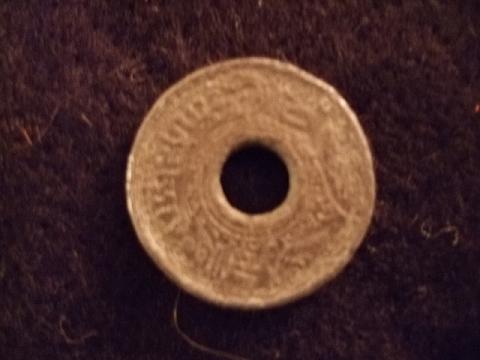
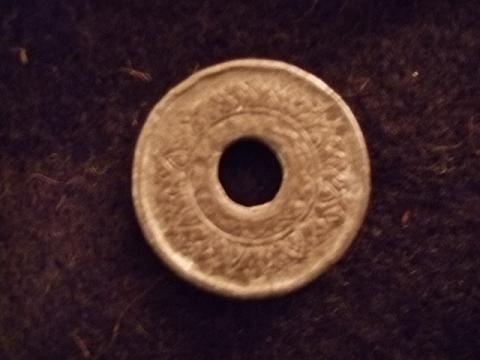
Coin #1 is definitely Thailand, I'm just not sure of the denomination and date. There was a whole series of coins from 1 satang to 20 satang, all the same design, just different sizes, issued just before and during WWII. I'm sure I can see the numeral "0" in the denomination, so I know it has to be a 10 or 20 satang.
Thai coins are dated according to the Buddhist Era calendar, for which Year 1 was 545 BC; subtract 543 from BE dates to get AD dates.
These coins were struck in two separate series. In the first, dated 2484 (= 1941 AD), the 10 and 20 satang coins were made of .650 fine silver. The same coins from the second series dating from 2485 to 2488 (1942-1945), were made of tin, a metal abundant in Southeast Asia and used as a coinage metal in the area for several hundred years.
Tin is a terrible metal to make coins from; it's soft, heavy, and turns black quickly, especially in tropical conditions. Your coin frankly doesn't look horrible enough to be made of tin, so unless better pics are available, I'll assume it's a silver one. CV for a silver 10 satang is $4 in EF, $6 for the 20 satang.
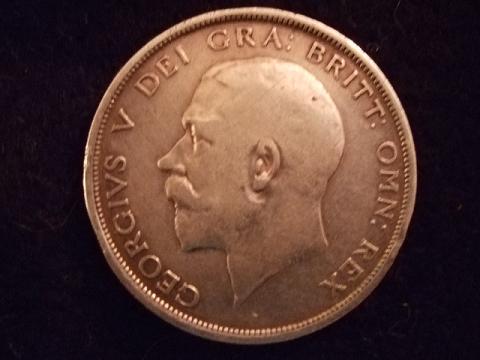
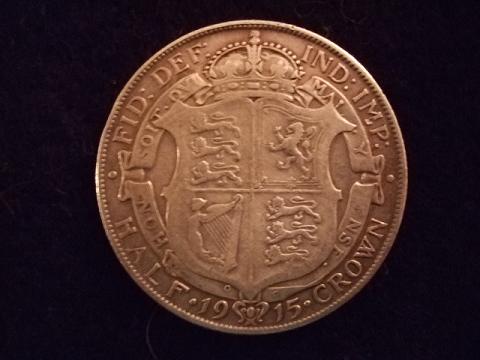
Coin #2, the British halfcrown, is made of sterling silver (.925 fine). The four quarters of the coat of arms represent England (top left and bottom right), Scotland (top right) and Ireland (bottom left).
In Britain's predecimal monetary system, there were 4 crowns to a pound, so a halfcrown was 1/8th of a pound, or 12½ pence in modern British money. At the time, a crown was roughly equal to a US dollar, so a halfcrown was about the same as a half dollar.
Coin #3, the British penny. That's an actual "penny", not a slang-word for a "cent" - Britain wasn't using a decimal system at the time; there were 240 pennies to a pound.
You can probably see the faint outline of the king's portrait, backwards, showing through on the other side. This is known as "ghosting", and British pennies were especially prone to this. It's considered a normal side-effect of the coin's design and minting process, and not a mint error.
There are also two mintmark varieties to look for on 1919 pennies: none, H and KN. The pic's too blurry to tell if there's a mintmark there or not. Look to the left of the date. H and KN are both scarcer than "none".
Don't say "infinitely" when you mean "very"; otherwise, you'll have no word left when you want to talk about something really infinite. - C. S. Lewis










 DSCF0471.jpg
 DSCF0472.jpg
 DSCF0469.jpg
 DSCF0470.jpg
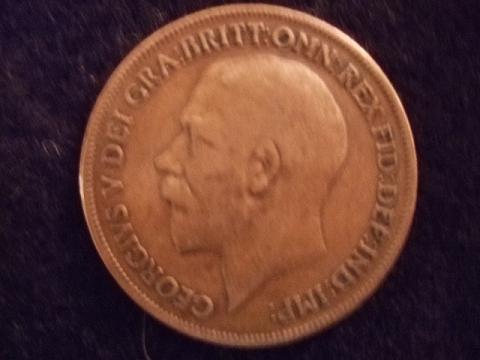 DSCF0467.jpg
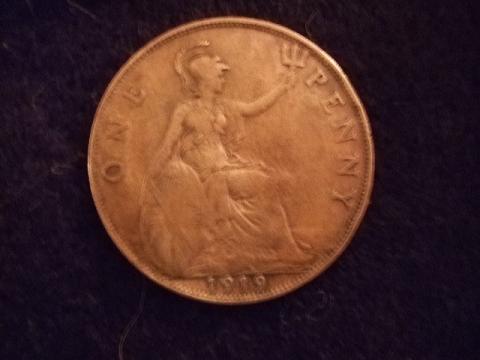 DSCF0468.jpg


 Posted 02/08/2008 09:40 am


