| Author |
 Replies: 15 / Views: 3,243 Replies: 15 / Views: 3,243 |
|
|
New Member
United States
6 Posts |
Anyone have any idea what this is or where I can research it? Image Insert: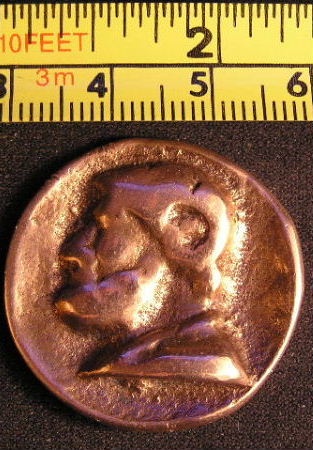 b]Image Insert:[/b] 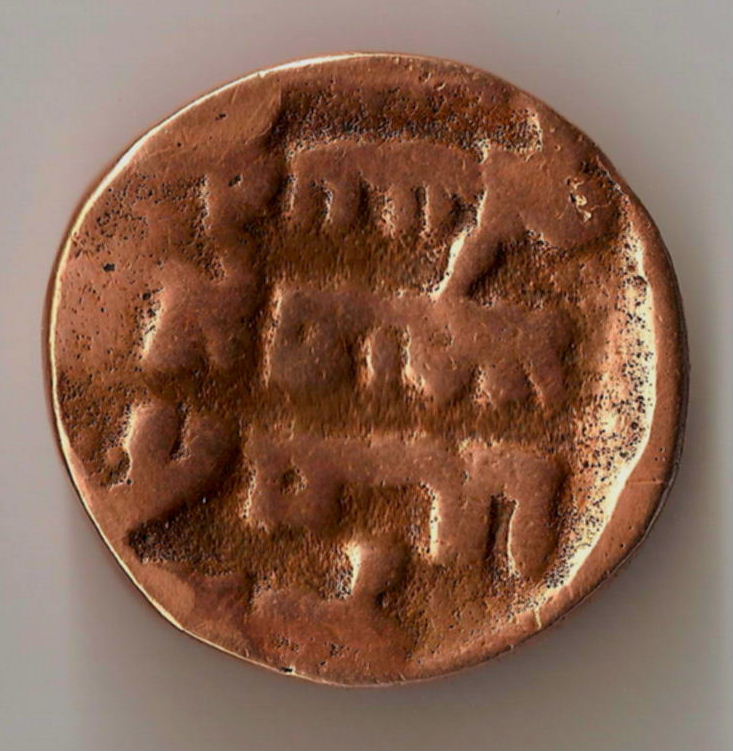 Edited by Sap
03/07/2008 07:57 am
|
|
|
|
New Member
22 Posts |
It is an Arab / Islamic coin and it is turned up side down.
|
|
Moderator
 Australia
16982 Posts |
I thought that, but that didn't really look right upside-down, either. Perhaps it's even an Indian script.
What's on the other side?
Don't say "infinitely" when you mean "very"; otherwise, you'll have no word left when you want to talk about something really infinite. - C. S. Lewis
|
|
Moderator
Australia
16982 Posts |
Thanks for posting the other side. That portrait doesn't really look like anything I've seen in the Ancient series, except perhaps early Parthian coins like this one. I did find this one with a similar basic design, but the artwork is much cruder, and those "horns" are indeed strange. From just the reverse, and description of the obverse, I thought it might be a mediaeval Islamic coin with a portrait copied off an old Greek or Roman coin, but seeing it now it looks too "classical" to be an Islamic copy. We're looking fro somewhere that used good, well-formed "classical" Greek-style portraits and a definitely non-Greek language. I'm stumped.  Don't say "infinitely" when you mean "very"; otherwise, you'll have no word left when you want to talk about something really infinite. - C. S. Lewis
Edited by Sap
02/12/2008 8:05 pm
|
|
Pillar of the Community
United States
1691 Posts |
Looks HEBREW...an ancient coin of Israel!
|
|
Moderator
Australia
16982 Posts |
quote:
Looks HEBREW...an ancient coin of Israel!
That was YosemiteGold's first theory, too (which he has since edited away). But while the script does look Hebrew (or at least from one of the Semitic alphabets), it looks almost entirely unlike an ancient Jewish coin. First off, if it's Hebrew, it's modern Hebrew - ancient Hebrew letters looked different enough to be noticeable even on a coin that well worn. Secondly, the Jews interpreted the commandment "no graven images" to include prohibiting placing pictures of humans or animals on coinage. Ancient Jewish coins (and indeed, most modern Israeli coins) tend to only show plants and inanimate objects (cups, musical instruments, etc). While they were happy enough to use "unlawful" and even overtly pagan money in everyday trade, coins they made themselves (such as during the First and Second Jewish Revolts) never used portraits. In short, no coin with Hebrew writing on one side should have a portrait like that on the other. Check out this page from Wildwinds and you'll see what I mean, about the lettering and the lack of portraits - all the portrait coins on that page were issued by the Romans, and use either Latin or Greek script. I'm beginning to think this is some kind of modern fantasy, perhaps designed to look kind-of-ancient. Don't say "infinitely" when you mean "very"; otherwise, you'll have no word left when you want to talk about something really infinite. - C. S. Lewis
|
|
New Member
 United States
6 Posts |
I've enjoyed lurking around this website for quite awhile now and have been amazed at everyone's knowledge and helpfulness. Thanks for trying SAP.
Atlas, I was told that the writing was possibly Hebrew and that the portrait was of Octavius but I haven't been able to find any info anywhere. Thanks all
|
|
Moderator
Australia
16982 Posts |
Octavian (a.k.a. Roman emperor Augustus) was clean shaven, as was the fashion in 1st century Rome, so whoever this is supposed to be, it isn't him.
Don't say "infinitely" when you mean "very"; otherwise, you'll have no word left when you want to talk about something really infinite. - C. S. Lewis
|
|
New Member
United States
6 Posts |
Could this be a portrait of Zeus with his horns and beard written in Arabic? Where would I go to find out the translation? I am now determined to trace its origin, if it is the last thing I ever do! The coin weighs in at 16.1 grams by the way. Any guidance would be Greatly appreciated.
My apologies if I'm being a pest.
Cory
|
|
Pillar of the Community
United States
621 Posts |
quote:
I'm beginning to think this is some kind of modern fantasy, perhaps designed to look kind-of-ancient.
That was my initial reaction. Could the horns suggest some kind of satanic talisman? |
|
New Member
United States
6 Posts |
There's a new theory. I'm sure the answer lies in deciphering the legend.
talisman (plural talismans)
A small amulet or other object, often bearing magical symbols, worn for protection against evil spirits or the supernatural.
|
|
Moderator
Australia
16982 Posts |
Well, the first difficulty with translating it is recognising the language. Once that can be determined, we can start to try to translate it. Of course, if it's a fantasy piece, it may not even be an actual language, only meaningless squiggles. But let's not give up hope. The language it looks most like is Hebrew, so let's have a go at applying the modern Hebrew alphabet to this coin. Here's what I come up with: 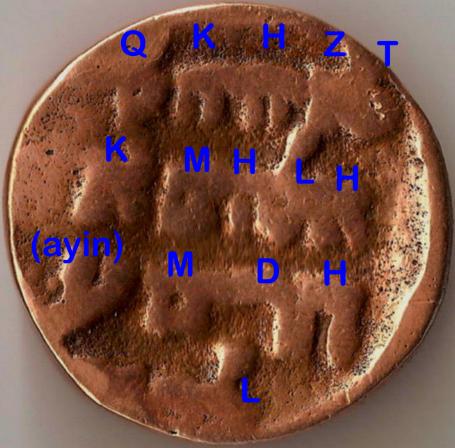 Most of the letters are only my best-guesses, with several possible options for each slot; if it's Hebrew, it's not clear Hebrew. I'd assume folks like Giladzuc, who's from Israel, would have been quickly able to tell if the words and lettering obviously made sense to them. Don't say "infinitely" when you mean "very"; otherwise, you'll have no word left when you want to talk about something really infinite. - C. S. Lewis
|
|
Pillar of the Community
United States
1691 Posts |
The Romans did rule ancient Judea so maybe it is Roman coinage from ancient Judea?
|
|
Moderator
Australia
16982 Posts |
The Romans did make Provincial coinage for the Judaean territory, but such coinage always used the Greek alphabet, never Hebrew, and they were sensitive enough to not use portraits of any kind on the coinage (though the emperor was usually named). Here's a classic example, a prutah or "widow's mite" taken from the Wildwinds link I posted to earlier, from the time of Pontius Pilate (circa 29 AD), and naming Emperor Tiberius:  As you can imagine, this series is very popular with "biblical coin" collectors, and is well studied. Don't say "infinitely" when you mean "very"; otherwise, you'll have no word left when you want to talk about something really infinite. - C. S. Lewis
|
|
New Member
United States
6 Posts |
HOLY MOSES!! I have finally and definitively found the origin and cause of confusion (translation) relating to this medal. Check this out http://penelope.uchicago.edu/pseudo...seudo59.html Now I'm in search of its value. Thank you Sap and everyone else for your efforts. |
|
Moderator
Australia
16982 Posts |
Well done, YG! That's it, alright.
Never would have guessed the horned guy is supposed to be Moses.
So ID confirmed, but still many mysteries remain. Although we know it has to originate from the middle ages, and an example was known as early as the mid-1600's, we don't know who made the original silver medals, or why, or how old this copper example might be.
Since we now know it's not ancient (and therefore hasn't been buried for centuries, dig up and then cleaned) it's reasonable to assume that the general fuzziness and graininess is an indication that this piece has been cast. The indistinct lettering might indicate it's a copy of a copy of a copy, so it may even be of fairly modern manufacture.
Don't say "infinitely" when you mean "very"; otherwise, you'll have no word left when you want to talk about something really infinite. - C. S. Lewis
|
| |
Replies: 15 / Views: 3,243 |
|









 Posted 02/10/2008 08:07 am


