| Author |
 Replies: 10 / Views: 1,860 Replies: 10 / Views: 1,860 |
|
|
Pillar of the Community
United States
2643 Posts |
Spent some time on V coins, and this appears to be a Constantine II with Victory on the reverse. Can anyone tell me the mint? Is this Constantine II? What would the legend on the obverse and reverse read as? Many thanks. 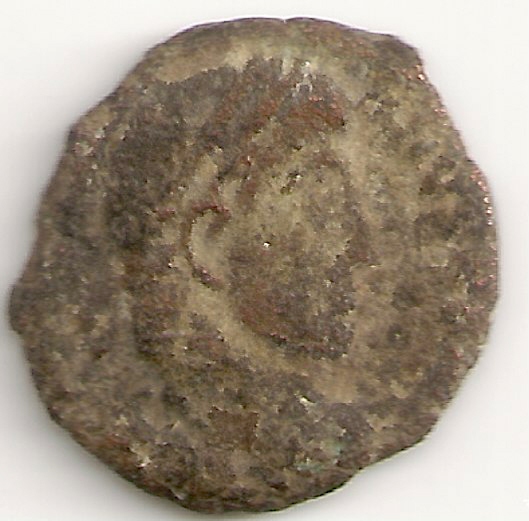 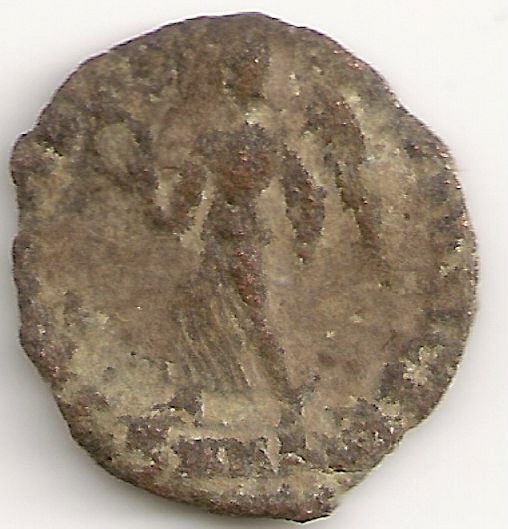 |
|
|
|
Pillar of the Community
United States
7067 Posts |
Arkie, there appears to be a "V" on the obverse at about the level of the emperor's eyes (at least that's what I think I'm seeing). Might this then be a Valentinian I with obverse legend D N VALENTINI-ANVS P F AVG (or something similar)? (Reverse = SECVRITAS - REIPVBLICAE) Like: 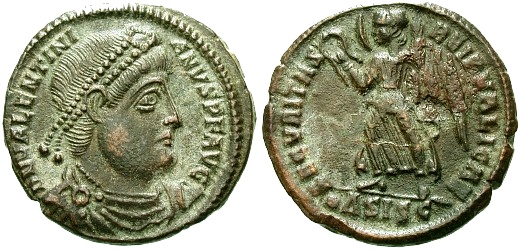 |
|
Moderator
 United States
23731 Posts |
This style was used mostly by Valentinian and Valens with the larger bust. I agree with Bob that it's Valentinian. The mint might be SNM for Sirmium.
|
|
Pillar of the Community
 United States
2643 Posts |
|
|
Pillar of the Community
United States
949 Posts |
I agree in reading the "ANVS" on the obverse right => Valentinian.
For coins of Valentinian the mint mark is in the wrong configuration for Sirmium. More likely Nicomedia; perhaps SMNA. If it is Nicomedia the reverse is SALVS REI-PVBLICAE which might explain the slightly different appearance of the central figure from that of Securitas.
{Edit - My mistake. The Salus reverse has the figure seated. This has to be the earlier SECVRITAS-REIPVBLICAE as Bob L originally suggested. However, I stand by the attribution to the mint at Nicomedia.}
The effacement of the rest of the exergue tempts another character, but Antioch is also not possible.
Edited by lrbguy
06/21/2016 12:33 am
|
|
Valued Member
United States
129 Posts |
Hi,
Just curious if there's a reason for the conclusion that this is Valentinianus instead of Gratianus? Would like to see how the determination is broken down.
|
|
Pillar of the Community
United States
949 Posts |
1. For me it starts with the mint mark. The letter combinations are rather limited, and an attribution to Nicomedia seems most likely, as I posit above.
2. The obverse seems to show quite clearly an NVS portion of inscription on the right side, which also seems to be preceded by an A and then a break.
For coins of Nicomedia of this module (AE3) the break pattern for Gratian reads as NVS after the break, not ANVS. The break pattern for Valentinian does read as ANVS after the break.
If the module has been misread, or the mint can be shown not to be Nicomedia, then other combinations may be possible. So the analysis is not exhaustive, but preliminary.
By what process/logic would you attribute the coin to Gratian?
|
|
Pillar of the Community
United States
7067 Posts |
Cap, for me it simply came down to the position of the "V." On the Gratians the "V" is most often above the level of the emperor's eyes.
|
|
Valued Member
United States
129 Posts |
Hi,
Sorry to take so long to reply, and thanks for replying to my question.
It seems that Gratian had -ANVS after the break for his issues from Anitioch and nowhere else. I didn't note the A prior to NVS, and I apologize for that.
I think the exergue reads SIRMA (? maybe that last bit is the E in REIBVBLICAE). So based only on my eyes and limited knowledge it is Sirmium (first officina), as echizento stated, and making this Valentinian I - SECVRITAS REIBVBLICAE.
Again, very much appreciate the insight the more experienced folks for all your willingness to help. Thanks for making me think.
|
|
Pillar of the Community
United States
949 Posts |
Quote:
I think the exergue reads SIRMA (? maybe that last bit is the E in REIBVBLICAE). So based only on my eyes and limited knowledge it is Sirmium (first officina), as echizento stated, Let me explain why it cannot be Sirmium. For the Valentinian period the mint at Sirmium used only one type of mint mark for bronze, and that is one in which the letters "SIRM" are preceded by the officina letter (for the two officinae A or B) or by nothing at all. Focusing on the exergual marking on this coin, the reconstruction in white follows the reading suggested by "SIRMA"; the reconstruction in yellow follows my suggestion for Nicomedia, "SNMA" with an uncertain disruption of the surface after it. 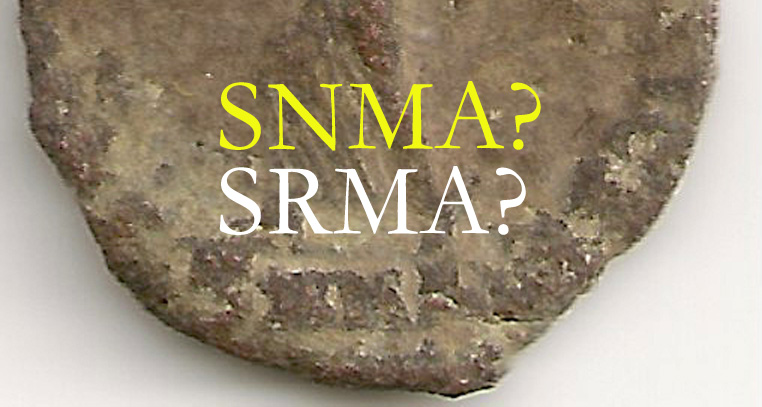 If the initial exergual letter is read as an "S" and the second as "R" there is no room or mark between them corresponding to an "I". Moreover, for a mark from Sirmium the officina letter should precede but not follow. It is questionable whether there is another leatter ahead of the "S" (I am dubious) but there is no question that something resembling an A follows what is being read as an "M." In my reading the initial letter is an S followed by a slightly deformed "M." While the next letter bears resemblance to an "M" it could just as easily be an upper case "N." This followed by an "A" and nothing more. Since the mark form being proposed for Sirmium is not attested for this period (or any that I know), but the mark form proposed for Nicomedia is attested for coins of Valentinian, I submit that the reading as SMNA has the higher probability. Edited by lrbguy
06/25/2016 12:57 pm
|
|
Valued Member
United States
129 Posts |
lrbguy, thank you very much for showing how you came to your conclusion, and especially for pointing out the placement of the officina letter PRIOR to 'SIRM' in the known coins for Valentinian. Based on that, your reading seems most likely. Thanks again for taking time to explain.
|
| |
Replies: 10 / Views: 1,860 |
|







 Posted 06/19/2016 6:29 pm





