| Author |
 Replies: 75 / Views: 10,529 Replies: 75 / Views: 10,529 |
|
Pillar of the Community
2087 Posts |
My example of this lens is an older enlarger lens version. Schneider Kreuznach(SK) still produce the same lens but in a different body. They sell this newer version as a machine vision lens. In researching machine vision I have always been fascinated by the extreme, to my eyes, amount of extension that almost seems to be common with such lenses. So last night I decided to try my version of the lens reversed with as much extension as I could assemble. I was intrigued and impressed by the result. All I had was two extension ring sets and a bellows. I could have linked two bellows together but previous experience told me that this would introduce too much vibration. The result was 320mm of extension and a magnification of just below 8X. now I don't have the experience to say how it compares to a Microscope objective what I can say is I now understand that these lenses can take a lot of extension while maintaining a reasonable working distance. At the extension I set up the working distance, from subject to the first element of the reversed lens, was 35mm. 35mm is much greater than that of the cheap 4, 5 & 10X microscope objectives I have. I discovered one rectifiable problem I didn't have any means to diffuse the light. So the demonstration stack does suffer as a result. What I found was the lens even at this level of extension appears to have a very flat field( much better than my microscope objectives) and there appears to be potential for further extension, without getting into empty magnification territory. It also easily covered the 36mm X 24mm sensor. It was much easier, and more effective, to use than my cheap 10X objective. I just left the stackshot at the currently set 0.007mm step, and used an Axumite coin as a subject. 63 shots and this is the result: 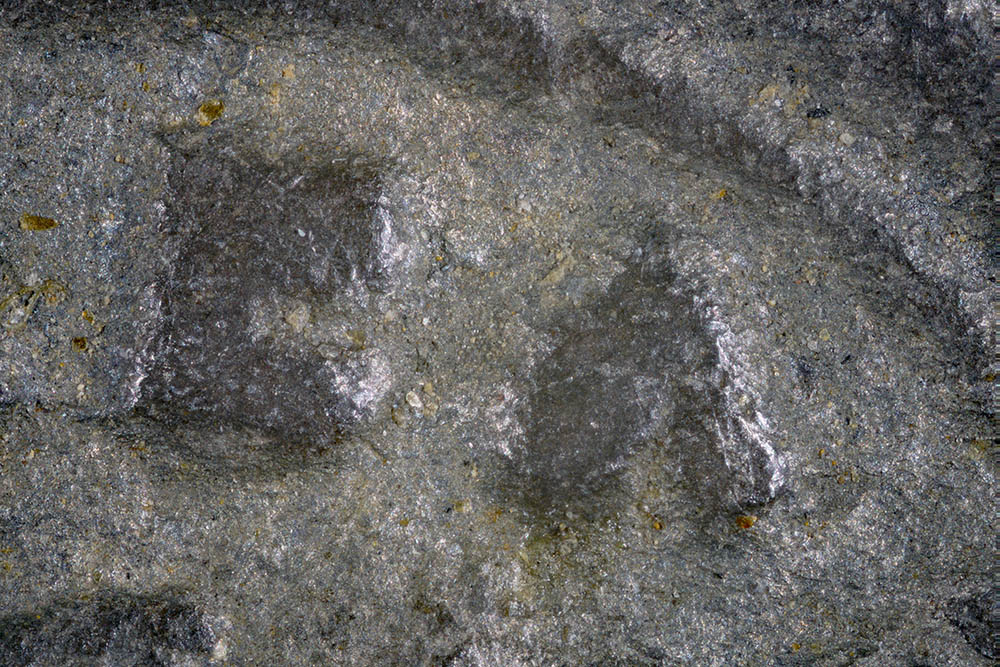 Edited by austrokiwi
07/25/2016 01:00 am
|
|
|
|
Pillar of the Community
Canada
2784 Posts |
austrokiwi excellent. I have purchased a reverse ring for my sk. I want to find out how far I can push the sk. very well done austrokiwi. excellent photo.
|
|
Pillar of the Community
 2087 Posts |
Quote:
very well done austrokiwi. excellent Thank you Rocky but I am not happy with it... I am starting to wind back my view that I hadn't reached the point of empty magnification. Looking at the picture after a few hours I need to go though the magnification range of the lens and see more thoroughly what is going on. I do like the lens Mounted normally it handles 0.2X through to 1X happily and reversed it covers up to 5 X well. I need to do some more playing round to assess if at higher magnification it is actually performing well Edited by austrokiwi
07/25/2016 11:14 am
|
|
Pillar of the Community
Canada
2784 Posts |
austorkiwi I have purchased a sk 45mm apo. I hope to pick it up on Wednesday. I will have to wait for the reverse ring. I am very glad thou to see you push this lens. I like to see where they performer there best and at what magnification. nice work austrokiwi. wondering austrokiwi have you heard about this new forum. they are converting old DSLR into microscope camera. I believe that this group has started to promote. this new adaptor. they attach the adaptor to a round microscope post. the adapter has built in correction glass. you attach the microscope objective. what ever power you want. there images are very good. actually outstanding. if I find the link again I will attach it here. have a great one
|
|
Pillar of the Community
2087 Posts |
Rocky , which Forum are you referring to? I had the SK45/4 but when I got the 40/2.8 I sold it.
|
|
Valued Member
United States
71 Posts |
Thanks for sharing the experience. Was there any significant diffraction at 8X? The effective aperture would be at least F2.8*(8+1) = F25.2, probably even smaller if a higher f-stop was used.
|
|
Pillar of the Community
2087 Posts |
I think you have identified what I didn't like about the photo. The picture that has been posted is significantly reduced and therefore looks sharper than the original. At that level of magnification I left the lens wide open. As Scotty put it... "Ye canna change the laws of physics Jim"
|
|
Valued Member
United States
71 Posts |
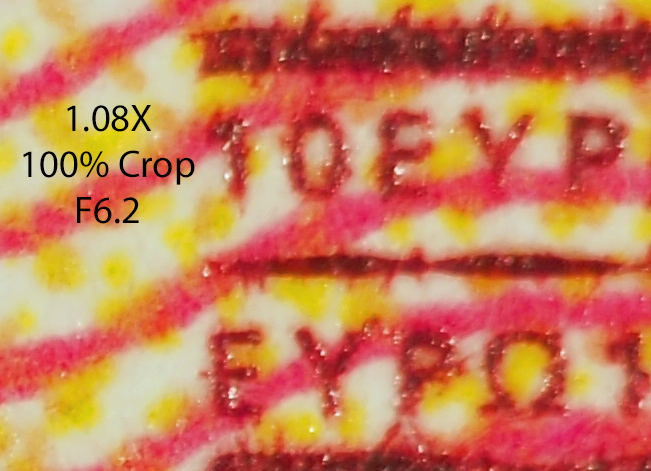
After venturing beyond 5X a few times, unsuccessfully because of diffraction, I am now very wary of high mag shots. It is easy to go beyond 5X, with a Canon 20mm macrophoto lens for example, but then the picture has to be significantly reduced to achieve resemblance of sharpness. 100% crops are just blurry.
The sad thing is that it took me some time to figure out that the blurriness was caused by diffraction. I was blaming vibration for it.
|
|
Pillar of the Community
 United States
4051 Posts |
All is not lost. A 10x 0.25 objective has a nominal aperture of approximately f1.8:
Feff=M/(2*NA)=(M+1)Finf
Finf=M/((M+1)(2*NA))
At 10x, this means an effective aperture of f20, which is definitely into diffraction territory. But many 10x objectives have wide enough coverage that you can push them down to 5x, thus achieving f11, and be within striking distance of the DLA of many of the cameras we use. At f11, you won't see diffraction very strongly, if at all. Even if the coverage is not that great, you can still get excellent center sharpness, then crop the parts you want.
10x 0.25 objectives are quite cheap and plentiful, which is somewhat amazing to me. An optic that is optimized for superb performance at 10x magnification, with a nominal aperture of f1.8, can be purchased for peanuts!
Perhaps I'll do a shootout of 10x objectives at 5x to see what one(s) do best there.
edited to add: I see you said "beyond 5x" but my response focused on 5x...
Indeed, you will see diffraction effects at 10x with most objectives on newer cameras. If you use an older camera, with larger pixels, you won't see it as much, but the spatial resolution is lower.
Keep in mind that all cameras have a built-in limitation of resolution due to the sensor algorithms, AA filters, etc. Even cameras without AA filters do not really provide full resolution at 100% pixel density, because they don't really have as many pixels as they say they do. The result is that in order to get full resolution, a 2x downsize is needed in order to ensure each image pixel has full resolution of RGB.
So bottom line, if you always need to downsize by 2x for maximum sharpness and resolution, then you can tolerate an effective aperture of 2x the DLA of the lens, and still have full resolution. This opens the field to a wider range of objectives and magnifications.
Contact me for photographic equipment or visit my home page at: http://macrocoins.comEdited by rmpsrpms
07/31/2016 09:44 am
|
|
Pillar of the Community
2087 Posts |
|
|
Pillar of the Community
United States
4051 Posts |
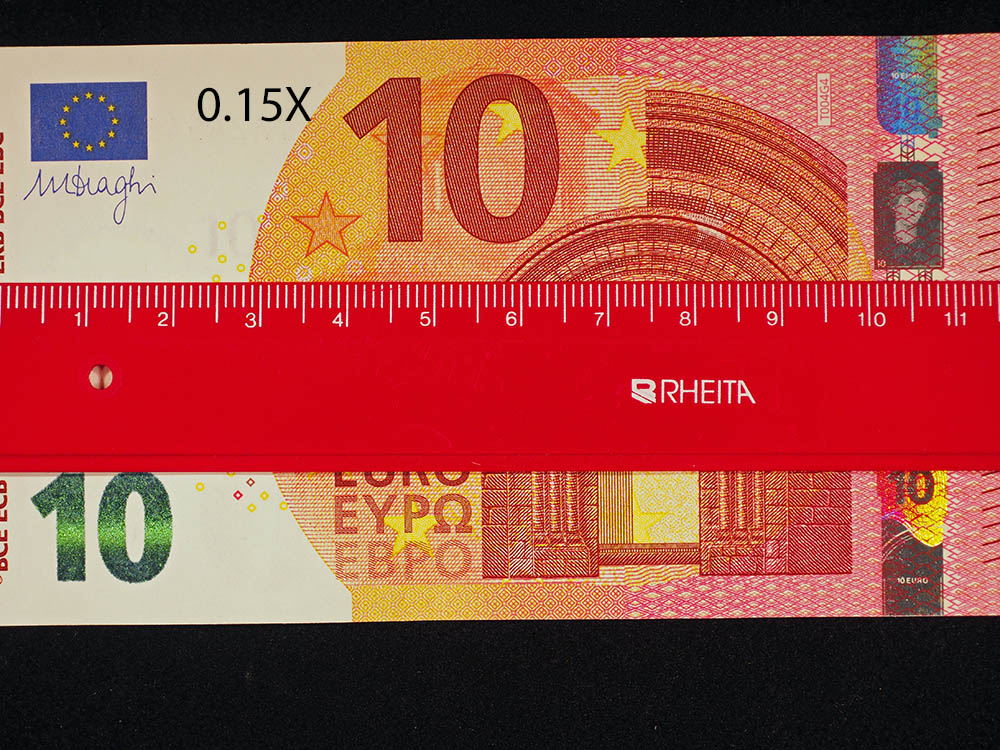
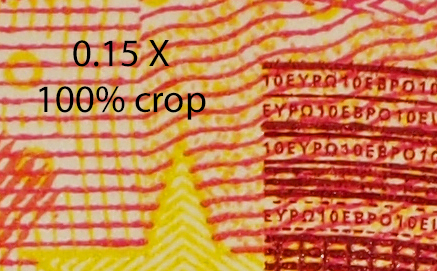
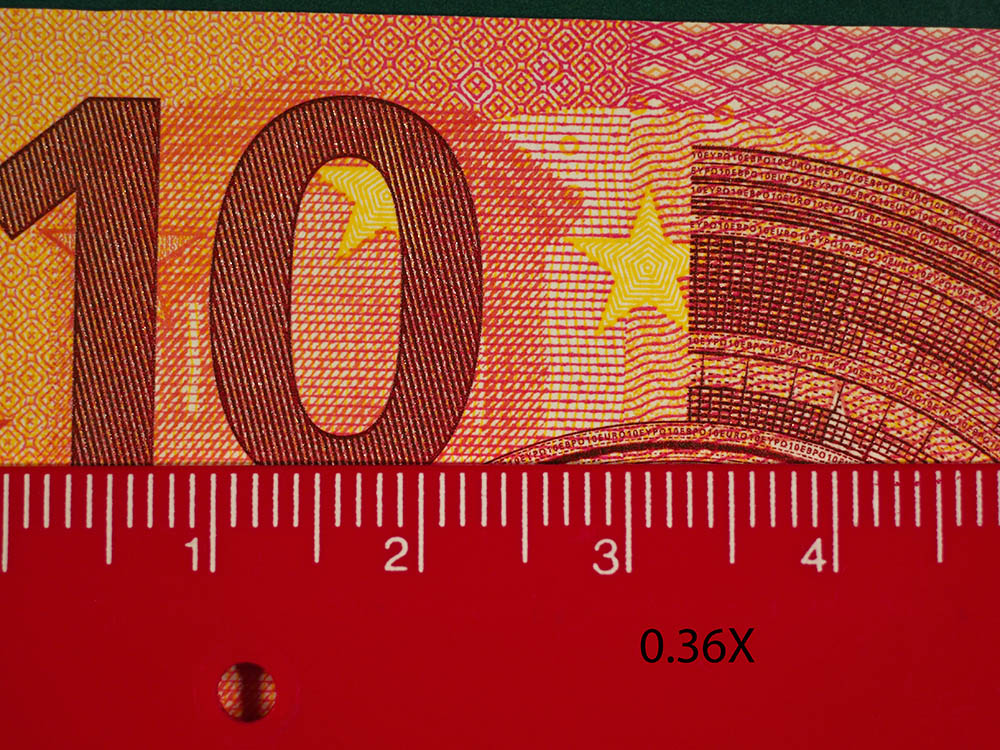
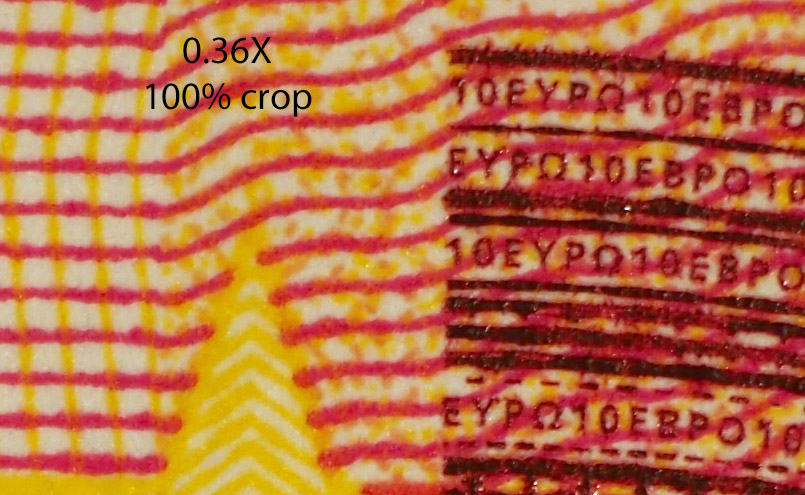
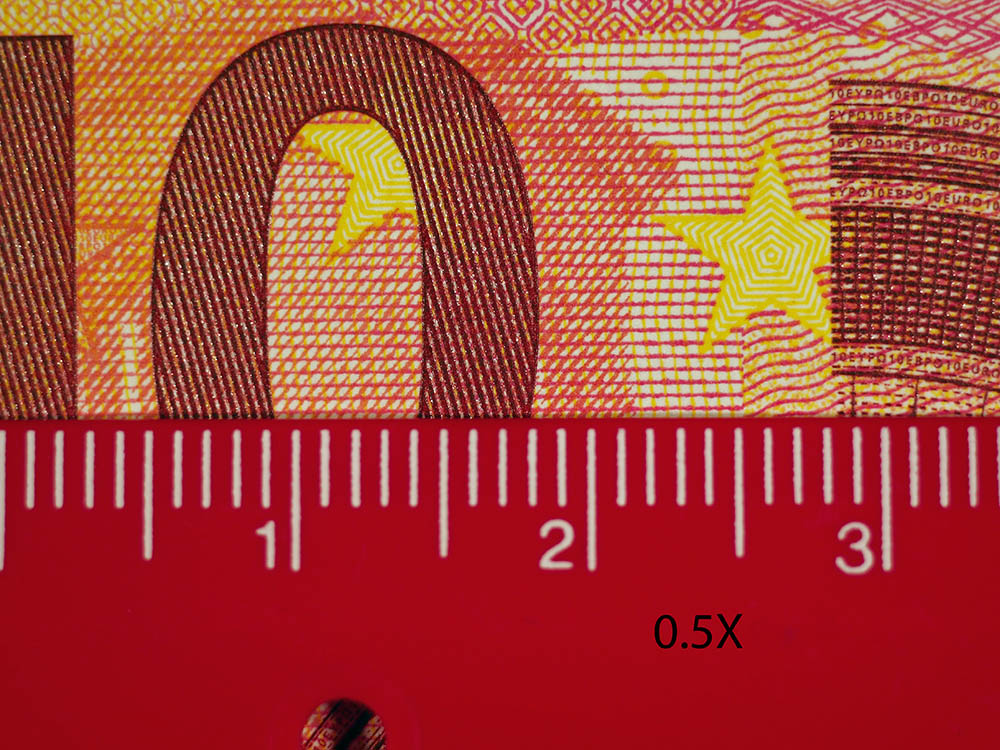
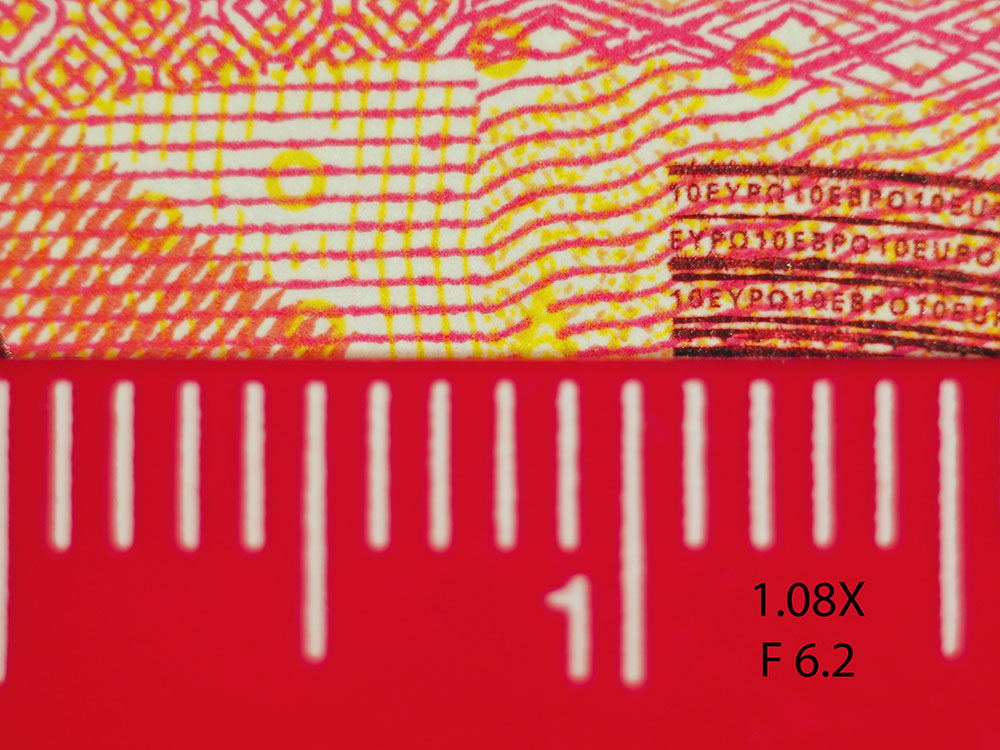
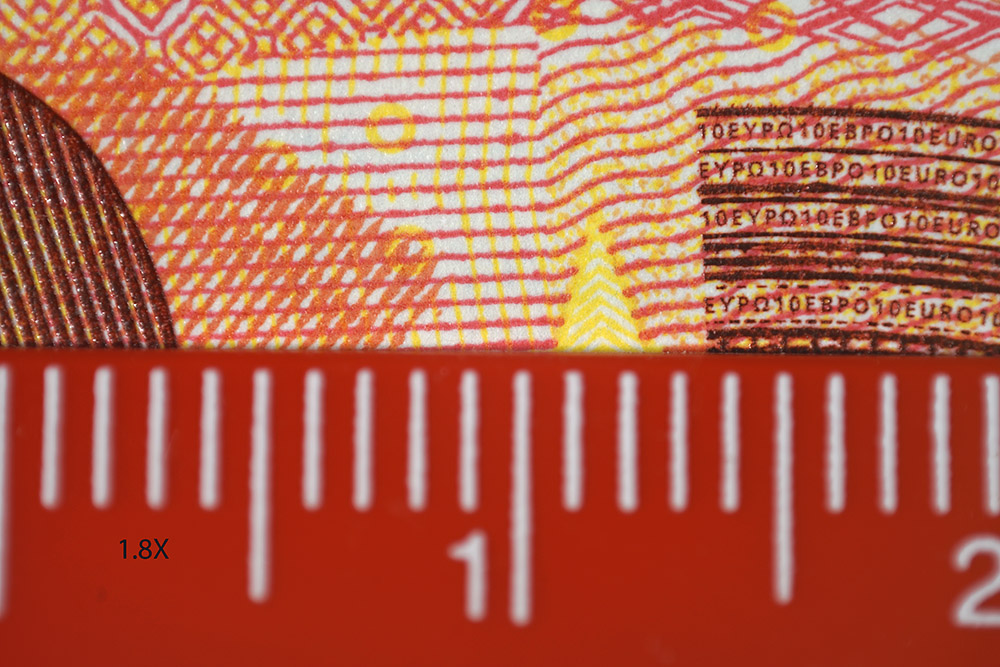
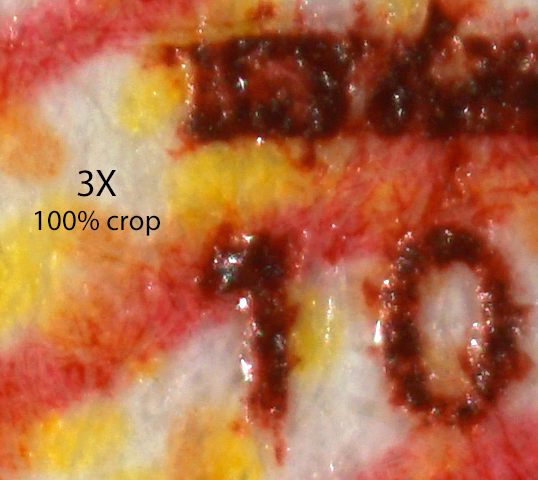
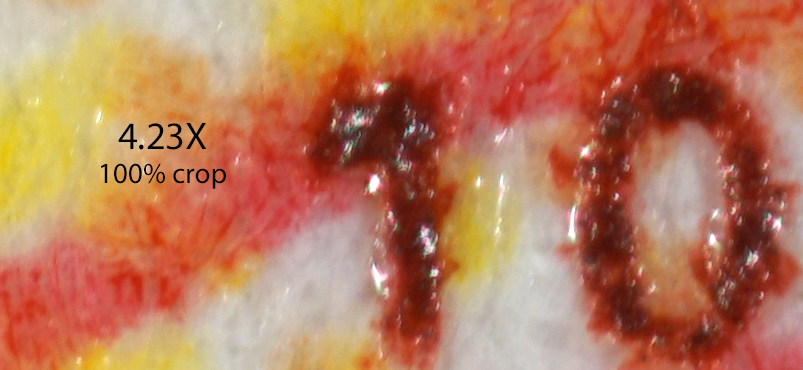
AK...that lens is doing very well across the full mag range. It seems like your 0.5x shot is a bit OOF, since the 0.36x and the 1.08x are looking better.
I'm coming to realize that I've been concentrating on the 75-105mm range of focal lengths primarily because of the long register distances of the Canon camera I use. Its 44mm register distance, plus perhaps another 44mm minimum bellows extension, plus perhaps another 12mm for camera and lens adapters, gives a minimum total extension of perhaps 100mm. This is very limiting and with a 75mm lens allows only .33:1 minimum magnification.
The Sony/MFT register distances of 18-19mm removes 25-26mm from this equation, giving a total minimum extension of perhaps 75mm. This can allow a 60mm lens to have .25:1 minimum magnification. If you take care with adapters, and limit yourself to bellows with 36mm minimum extensions, you can gain perhaps another 10mm, which would allow a 50mm lens to get to 0.3:1. It would be huge to be able to use 50mm lenses, as plentiful as they are.
I assume you are direct-mounting your 40mm lens with a helicoid or extensions to achieve 0.15x, correct?
Contact me for photographic equipment or visit my home page at: http://macrocoins.com |
|
Pillar of the Community
2087 Posts |
Edited by austrokiwi
07/31/2016 2:57 pm
|
|
Pillar of the Community
United States
4051 Posts |
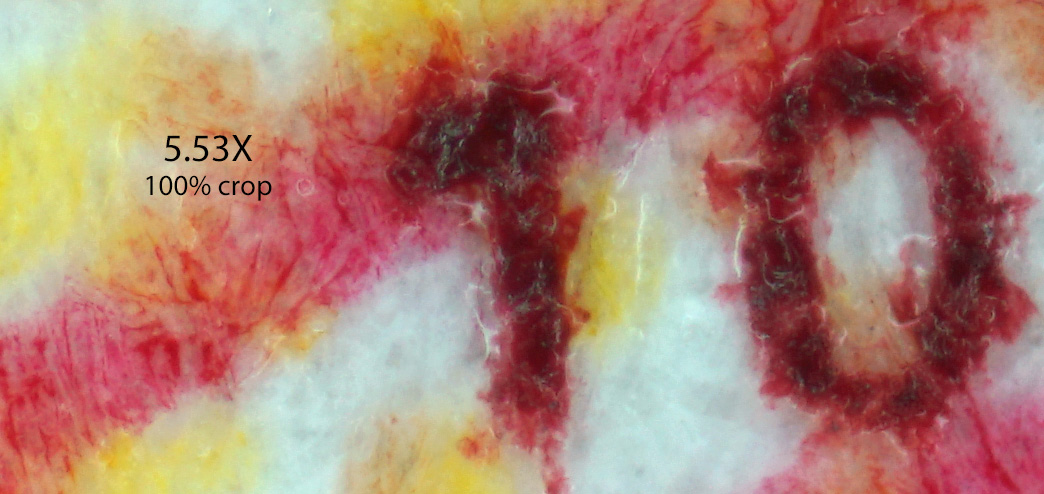
The 5.53x is surprisingly good, too good for a single shot...stacked?
Contact me for photographic equipment or visit my home page at: http://macrocoins.com |
|
Pillar of the Community
2087 Posts |
Quote:
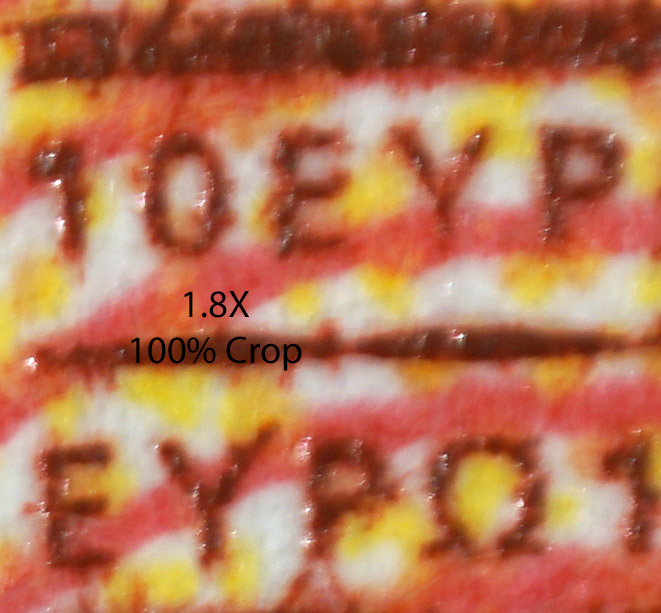
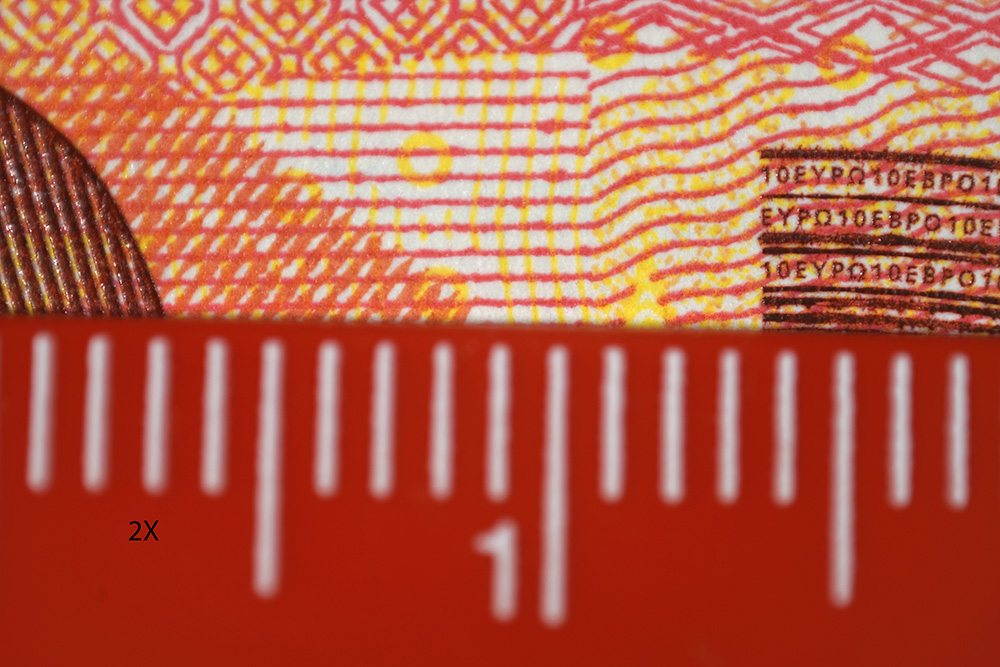
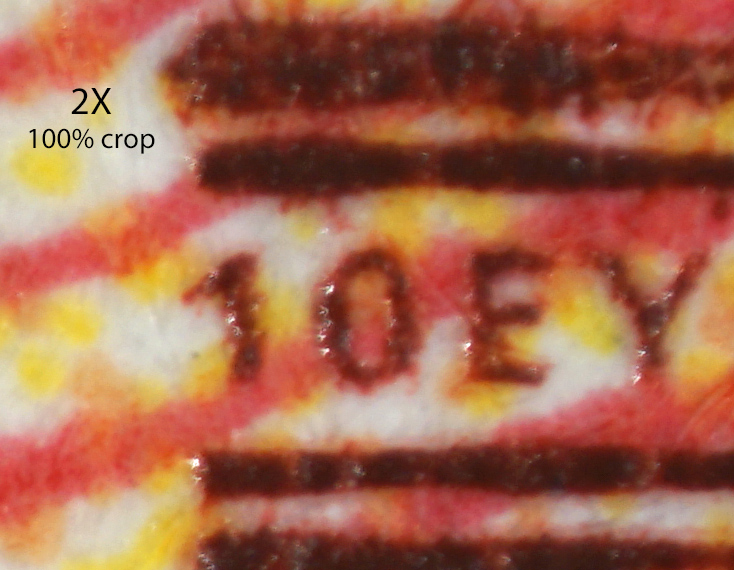
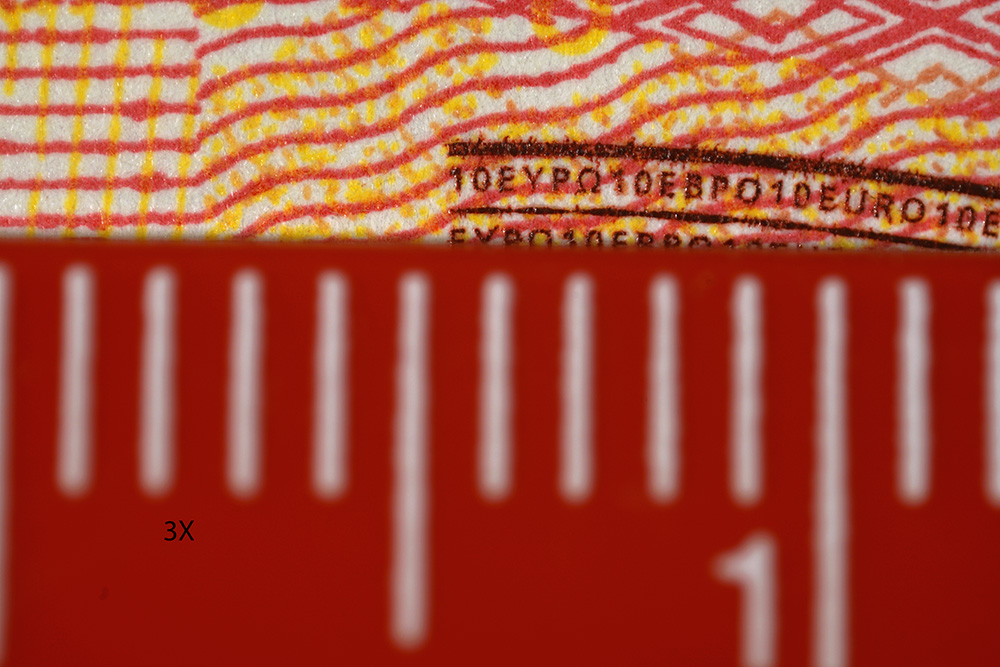
The 5.53x is surprisingly good, too good for a single shot...stacked?  I used the €10.00 note so that I didn't have to stack. It was a single shot..... Its an impressive lens ... To morrow I will push beyond 5 Times but I suspect I will find the limit of its performance is not too far beyond 5X |
|
Pillar of the Community
United States
4051 Posts |
The 5.53x shot has a very different "character" than the previous ones. The highlights are much more subdued, and the color is more saturated, with reds looking more red. White balance is different also. Did you change lighting? The 4x is blurry, but I can't imagine this small shift in focus would cause such a color change on an Apo lens. I did a quick animation of the two images to show the shifts...  Contact me for photographic equipment or visit my home page at: http://macrocoins.com |
|
Pillar of the Community
2087 Posts |
I can see the difference, but I have no idea how it occurred I just took the series of shots. Focus was difficult as it only took a tiny( very tiny) movement to take the note from focus to out of focus. It might be something to do with the aperture indicator( light leaking in on the earlier shots). other than that I have no idea how the difference arose. The lens is still set up for that last shot I will check to see if the aperture changed when I added the extension.
Edit: DOH!! ( Homer Simpson moment) the working difference had dropped to such a level I had switched to a microscope ring light for the last shot I didn't change the white balance from the previous shots.
Edited by austrokiwi
07/31/2016 11:59 pm
|
| |
Replies: 75 / Views: 10,529 |










 Posted 07/25/2016 11:13 am