Coin Community Family of Web Sites
Shop for APMEX Bullion on eBay!Vancouvers #1 Coin and Paper Money Dealer Royal Canadian Mint products, Canadian, Polish, American, and world coins and banknotes. 300,000 items to help build your collection! Specializing in Modern Numismatics Coin, Banknote and Medal Collectors's Online Mall Shop CCF Members on eBay!


Username:
Password:
Save Password
Forgot your Password?


This page may contain links that result in small commissions to keep this free site up and running.

Welcome Guest! Registering and/or logging in will remove the anchor (bottom) ads. It's Free!

Survey Of Counterfeit Coins On Ebay

To participate in the forum you must log in or register.
Author Previous TopicReplies: 30 / Views: 12,000Next Topic
Page: of 2
Pillar of the Community
swamperbob's Avatar
United States
5362 Posts
 Posted 03/02/2008  11:22 pm Show Profile   Bookmark this topic Add swamperbob to your friends list Get a Link to this Message Number of Subscribers
I think I have mentioned elsewhere that about once a year, I do a rough spot check of ebay and record the numbers of counterfeit coins posted and the number of bidders. This year I expanded my spot check and I thought I would post the results, because they were surprising to me.

For three months I watched ebay and recorded the results - I was hunting only for coins that were ADMITTED counterfeits, non-regal, fakes, frauds, copies and replicas. I did a daily search of the coin section using each of those terms and put the coins on my watch list. When the auctions ended I recorded results. But this time I also recorded the bidder names and broke the numbers down into three categories (based solely on my personal interests).

The groups I recorded were Mexican Cap and Ray counterfeits (my favorites), Mexican Colonial Portrait counterfeits (recognized by Colonial collectors) and all other types of counterfeits. That last category includes the rest of the world but the Great Britain coppers and US counterfeits are the vast bulk of the other group - many are new and come from China. (Based on a 1 week spot check, 19 out of 20 coins in the other group were US or GB.)

I did not attempt to record the counterfeit coins sold on ebay with NO warning from the seller. I did that because I would have had to look at every coin listed on ebay and that would be an insane amount of work. However, I did look at EVERY auction involving a Mexican coin. That is my normal daily search.

I was interested primarily in the level of interest of buyers - people like myself who buy counterfeits intentionally. I also did not differentiate between the legal and illegal offerings. In the US - counterfeit US coins are for the most part illegal to own or sell, so the number of purely illegal auctions is LARGE.

Here are the results.

1,068 counterfeit coins were listed openly on ebay.
1,416 different bids were made on these coins. (Many did not sell)
I DID NOT count multiple bids. In many cases only the top bid.
540 different ebay identities bid. That was a surprise!

Only 50 of the 540 bidders (about 1 in 10) bid in more than one of the three categories. They break down by category as:
58 bidders for Cap and Ray
79 bidders for Portrait
403 bidders for others

The categories of identified counterfeits break down as:
24 Cap and Ray
72 Portrait
972 Others

As I noted above, I also identified all Mexican Cap and Ray coins that I considered to be Counterfeit. This amounted to an ADDITIONAL 134 coins. They attracted 108 bidders.

So there were 158 Cap and Ray counterfeits that I spotted in 90 days but only 24 were properly attributed - that is about 1 out of every 7 that is properly identified. If this ratio is applied to the other 2 categories - it could mean that the real numbers were 474 portrait and 6,399 other counterfeits.

This is very interesting but not a scientific study. It does indicate that there is a significant interest in counterfeits on ebay and that the majority of counterfeits are not appropriately identified.

By the way, ONLY 6 auctions were caught and terminated by ebay in this period - ALL 6 were obvious or properly identified. In the same period there were numerous criminal frauds where modern worthless fakes were sold for hundreds of dollars.

A couple final comments - ebay now makes many auctions that pass $100 anonymous. I lost bidding records on a great number of auction bidders because the bids exceeded $100 and the identities of all but the high bidders were eliminated. I also did not bother recording auctions with PRIVATE bidders lists so if anything, my numbers are UNDERSTATED.

Just thought someone might find this interesting.
Moderator
Learn More...
Sap's Avatar
Australia
16805 Posts
 Posted 03/03/2008  12:39 am  Show Profile   Bookmark this reply Add Sap to your friends list Get a Link to this Reply
So, just to clarify a couple of things...
1. These weren't listed in the "Novelty and Replica" or "Reproduction" sections, these were in the main coin section, right?

2. Were the Cap and Ray and Portrait counterfeits contemporary, or modern Chinese copies? Or a mixture of the two?

Speaking of Chinese copies, have you seen this thread over on CU, showing pictures of Chinese counterfeiters in action, and some of the dies they use? Most fascinating.
Don't say "infinitely" when you mean "very"; otherwise, you'll have no word left when you want to talk about something really infinite. - C. S. Lewis
Pillar of the Community
Peter THOMAS's Avatar
Australia
2830 Posts
 Posted 03/03/2008  09:00 am  Show Profile   Bookmark this reply Add Peter THOMAS to your friends list Get a Link to this Reply
G'day, I collect by year.
One of my targets is British coins of 1820 (only the threepence to go before I complete the set).
I discovered that many counterfeits exist: particularly of the shilling and the half-crown. I have only ever seen one counterfeit Crown.
Usually they are struck in brass, or sometimes copper, then coated in something - perhaps mercury - to give them a silver appearance. Some coins still have traces of this coating evident in the protected parts of the surface. The sole Crown was exceptional, in that it was made of lead, which might feel right for weight, and when newish, might pass for silver.
I have acquired a few of these, as I think they are interesting conversation starters, when juxtaposed to the real thing.
It is also a special sensation to hold a fake, when you know that when it was made, the penalty for possessing it was "death".
Now, I haven't kept the figures like SwamperBob has, but my impression, after searching "1820" in coins, and ticking the "worldwide" option, in Ebay-USA, Ebay-UK, and Ebay-Oz (get a different result each time), every week for over 2 years:
The number of fakes is at least 10% of all coins offered in shillings & half-crowns.
there are always a couple of fakes to be had, if you want them.
Only about 10% are listed as fakes, counterfeits, etc.
The other 90% are evident to me because of the colouration. I think these are mostly sold by uninformed sellers. I say this because sometimes, the seller imagines that he's "onto something": high start price, and the description "Rare brass shilling" or similar. Some imaginative entrepreneurs make up little stories about "emergency money".
All the ones that I have acquired seem to me to have been manufactured circa 1820, rather than recently. Most don't show a lot of evidence of wear: they became worthless once the coating started to disappear.

And thankyou Sap for that link to the factory. I've visited China four times, and have seen lots of such coins. The only one I bought was a silver UK penny of 1907 (Britannia reverse), with a young head Queen Elizabeth obverse: the most spectacular example of a numismatic mule I have encountered, and I got it for a dollar.

Peter in Oz


Pillar of the Community
swamperbob's Avatar
United States
5362 Posts
 Posted 03/03/2008  10:33 am  Show Profile   Bookmark this reply Add swamperbob to your friends list Get a Link to this Reply
SAP - These were all listed in the COIN section. None are properly marked "COPY" even when they are modern copies. I do not bother with the Replica section.

The Portrait coins by a very wide margin were Contemporary counterfeits. I think the market is maturing in that case and the sellers on ebay are aware they can make more money selling contemporary counterfeits when they are properly identified. I didn't specifically list any Chinese types - but I can't recall any being in the total.

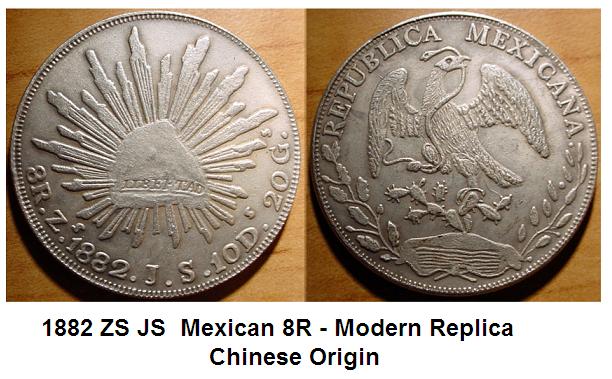
The Cap and Ray coins are split about half and half Contemporary and Modern Chinese. I was actually quite surprised at the number of times the VERY BAD 1882 Zs Chinese replica was listed as a counterfeit or a contemporary counterfeit. Personally I think that calling the 1882 Zs a "counterfeit" is deceptive. It sold almost every time it was listed and a couple times sold for over $20. It is a nearly worthless coin. Here is the one I am referring to:

Image Insert:
Survey-Of-Counterfeit-Coins-On-Ebay


With respect to the Cap and Ray coins that were not properly identified, the large majority were contemporary copies. Most of the sellers that I contacted had no idea they were counterfeit. There were 10 auctions relisted or modified as a result of my initial contact. But I did not contact all of the sellers. There were perhaps 10-12 copies of the 1882 Zs mixed in as originals and once again most of them sold.

I had not seen the pictures of the Chinese operation. The pictures are very interesting and typical of the small shop operation. There is one apparatus shown that is apparently an edger. The coins are fed in from a vertical tube. It has two moving wheels (a fly wheel and wheel driving the piston) and you can see the coin rolling along between two parallel flat bar dies. One die is driven by a piston and the other die must be fixed. They are edging POST STRIKE as evidenced by the struck coins in the sack. But if they were to make better edge dies (circle and rectangle for portraits) and if they edged their blanks BEFORE the strike - they could improve the end product a great deal. It also appears that they may be mixing in silver blanks. Some of the coins do have a "silver" coloration.

If you notice - some of the dies are made worn. The greek coin partially shown in one picture is clearly copied from a worn original and lacks high point detail.

These dies appear to be steel and may be photo engraved or produced by computer engraving of some sort. The fields are clearly ground to surface the dies - but it is poorly done. I can not see a camber. The dentils are very short on the dies - they should enlarge the die face and extend the dentils a couple millimeters and strike without the centering collar. This would produce a far better end product for the copies of screw press coins.

Peter THOMAS There are innumerable counterfeits of the GB issues you point out. All of the milled series were targeted. There are in fact crowns, but they are not sa plentiful as say the shillings. I believe the shillings were copied more often than any other denomination except the half pennies.

The crown you describe should be alloyed with something to make it hard. Lead counterfeits were never successful. Pewter was used but rarely pure lead. They usually used antimony as a hardener as I recall. At times people mistake zinc alloys for lead. Zinc is a lot lighter (lower SG) but I have seen many coins labeled lead that were actually zinc. Zinc has a greasy feel and may have a surface covered with "dots".

I also agree with your ratios. I have tracked counterfeits as a percentage of all auctions but find that the results vary widely.

For the Cap and Ray 8Rs - there is a distribution based on date as well. Counterfeits of the coins dated in the 1830s are common while counterfeits of the 1850s coins are RARE.

The thin silver (mercury or paint) washes are far more common than the older Sheffield plate coins. The Sheffield coins are metal sandwiches - three layers with thin silver sheets pressed onto an off metal core. These counterfeits Crown and half crown size were made from 1790s to 1820s. You should be looking for those.
Pillar of the Community
thq's Avatar
United States
3342 Posts
 Posted 03/03/2008  11:19 am  Show Profile   Bookmark this reply Add thq to your friends list Get a Link to this Reply
Interesting....and I seem to be having no trouble finding those counterfeit 1805 Mo 8R portraits these days.....

Yesterday I took Bob's advice and set up a rig to measure specific gravity. I made a noose out of sewing thread (which had a wet displacement of .01 cc, which I deducted from coin volumes for the sg calculation) then suspended the coin from a ring stand. Underneath I used a beaker full of water placed on a good 2 place platform scale, which I could tare out as needed. Amazing how well this trick works to give you a coin's volume - much better than trying to use a micrometer and coin diameter - and it was easy to test a variety of 20 coins in an hour. Accuracy is about +/- .05 g/cc. The only irritating problem was having a coin slip out of the noose....

Here are the highlights. Real coins first.

1. 1890 English crown in F. Specific gravity of 10.41, consistent with sterling.
2. 1785 Potosi 2R in VG. 10.57 sg - high - about what I'd expect from pure silver. The coin rings like silver.
3. 1671 Potosi 4R corroded shipwreck cob. 10.06 sg - low - based on what I've read about Potosi mint fraud it's not all that surprising.
4. 1831 Rouble in VF. 10.30 sg. Coin silver.
5. An 5K 5 Franc in VG. 10.23 sg. Ditto.
6. 1926D $1 in VF. 10.33 sg. Ditto.
7. 1856S $5 in VG. 17.35 sg. This is a little high for US coin gold (17.16-17.20), and could be marked up as my experimental error (small coin accuracy is lower than for crowns). But it makes me wonder whether any of the early San Francisco coinage was done with native gold, which as I understand it was all over the map but typically ran 17.5 sg.

Now the fakes:

1. 1796 Pavel I cast coronation rouble. 10.74 sg. Higher than any real silver coin. Rings like lead. For this sg my best estimate is 93% lead, 7% tin.
2. 1805 Mo 8R (NY dealer). 10.32 sg. Coin silver.
3. 1805 Mo 8R (TX dealer). 10.22 sg. Ditto. I got this coin hoping to get a genuine reference Mo to compare with #2. However, this coin displays all the bad features of the first: surface bumps, edge cracks, and spectacularly poor rim figure application (it appears the coin was flipped and rimmed twice - in places the detail goes from squares and circles to a kind of serpentine composite). Are there any real 1805 Mo's out there?
"Two minutes ago I would have sold my chances for a tired dime." Fred Astaire
Valued Member
houston_guy462004's Avatar
United States
235 Posts
 Posted 03/03/2008  11:53 am  Show Profile   Bookmark this reply Add houston_guy462004 to your friends list Get a Link to this Reply
There seems to be an increasing number of Asian replicas of Dutch ducatoons (silver riders). I have encountered only two worthwhile contemporary counterfeits in February --- an 1807 capped bust half dollar (very crude casting) and an 1834 five-franc coin.
Pillar of the Community
swamperbob's Avatar
United States
5362 Posts
 Posted 03/03/2008  8:00 pm  Show Profile   Bookmark this reply Add swamperbob to your friends list Get a Link to this Reply
thq Glad to see you are doing the Specific Gravity tests. I think far too many collectors are in awe of the test when it is really just High School level science at most.

It is not a perfect test by any means but it is a good quick method to determine certain forgeries when they are made with good dies (or real dies in the cases of Mint originated fraud).

I don't know much about the sources of Potosi silver, but how about a contaminant? The Zs coins have as much as 1/2% gold by volume on a rather routine basis with some coins much higher and some Columbian coins have up to 1% Platinum as a contaminant. Perhaps you could try to locate mint (mine) histories to see what the "extra" elements were in that case.

The XRF tests (which so far are still very expensive) do much better and trace elements can identify forgers. But until the test becomes commonplace SG is about all we have.

Regarding 1805 as a date used by forgers - it is VERY popular indeed. I have a dozen different counterfeit die pairs for that one year. There is also an entire series of buttons that use that same date 1805. I have not yet determined what makes 1805 in particular so darned attractive.

houston_guy462004 - February was a pretty good month for me. Here are my February contemporary circulating counterfeit additions from ebay:

2/3/08 1819 Mexico ZsAG 8R
2/5/08 1814B Brazil 960R
1847 Mexico ZsOM 1R
1868 Mexico ZsYH 2R
2/7/08 1782 Mexico FM 8R
2/8/08 1840 Mexico G J 8R
2/10/08 1818 Mexico TH 8R
1833 Mexico GaFS 8R
1833 Mexico GoMJ 8R
2/14/08 1831 Mexico GoMJ 8R
2/20/08 1826 Guatemala 8R
2/21/08 1888 Mexico MoTH 8R
2/24/08 1804 Bank of England Dollar
2/24/08 1808 Mexico MoTH 2R
1833 Mexico ZsOM 8R
1838 Mexico ZsOM 8R
1862 Mexico MoCH 8R

And an additional 21 Cap and Ray 8R counterfeits purchased off ebay.


Pillar of the Community
Peter THOMAS's Avatar
Australia
2830 Posts
 Posted 03/03/2008  9:19 pm  Show Profile   Bookmark this reply Add Peter THOMAS to your friends list Get a Link to this Reply
G'day, SwamperBob: please look into the 'Bay at Item number: 170197846105. There are already two queries as to its genuineness.
your thoughts ?
Peter in Oz
Pillar of the Community
swamperbob's Avatar
United States
5362 Posts
 Posted 03/03/2008  11:20 pm  Show Profile   Bookmark this reply Add swamperbob to your friends list Get a Link to this Reply
thq I just spotted another 1805 for you. The seller can't read a Spanish American 5 but I would bet this one will have the bad edge like the other 2. I may be wrong but I immediately had a very odd feeling about this one. I do get initial impressions when I look at a coin that are right about 9 out of 10 times.

http://cgi.ebay.com/1806-Mexico-8-R...230228776326

Peter THOMAS Regarding ebay 170197846105 - in my opinion it is likely a Modern counterfeit. A date of 1960 is early but not impossible for the type. I own two different versions of this coin both Chinese. One of the two has a die break at the rim near the date. It is a break that was progressing toward becoming a Cud. I think I see the beginnings of the same die break (at a chip state) below the date on this coin. So I think this coin was made between the two that I own. I can not recall off hand when I bought the first of my two copies but it was a while ago.

This coin should be a screw press strike - NO COLLAR. There should be no raised rim. But in this case it really looks like a Modern Rim - almost like a wire rim - even where there are no traces of dentils - the rim appears to rise suddenly at the edge. The fact that there are apparently larger dentils at the top of the coin is simply due to the fact that the original was struck eccentrically. Remember when they make a transfer die they copy the original coin precisely - if the original is slightly off center then all the copies will be identical. The thin raised rim is the problem not the fact that the coin is off center. The raised rim is wrong and especially wrong where there are NO DENTILS visible. One other fact to consider - edging a coin after it is struck produces just such a raised rim.

I also find the color of this coin suspicious. The color is "dead" - I know that is not a scientific term but it is the best way to describe the feeling the coin gives me. Where are the dings, scratches or discolorations that give the coin life?

One last comment - a fake can be made to weigh 27 grams by making it too thick or by striking it on a silver blank. If you look at the SAP posting with the link to the Chinese forger pictures - you will see that nothing would prevent a silver strike. Just insert a silver planchet. The cost of the blank is higher - but if you take a silver ounce round and smooth it down you can make a 27 gram planchet quite quickly.

Unless you want to buy a forgery - I would steer clear of the auction.
Edited by swamperbob
03/03/2008 11:25 pm
Pillar of the Community
Peter THOMAS's Avatar
Australia
2830 Posts
 Posted 03/04/2008  06:28 am  Show Profile   Bookmark this reply Add Peter THOMAS to your friends list Get a Link to this Reply
G'day, SwamperBob: thankyou for that.
I'll keep my money in my pocket for a little longer.
Peter in Oz
Pillar of the Community
swamperbob's Avatar
United States
5362 Posts
 Posted 03/06/2008  11:37 am  Show Profile   Bookmark this reply Add swamperbob to your friends list Get a Link to this Reply
The following auction is for a rather poor but early Chinese copy of an 1817 8 Reale. The coin has a reeded edge according to the seller and he says he got it 25 years ago in China.

http://cgi.ebay.com/ws/eBayISAPI.dl...280206255291

He has one bid at $49 (which is 3 or 4X too much) but now that he knows it is not real we will see what he does.

Does anyone else HATE the new ebay system of hiding bidder ID's? Now you not only can not contact guys who bid on junk - you can't even tell who they are. I guess I timed my LAST survey at the right time. Good old ebay once again protects the scammers from the innocent.

Makes shill bidding harder to spot too.
Pillar of the Community
thq's Avatar
United States
3342 Posts
 Posted 03/06/2008  8:44 pm  Show Profile   Bookmark this reply Add thq to your friends list Get a Link to this Reply
Bob, I spent some time at HJBerk today studying the rims on Mexican 8 reales. They recently got in a pretty good sized group, half of which were gone by the time I got there. Looking at a 1790, an 1809 and an 1810 I got a pretty good idea of what the Mexican rim figure should look like. Not much wander and no blank spots, with matched overlaps. It is a smaller and finer figure than on the Potosi's, which runs from top to bottom. In other respects, one of their coins showed considerable surface planchet cracking, but not the scatter of raised bits I see in the fields on my 1805 Mo's.

"Two minutes ago I would have sold my chances for a tired dime." Fred Astaire
Pillar of the Community
swamperbob's Avatar
United States
5362 Posts
 Posted 03/06/2008  11:45 pm  Show Profile   Bookmark this reply Add swamperbob to your friends list Get a Link to this Reply
thq - Sounds like you had a great opportunity there. If anyone can look at 50 to 100 real 8R coins in a group - I think the "Boston" sytles will then jump out at you. But most people simply never see that many at one time and the counterfeit edge looks OK.

The surface cracking that I view as legitimate usually came from the planchet making process. The ingots are rolled between steel rollers and when done too fast it will cause the surface to crack in essentially parallel rows. This happened a lot more frequently on the counterfeit types because they were working faster I guess.

Pillar of the Community
Peter THOMAS's Avatar
Australia
2830 Posts
 Posted 03/09/2008  3:41 pm  Show Profile   Bookmark this reply Add Peter THOMAS to your friends list Get a Link to this Reply
G'day, further to my query, and SwamperBob's response, regarding Item number 170197846105, from The 'Bay:
bidding closed at GBP 186.10 [AU $403.51]; 32 bids.
That's a lot for a dud.
Peter in Oz
Pillar of the Community
swamperbob's Avatar
United States
5362 Posts
 Posted 03/10/2008  01:12 am  Show Profile   Bookmark this reply Add swamperbob to your friends list Get a Link to this Reply
It does seem like a lot for a counterfeit. But it happens all the time. I hope that the buyer takes the coin to a qualified dealer to check it out before he stores it for the future. Perhaps he can ask for a refund.

Pillar of the Community
Peter THOMAS's Avatar
Australia
2830 Posts
 Posted 03/10/2008  04:15 am  Show Profile   Bookmark this reply Add Peter THOMAS to your friends list Get a Link to this Reply
G'day, three potential bidders questioned this coin, and the seller's responses became part of the listing. If I was the seller, I would say that the sale was for for the coin "as is"; that there was no attempt to misrepresent; that buyer's were free to make their own evaluation; and they went in with their eyes open. I think the seller would have a good defence in this case.

The other issue is how soon the fake shows up: if the buyer is happy, or happily ignorant, and puts the coin away, it may be a decade or more before he/she, or his/her heirs, have to face up to an unpleasant possibility. By which time, the seller has moved on (shuffled off ...), even if he was genuine.

It's a funny business ...

Peter in Oz
  Previous TopicReplies: 30 / Views: 12,000Next Topic
Page: of 2

To participate in the forum you must log in or register.


Disclaimer: While a tremendous amount of effort goes into ensuring the accuracy of the information contained in this site, Coin Community assumes no liability for errors. Copyright 2005 - 2026 Coin Community Family- all rights reserved worldwide. Use of any images or content on this website without prior written permission of Coin Community or the original lender is strictly prohibited.
Contact Us  |  Advertise Here  |  Privacy Policy / Terms of Use

Coin Community Forum © 2005 - 2026 Coin Community Forums
It took 0.46 seconds to rattle this change. Forums