Funeral procession of that old pumpkin head Vespasian

Obv. DIVO AVG VESP S P Q R
Team of four elephants drawing ornamented car surmounted by seated statue of Vespasian (radiate) holding scepter and Victory
Rv. IMP T CAES DIVI VESP F AVG P M TR P P P COS VIII around large S C
Sear 2572
24.24 grams 34-5mm
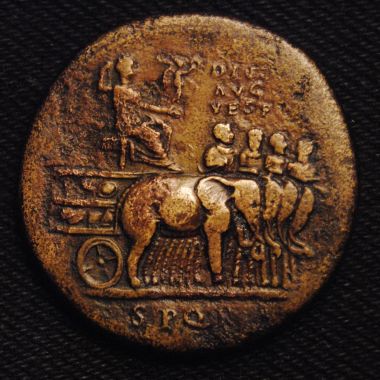
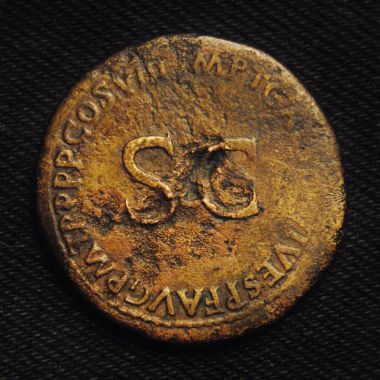
I have often heard that the funeral celebration of Vespasian was a raucous affair with the music comedies and feasting lasting for many days. The description of the coin states that a seated statue was drawn by the elephants.
But after consulting Suetonius I prefer to imagine that it was probably one of the many comedians that Vespasian so favored with his largesse. He was especially fond of the sort of self deprecating humor that many emperors might have never forgiven.
One joke as retold by Suetonius I think is revealing.
"having asked procurators in a loud voice how much his funeral procession would cost and hearing the reply
"Ten million sesterces !" cried out:
"Give me a hundred thousand and fling me even into the Tiber."The humor of it makes no sense at all really unless it was actually being spoken by the aforementioned "statue".
So there he is
The Roman Rodney Dangerfield (I don't get no respect) drawn by four elephants doing 1st century standup (more safely seated) in one of the biggest funeral parties the world has ever seen.
SUETONIUS
Life of Vespasian
19-2519) At the plays with which he dedicated the new stage of the theatre of Marcellus he revived the old musical entertainments. To Apelles, the tragic actor, he gave four hundred thousand sesterces; to Terpnus and Diodorus, the lyre-players, two hundred thousand each; of several a hundred thousand; while those who received least were paid forty thousand, and numerous golden crowns were awarded besides. He gave constant dinner-parties, too, usually formally and sumptuously, to help the marketmen. He gave gifts to women on the Kalends of March, as he did to the men on the Saturnalia.
Yet even so he could not be rid of his former ill-repute for covetousness. The Alexandrians persisted in calling him Cybiosactes, the surname of one of their kings who was scandalously stingy. Even at his funeral, Favor, a leading actor of mimes, who wore his mask and, according to the usual custom, imitated the actions and words of the deceased during his lifetime, having asked procurators in a loud voice how much his funeral procession would cost, and hearing the reply "Ten million sesterces," cried out: "Give me a hundred thousand and fling me even into the Tiber."
20) He was well built, with strong, sturdy limbs, and the expression of one who was straining. Apropos of which a witty fellow, when Vespasian asked him to make a joke on him also, replied rather cleverly: "I will, when you have finished relieving yourself."He enjoyed excellent health, though he did nothing to keep it up except to rub his throat and the other parts of his body a certain number of times in the tennis court, and to fast one day in every month.
21) This was in general his manner of life. While emperor, he always rose very early, in fact before daylight; then after reading his letters and the reports of all the officials, he admitted his friends, and while he was receiving their greetings, he put on his own shoes and dressed himself. After despatching any business that came up, he took time for a drive and then for a nap, lying with one of his concubines, of whom he had taken several after the death of Caenis. After his siesta he went to the bath and the dining-room; and it is said that at no time was he more good-natured or indulgent, so that the members of his household eagerly watched for these opportunities of making requests.
22) Not only at dinner but on all other occasions he was most affable, and he turned off many matters with a jest; for he was very ready with sharp sayings, albeit of a low and buffoonish kind, so that he did not even refrain from obscene expressions.43 Yet many of his remarks are still remembered which are full of fine wit, and among them the following. When an ex-consul called Mestrius Florus called his attention to the fact that the proper pronunciation was plaustra rather than plostra, he greeted him next day as "Flaurus." When he was importuned by a woman, who said that she was dying for love for him, he took her to his bed and gave her four hundred thousand sesterces for her favours. Being asked by his steward how he would have the sum entered in his accounts, he replied: "To a passion for Vespasian."
23) He also quoted Greek verses with great timeliness, saying of a man of tall stature and monstrous parts:
"Striding along and waving a lance that casts a long shadow,"
and of the freedman Cerylus, who was very rich, and to cheat the privy purse of its dues at his death had begun to give himself out as freeborn, changing his name to Laches:
"O Laches, Laches,
When you are dead, you'll change your name at once
To Cerylus again."
But he particularly resorted to witticisms about his unseemly means of gain, seeking to diminish their odium by some jocose saying and to turn them into a jest. Having put off one of his favourite attendants, who asked for a stewardship for a pretended brother, he summoned the candidate himself, and after compelling him to pay him as much money as he had agreed to give his advocate, appointed him to the position without delay. On his attendant's taking up the matter again, he said: "Find yourself another brother; the man that you thought was yours is mine." On a journey, suspecting that his muleteer had got down to shoe the mules merely to make delay and give time for a man with a lawsuit to approach the emperor, he asked how much he was paid for shoeing the mules and insisted on a share of the money. When Titus found fault with him for contriving a tax upon public conveniences, he held a piece of money from the first payment to his son's nose, asking whether its odour was offensive to him. When Titus said "No," he replied, "Yet it comes from urine." On the report of a deputation that a colossal statue of great cost had been voted him at public expense, he demanded to have it set up at once, and holding out his open hand, said that the base was ready. He did not cease his jokes even when in apprehension of death and in extreme danger; for when among other portents the Mausoleum opened on a sudden and a comet appeared in the heavens, he declared that the former applied to Junia Calvina of the family of Augustus, and the latter to the king of the Parthians, who wore his hair long; and as death drew near, he said:
"Woe's me. Methinks I'm turning into a god."24) In his ninth consulship he had a slight illness in Campania, and returning at once to the city, he left for Cutiliaeº and the country about Reate, where he spent the summer every year. There, in addition to an increase in his illness, having contracted a bowel complaint by too free use of the cold waters, he nevertheless continued to perform his duties as emperor, even receiving embassies as he lay in bed. Taken on a sudden with such an attack of diarrhoea that he all but swooned, he said: "An emperor ought to die standing," and while he was struggling to get on his feet, he died in the arms of those who tried to help him, on the ninth day before the Kalends of July, at the age of sixty-nine years, seven months and seven days.e
25) All agree that he had so much faith in his own horoscope and those of his family, that even after constant conspiracies were made against him he had the assurance to say to the senate that either his sons would succeed him or he would have no successor. It is also said that he once dreamed that he saw a balance with its beam on a level placed in the middle of the vestibule of the Palace, in one pan of which stood Claudius and Nero and in the other himself and his sons. And the dream came true, since both houses reigned for the same space of time and the same term of years.







 Posted 09/14/2016 2:32 pm





