| Author |
 Replies: 11 / Views: 2,062 Replies: 11 / Views: 2,062 |
|
|
Pillar of the Community
United States
541 Posts |
There are as many different ways to collect foreign coins as there are collectors. Most common ways to collect are by country, type or date and mint. Another way is to collect ruler portraits which may be a more economical and interesting way. There is a medal however which provides a major short cut for portrait collectors of the German States. The medal comes in silver and bronze versions. Both versions are the same in size at 56 mm and very close in weight with the silver version at 75.4 grams and the bronze at 73.1 grams. The medal is signed on the obverse by W. Kullrich and H. Weckwerth. and on the reverse by G. Loos and H. Weckwerth so it is most likely a product of the Berlin mint. The obverse of the medal has a group of thirteen standing men beneath the date of 1870 and above the exergue containing "WIR WOLLEN SEIN EIN EINIG VOLK VON BRUDERN IN KEINER NOTH UNS TRENNEN UND GEFAHR." which is a slightly altered quote from Schiller's WILHELM TELL play, poetically calling for national unity. The standing men are from left to right: Nicolaus Friedrich Peter Grand Duke of Oldenburg, Ludwig III Grand Duke of Hessen, Ernst II Duke of Saxe-Coburg and Gotha, Ernst Duke of Saxe-Altenburg, Johann King of Saxony, Wilhelm Duke of Brunswick (Wolfenbuttel Line), Wilhelm I King of Prussia and Emperor of Germany, Friedrich I Grand Duke of Baden, Karl Alexander Grand Duke of Saxe-Weimar, Ludwig II King of Bavaria, Friedrich Franz II Grand Duke of Mecklenburg-Schwerin, Friedrich Wilhelm Grand Duke of Mecklenburg-Strelitz and Karl King of Wurttemberg. The reverse has the crown of Charlemagne above 1871 in a wreath of oak leaves and palm fronds. 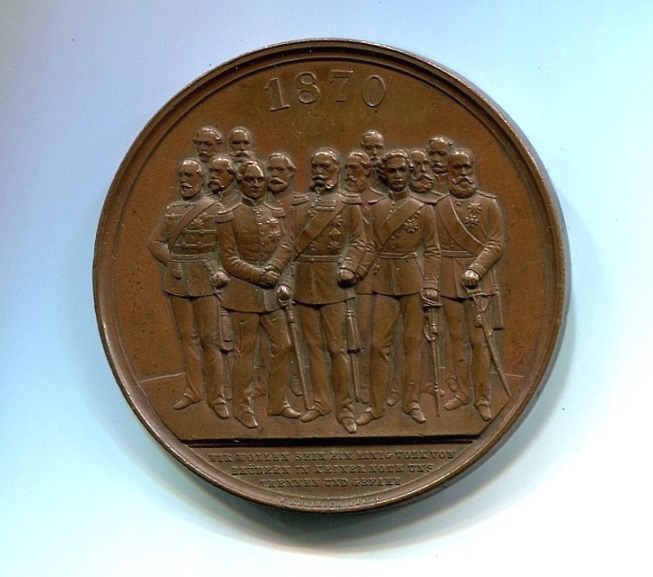 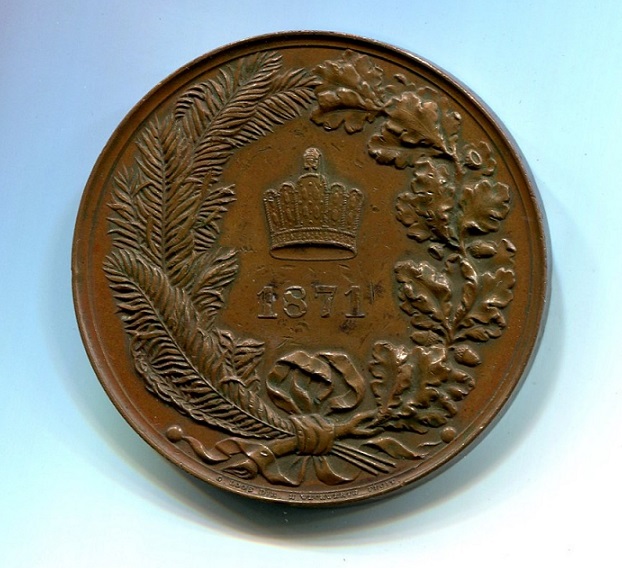 Edited by retiredkper
09/23/2016 01:16 am
|
|
|
|
Pillar of the Community
Canada
695 Posts |
Quote:
The reverse has the crown of Charlemagne above 1870 in a wreath of oak leaves and palm fronds. Shouldn't this be '1871'? Just curious as to why the medal shows 1870 on obverse and 1871 on reverse. |
|
Pillar of the Community
Canada
4911 Posts |
I'm not completely sure but either
A: the war began in 1870 and ended in 1871(all I remember is it was a short war)
B: "1871" is there because that's when Germany unified. (all the people you see on the obverse are leaders of the various states who united with Prussia during the war)
Feel free to call me Will.
|
|
Pillar of the Community
 United States
541 Posts |
thedollarman is correct. The Franco Prussian War started in 1870 and ended in 1871 when the 2nd German Empire was proclaimed. The 1870 date in my reverse description was a typo on my part which I just corrected.
Edited by retiredkper
09/23/2016 01:18 am
|
|
Valued Member
Germany
303 Posts |
Interesting medal! The Franco-Prussian war was the last of the three wars of German unification (before there was also the Second Schleswig War and the war between Austria and Prussia). In German these three wars are called 'Einigungskriege'.
In that context it is also very interesting to see the 'Siegesthaler' (Victory Thalers) that have been minted in 1866 and 1871 by several German States (Prussia, Bavaria, Saxony, etc.) to celebrate the victory in these three wars.
|
|
Pillar of the Community
United States
541 Posts |
The Franco Prussian War was a gold mine for collecting. In addition to the coins Potsdam mentions there are a lot of military medals; French, German plus one from Belgium and Switzerland! The Belgians mobilized and nearly joined the German side and the Swiss mobilized to protect their borders and interned large numbers of French troops who didn't want to surrender their arms to the Germans. Also on the 25th and 40th anniversaries of the war many local towns etc. issued commemoration medals to their resident war veterans of 1864,1866 and 1870-71. In addition there are many medals issued for 1870-71 by Germans in the US and South America plus a flood of private patriotic medals in Germany and France.
|
|
Valued Member
Germany
303 Posts |
@retiredkper You're absolutely right. Reading your post I have to think about German medals that were minted in 1871 after the victory over France. Special about these medals is that the material that was used to mint them came from french artillery that was captured by the Germans. This is also marked in the edge inscription that says "AUS EROBERTEM GESCHUETZ", meaning 'made of conquered cannon'.
|
|
Pillar of the Community
United States
541 Posts |
Thanks Potsdam! Medals made from captured cannons is another neat collecting theme. Many of the German medals fall into that category as well as the more famous British Victoria Cross and the U. S. Medal of Honor. Also like your site.
Edited by retiredkper
09/25/2016 01:01 am
|
|
Pillar of the Community
United Kingdom
709 Posts |
Potsdam: I have just visited your site on the above recommendation. I liked it very much and will come back again and again.
One thing I liked was the simple layout, easy to use for old duffers like me.
You inspire me to look again at my German coins.
Edited by Anaximander
09/25/2016 04:41 am
|
|
Pillar of the Community
Australia
7096 Posts |
I know nothing about this Medallion But those "Palm Fronds" look to me to be "Quills" and would represent the power of the pen  |
|
Valued Member
Germany
303 Posts |
@retiredkper: Oh, I didn't know that there were more medals made of captured cannons. It is just amazing to imagine the history behind these medals.
And thank you guys for the positive feedback on my website. :) I am happy if people enjoy it and maybe even start collecting a few coins from Germany.
|
|
Pillar of the Community
United States
541 Posts |
Looks possible trout but I think it unlikely since it was a military victory. The medal was written up in one of the old Jaeger books with a green or red cover. Can't find mine now but when I do I'll bet the answer is there.
|
| |
Replies: 11 / Views: 2,062 |
|










 Posted 09/22/2016 10:16 pm


