| Author |
 Replies: 17 / Views: 7,707 Replies: 17 / Views: 7,707 |
|
New Member
United States
23 Posts |
I've had this one for awhile, just digging through my old stuff now. I'm from the United States, got this given to me as a dime in some change, so I suppose I'm 10 cents in to it :) It is a 1981 Canada 1 Cent, it is silver in color, not the usual copper. It looks even more silver in person than the photos. Probably just something silly, but curious of any other opinions. 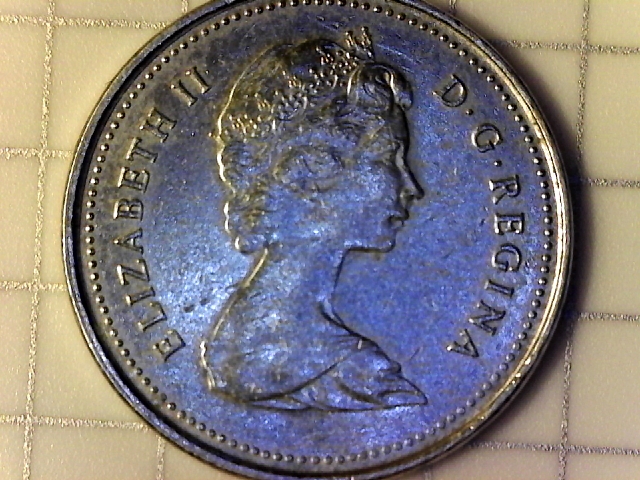 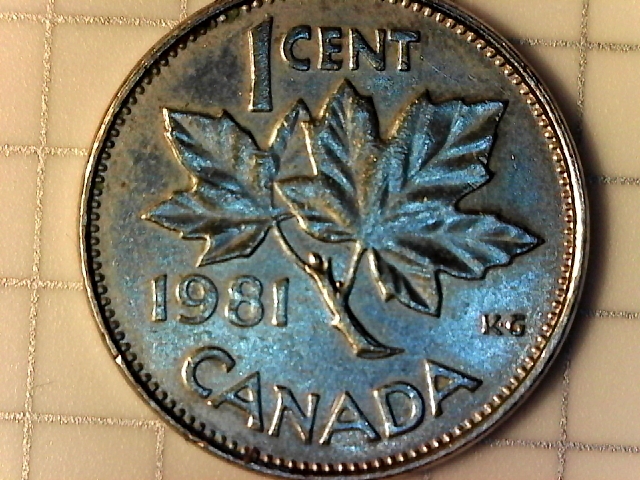 |
|
|
|
Pillar of the Community
Canada
818 Posts |
weight of the coin would go a long way in helping determine if it is a wrong planchet error
|
|
New Member
 United States
23 Posts |
|
|
Pillar of the Community
Canada
1747 Posts |
is it magnetic? weight as well. however if this was a dime, you would probably know because the thickness is wayyy different from a penny.
I think it is either painted or plated.
|
|
New Member
United States
23 Posts |
2.844g is weight / non magnetic
|
|
New Member
United States
23 Posts |
I got another photo to come out a little bit now too. 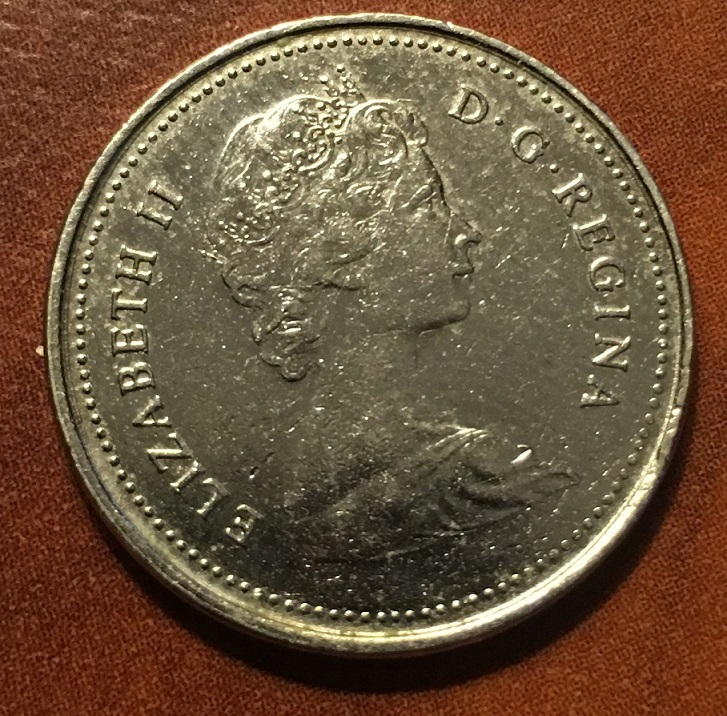 |
|
Pillar of the Community
Canada
5341 Posts |
The 2.8g is the weight of a penny, non magnetic, probably plated but XRF for sure, difference of a couple hundred bucks or 1 cent
|
|
Bedrock of the Community
Canada
21876 Posts |
That's the right weight for a 81 cent and as it was
made of copper, it would be non-magnetic.
Possibly a mercury coated High School experiment coin.
|
|
New Member
United States
23 Posts |
Thanks greatly for the input all that responded :)
|
|
Moderator
 Canada
10473 Posts |
It could also be struck on a New Zealand 5-cent coin (2.83 grams, copper-nickel planchet). I have one as an example: http://www.PCGS.com/cert/33950452I have an XRF in my lab at work, and I am very familiar with off-metals in this series. I would happily test it for you at no cost, you just have to pay the shipping. I have done this for others in the forum. "Discovery follows discovery, each both raising and answering questions, each ending a long search, and each providing the new instruments for a new search." -- J. Robert OppenheimerContent of this post is licensed under a Creative Commons Attribution-NonCommercial 3.0 Unported License. See: http://creativecommons.org/licenses...0/deed.en_USMy eBay store
|
|
Pillar of the Community
Canada
872 Posts |
http://goccf.com/t/163380Here is the thread for an off metal 1 cent from 1989. The weight is the same as yours at 2.85 grams. The 1989 is struck on a new Zealand 5 cent planchet and now resides with our local Canadian mod, SPP. So you never know...keep researching. This is a list of countries that have had coins struck by RCM. you have to go through them one by one to see if you can find a matching foreign planchet for your year. Good luck! http://www.coinscan.com/for/foreign.htmlEdit: the coin SPP is showing is the same one in my attached thread. He posted before I got a chance due to bath time for my daughter 
Edited by robmck1967
10/13/2016 10:14 pm
|
|
New Member
United States
23 Posts |
I have an Ohaus scale that goes down to mg's, and while not certified, I do think it is very accurate. I took the weights from the kit and put on 2.8g and it read spot on. Did it a few different ways (different mixtures of weights, got it to read a mg off at worst).
I do throw all the Canadian pennies I get from change in a cup, I was able to find a normal looking 1981 in there (Other years I think weigh the same, but like the idea of finding an exact 1981). It weighed 2.845g. Do they actually weigh a little more than 2.8g ?
I put a USA nickel out of my pocket on it just now too, was 4.998g. Which seems realistic, a little wear it could lose 2mg of weight or my scale could be off by that too. But, that 44mg off seems like a bit much.
I find quite a few aspects of this strange. For instance if it was coated with mercury, would that mercury have some weight added to it (Would make sense it weight 44mg more) but then we have the other 1981 that is weight 45mg over the 2.8g.
Now I'm back to being curious about it again :)
I read in that other thread that the mercury can have a greasy feel to it. It does feel slightly more greasy than the normal 1 cent, but no more than a Canadian dime I have sitting does.
All this said, I am in the United States and not daily familiar with these coins. Mostly, the Canadian coins are a "let down" to me haha - I search dimes from the bank and look at them from the side to see if there is a copper band. My heart skips a beat every time I see no copper band on the side, I get excited and then I'm sad when it is a Canadian and not a 1964 or older USA dime for the 90% silver content :)
I appreciate the offer to test it, and I may very well accept that offer if its left open ended still after awhile longer of talking about it.
I don't think it is the 5 cent one because that one had extra space around the edges in the pictures, and this one looks really close to the other 1981 I have to look at, just not the same color.
|
|
Bedrock of the Community
Australia
21789 Posts |
1981 Canadian bronze One Cent coin has a specified mass of 2.800 grams, diameter 19.10 mm.
It is plausible? that a wrong copper nickel blank was used: an Australian or New Zealand blank Five Cent blank could have been used. Those coins have a mass of 2.83grams and a diameter of 19.41mm. There is a difference of 0.31mm between the finished Canadian One Cent and the Five Cent coins.
Would the Canadian One Cent striking collar take the larger Australian or new Zealnd blank without any obvious strike error damage?
XRF has it's limitations: It will analyse the atoms on the surface of the metal ONLY.
That will not rule out the possibility of plating.
It is a pity that PCGS did not note the mass of the coin that they verified.
I suppose that their methods of verification cannot be reviewed in this case. We will just have to take their word for it, along with their good reputation.
I hope that it does not devolve into having to file a tiny piece off teh edge of the coin to examione the interior with an XRF instrument. Sadly, damage must be done to do this.
Edited by sel_69l
10/14/2016 01:31 am
|
|
Pillar of the Community
Canada
5341 Posts |
Almost sure in 1980s no one is experimenting with mercury as a plating agent, probably too smart to use this product.
|
|
Valued Member
Canada
116 Posts |
Edited by Relic
10/14/2016 10:03 am
|
|
New Member
United States
23 Posts |
The mercury by my understanding is that it by itself would be a liquid at room temp but it bonds (I'm sure there is a better word than that though) with another metal and that rule changes at that point. I'm leaning in the mercury direction.
I spent more than an hour I probably shouldn't have today playing with the scale (Well, technically its a balance). I am able to reproduce errors now. More specifically, and most importantly, I can get the scale to read a lower weight if I place the coin on to it slowly. Which explains why when I stacked up 2.800 of weights I got it to read right. I do not have near the faith on the coin weight as I did before. If I slowly place the coin on the scale, then it reads closer to 2.8g, etc. So far all intents and purposes, lets assume this coin is simply standard weight for now.
I'm going to look in to what it costs to get the scale calibrated and certified. I'd really like to get that done now if its not terribly priced to do so.
|
| |
Replies: 17 / Views: 7,707 |







 Posted 10/13/2016 7:15 pm





