| Author |
 Replies: 10 / Views: 1,600 Replies: 10 / Views: 1,600 |
|
|
Valued Member
Australia
69 Posts |
Hi All, some expert advice appreciated. Boo-su? Kiangsu Pn 202 10 Cash. Non metallic - bronze? Should be authentic coin and not reproduction. Confirmation of coins ID and any thoughts about value, thanks ErikP 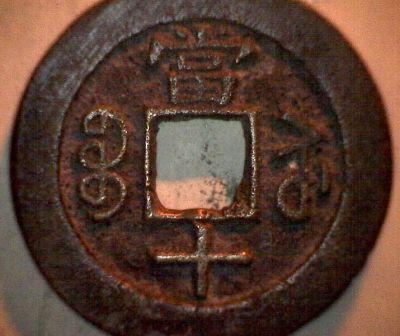 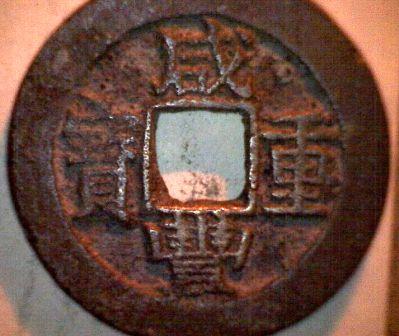 *** Moved by Staff to a more appropriate forum. *** *** Moved by Staff to a more appropriate forum. *** |
|
|
|
Valued Member
 Australia
69 Posts |
Hi coin weighs 13.75 g & 34 mm wide thanks ErikP
|
|
Moderator
 United States
34562 Posts |
@erikp, this looks like a 10 cash from the Qing Dynasty under Emperor Wen Zong (1851-1861 AD). These should be pretty hefty coins (about 30 mm). The wide rims suggest that it was minted between 1857 and 1861 AD.
"If you climb a good tree, you get a push."
-----Ghanaian proverb
"The danger we all now face is distinguishing between what is authentic and what is performed."
-----King Adz
|
|
Valued Member
Australia
69 Posts |
Hi Spence, thanks, do you know if its Boo-su? Kiangsu mint and after 1861? say 1862 I'm trying to find a match, regards ErikP
|
|
Moderator
United States
34562 Posts |
No prob. I'll help as much as I can, but there are others here who know much more than I do about these. What are the diameter and mass?
"If you climb a good tree, you get a push."
-----Ghanaian proverb
"The danger we all now face is distinguishing between what is authentic and what is performed."
-----King Adz
|
|
Valued Member
Australia
69 Posts |
Hi Spence, coin weighs 13.75 g & 34 mm wide non-magentic, some cross surface finish filing, thanks ErikP
|
|
Moderator
United States
34562 Posts |
Ok, until TypeCoin971793 or AnYangman weigh in, here are my thoughts (using Hartill as my guide). The emperor is definitely Wen Zong, so the timeframe is 1851 to 1861 AD and not later as you suggest. The characters on the rev are the denomination (dang shi) and the mint location (boo su). This means I agree with you that it was made in the Jiangsu/Kiansu region, which includes Shanghai. On the obv, the inscription is Xian Feng zhong bao, but the Xian has a little bit of a hook on the bottom left stroke. Also, the characters on the obv are a little larger than others. The diameter is 24 mm, which makes it a medium-size coin.
All this put together suggests to me that it can be attributed as Hartill #22.892 which was made in 1854 or 1855 AD. I'm about 80% sure on this, but I look forward to further clarification from our actual experts.
"If you climb a good tree, you get a push."
-----Ghanaian proverb
"The danger we all now face is distinguishing between what is authentic and what is performed."
-----King Adz
|
|
Valued Member
Australia
69 Posts |
Yes Spence, thats where I was stuck in period 1851 to 1861 but as unable to find match for the coin, thanks for your help much appreciated, thanks ErikP
|
|
Pillar of the Community
United States
6370 Posts |
I can't find any reason to refute Spence's attribution. Qing cash is not my expertise.
|
|
Valued Member
Australia
69 Posts |
Thanks TypeCoin971793, I'm not expert either yep will go with Hartill #22.892 thanks ErikP
|
|
Valued Member
Netherlands
91 Posts |
I too am definitely no expert on Qing cash, relying only on Hartill's general work for identification. I would say Spence's attribution is largely correct (props to you!). However, I am divided between either Hartill 22.892 or 22.894. Especially when looking at the calligraphy on the obverse, 894 seems to make more sense. Note the first stroke of "Bao" is more than just a dot on your coin, as well as the "dot" in Xian being located next to the horizontal stroke, instead of above it as on Hartill 22.892. And the slanted line below this dot (it is difficult describing the calligraphy through only words), is touching the bottom square component of this character, as in Hartill 22.894. The top most components of "Feng" touch the rim and the "Shi" on the reverse looks more like a '+' (22.894) than a Latin cross (22.892). These are all characteristics of Hartill 22.894, so the calligraphy matches almost exactly with this catalog entry. The size however does not, 22.894 being a couple of mm smaller than your coin. Hope this helps  . Again, no Qing expert, so correct me if I am wrong! |
| |
Replies: 10 / Views: 1,600 |
|








 Posted 10/15/2016 8:31 pm


