The Royal Mint - Since 2012
The Royal Mint has struck a special
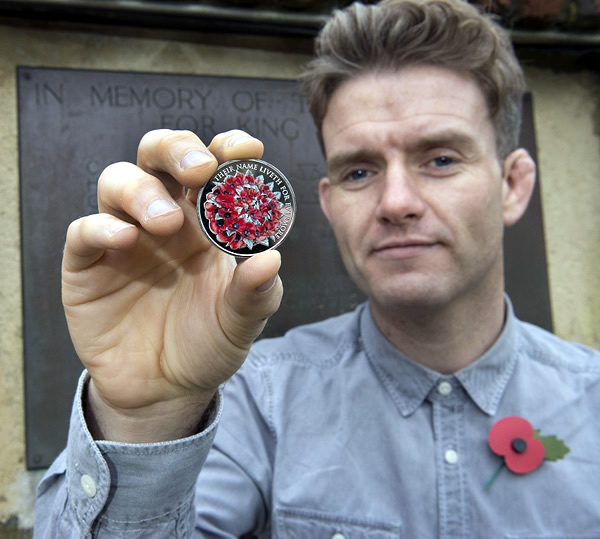
Remembrance Day Alderney £5 Coin each year featuring the poppy - a widely recognized symbol of remembrance - to honor servicemen and women who have lost their lives in times of war. For 2016, the poppy wreath takes center stage on a coin designed by
Royal Mint designer and engraver, Thomas Docherty. Ahead of Remembrance Day, we caught up with Thomas to find out a little more about the inspiration for his design.
 Tell us a little bit about yourself.
My name is Thomas Docherty, I'm a member of the coin design team and I've worked at
The Royal Mint for almost twelve years. I started at
The Royal Mint as a trainee engraver and worked my way up to being a fully fledged member of the team within a few years. I've been working on the job ever since.
What projects have you worked on at The Royal Mint? What have you been working on recently?Lately I've been designing for Bullion and Circulating coinage, conducting daily hand-finishing of master tools, and completing an overseas re-coinage project. The re-coinage project has been four and a half years in the making and I have designed the country's three highest denominations, which I'm really happy with - it's the biggest project I've completed since I've been at
The Royal Mint.
What do you enjoy most about your job as a coin designer/engraver?I'd say the opportunity to carry out research and the diversity of the role are my two favourite things.
I enjoy getting to look into things, things that I thought I would never get to research; I could be looking at Remembrance as a subject, the war, or I could be reading about endemic species of flora for overseas or at surface pattern work for a Bullion project. When I start my research, I'm a bit of a nightmare and usually end up in a bit of a rabbit hole, one subject leads to another and I end up miles away - I love that. I don't really know where it's going to go at the beginning, and then the more research I do, the more I start to feel like I'm getting somewhere and it starts to be fun. I really value the opportunity to delve into subjects that normally I wouldn't get to read about, that's always been interesting.
And then, the diversity of the job. I love that my role involves design and sculpture. The opportunity to make things has always been important to me. Nowadays, I sculpt digitally so I don't work at my bench as much, but I like that I still sit at my bench every day to hand-finish the tooling that goes on to produce coins. I can be at my desk, I can be at my work-bench or I could be at a coin trial - I like that I work in differing environments with the chance to work with members of other teams.
You say you don't go back to the bench much.We still go back for the tooling, so we still hand-work master tools, which I'm very glad about. If I were doing any traditional modelling, such as plaster or any clay relief sculpture, that would be completed at the bench, but I sculpt entirely digitally now.
Is that quite a switch for you?I used to work in plaster and clay and thought I always would. I didn't believe the software could match the subtleties of traditional sculpture, but we've invested in a new software which is brilliant at producing organic modelling.
The computer package that we were using before was well suited for architecture and typography - flat surfaces and angle plains - but to get the subtlety of a portrait I always thought that I would use clay or plaster (even though other members of my team were successfully using this software for these type of models). We're now using zBrush, which is excellent, and I'm very happy with the results that I'm seeing from the package. Some people will continue to work in plaster and may not transition to digital, but I doubt I'd go back to it now unless a project comes up where plaster sculpture would be better suited.
How did you go about designing the 2016 Remembrance Day coin? Where did you start?When I first received the brief my initial reaction was aimed towards monuments, the monuments of the war, these statues that were erected to commemorate people.
From there came the laying of wreaths at the monuments as an act of remembrance. If you go to any large town they will have some sort of memorial service on Remembrance day. It's something that really brings the community together, with many people paying their respects. The laying of wreaths really resonated with me. It's an act ingrained in culture.
Read the entire article... 









 Posted 11/26/2016 11:37 am


